Home
Blog
Composers
Musicians
Black History
Audio
About Us
Links
Composers:
Adams, H. Leslie
Akpabot, Samuel Ekpe
Alberga, Eleanor
Bonds, Margaret Allison
Brouwer, Leo
Burleigh, Henry Thacker
Coleridge-Taylor, Samuel
Cunningham, Arthur
Dawson, William Levi
Dede, Edmund
Dett, R. Nathaniel
Elie, Justin
Ellington, Edward K. "Duke"
Euba, Akin
Garcia, José Mauricio Nunes
Hailstork, Adolphus C.
Holland, Justin
Jeanty, Occide
Johnson, James Price
Joplin, Scott
Kay, Ulysses Simpson
Khumalo, Mzilikazi
Lambert, Charles Lucien, Sr.
Lambert, Lucien-Leon G., Jr.
Lamothe, Ludovic
Leon, Tania
Moerane, Michael Mosoeu
Perkinson, Coleridge-Taylor
Pradel, Alain Pierre
Price, Florence Beatrice Smith
Racine, Julio
Roldan, Amadeo
Saint-Georges, Le Chevalier de
Sancho, Ignatius
Smith, Hale
Smith, Irene Britton
Sowande, Fela
Still, William Grant
Walker, George Theophilus
White, José Silvestre
Williams. Julius Penson
AfriClassical Blog
Companion to AfriClassical.com
Guest Book
William J. Zick, Webmaster,
wzick@ameritech.net
©
Copyright 2006 - 2022
William J. Zick
All rights reserved for all content of AfriClassical.com
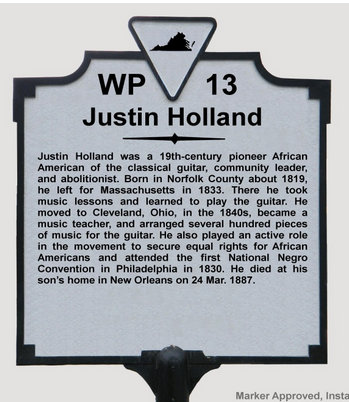
Historical Marker unveiled in
Chesapeake, Virginia on May 2, 2013
http://www.markerhistory.com/justin-holland-marker-wp-13/
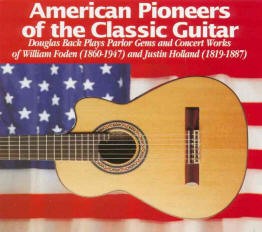
American Pioneers of the Classic Guitar
Douglas Back, guitar
Mento Music Press SMM 3023 (1994)
|
Home ->
Composers -> Holland, Justin
Français
Audio
Sample: Mento Music Press SMM 3023 (1994); American Pioneers of the Classic Guitar;
Douglas
Back, Guitar
Carnival of Venice Fantasie
1 Birth
"Justin Holland was born to free black parents in Norfolk County, Virginia on July 26, 1819,"
Barbara Clemenson writes in her article
in a journal of Case
Western Reserve University,
Justin Holland: Black Guitarist in the Western Reserve. Guitarist Douglas Back has made a recording which includes five
works of the composer, American Pioneers of the Classic Guitar, Mento Music Press SMM 3023 (1994).
It can be ordered at his Web site,
www.DouglasBack.com He writes in the liner notes:
|
More than just a successful musician, Holland
was also a dedicated humanitarian who
worked all his life to promote and advance the
causes of his race. Adopting the principles
that education and assimilation were the best
methods of overcoming racial barriers and
prejudices, he immersed himself in the
Eurocentric middle class culture of the day. |
2 Leaving Virginia
Barbara Clemenson
writes that White residents had adopted a new attitude toward
free Black residents:
|
Justin Holland left
Virginia for Massachusetts after his parents' deaths in
1833. Several factors probably influenced his move.
***
However their liberal attitude toward blacks changed as
the increased demand for slaves in the Deep South's
cotton belt, combined with their decreased supply due to
the restriction of the African slave trade, again made
them valuable property. |
3
Music Studies in Boston
Holland was only 14 when he left his home state and traveled to
Boston, Douglas Back relates:
|
Holland left Virginia in 1834 at the age of
fourteen and headed to Boston where he
became acquainted with the guitar after
hearing concerts by the Spanish guitarist
Mariano Perez. He began studying the guitar
with William Schubert, a noted composer and
arranger for the instrument. Holland also
undertook the study of the flute and piano at this time, though he maintained the guitar as
his primary instrument. |
4 Oberlin
Barbara Clemenson explains Justin's need to leave Massachusetts:
|
In spite of Holland's
economic success and musical training, Massachusetts
could not provide him with the education he desired. For
that he had to look to the Oberlin Collegiate Institute,
founded in Ohio's Western Reserve in 1833 to provide in
a Christian community a substantial education at the
lowest possible rates to students of both sexes. |
The liner notes tell us of two separate periods during which
Justin Holland was a student at Oberlin College in Ohio, first
for a year in 1841, when he was 22, and later for a shorter time
in 1845.
5 First Black Professional
Douglas Back tells us
what followed Holland's second period of study at Oberlin:
|
After returning to Oberlin in 1845, Holland
married and soon moved to Cleveland, Ohio,
where he established himself as a teacher of
guitar, mandolin, piano and flute, becoming
the city's first black professional. |
6 Negro Conventions
We learn from the liner notes that Justin Holland's role in the
struggle for freedom for African Americans involved work with
Fredrick Douglass and the Underground Railroad:
|
Between the years 1848 and 1854 Holland participated as an assistant secretary and
member of council at National and State
Negro Conventions, where he worked
alongside such noted activists as Frederick
Douglass. He is known to have worked with
the Underground Railroad and was secretary in charge of the "Central American Land
Company", an organization which
unsuccessfully attempted to purchase
sufficient land in Central America to institute a
free black colony. |
7 West Indies
We learn from Barbara
Clemenson that after Central America became infeasible as a
haven for African Americans, consideration was given to the West
Indies:
|
Central American
colonization proved infeasible when it was opposed by
foreign diplomats of those countries, but in 1858 Haiti
offered free passage and aid for black settlers and
emigrants began moving there. Holland himself lived in
the West Indies during the Civil War, but evidently did
not find there the opportunities he expected for after
two years he returned to Cleveland. |
8 Languages
The liner notes give an account of Holland's mastery of several
European languages:
|
Holland was also noted for his linguistic
abilities. He spent two years in Mexico during
the early 1840s learning Spanish in an effort to
master the language in which the methods of
the early Spanish guitar masters such as Sor
and Aguado were written. Later on Holland
became proficient at several other languages
including French, Italian, and German. |
9 Free Masons
Barbara Clemenson
writes of Holland's involvement with the Free Masons:
|
Holland was not solely
occupied with music but was also an active Mason after
joining Cleveland's Excelsior Lodge No. 11 in 1862.
|
Douglas Back
continues the story:
|
He used his talents as a
linguist when he became a leader in the black Free
Masons (Prince Hall). Because American white
Masons did not consider the Prince Hall Masons to be
legitimate, Holland began corresponding with foreign
Masonic Lodges seeking recognition and support.
***
The Viennese Masonic magazine Der Freimaurer published
a biographical article about Holland in 1877. |
10 Household Name
Back writes that Justin Holland made his name known in his
lifetime to amateur guitarists across the country:
|
Although Holland seldom performed in public, he developed a national reputation as a composer and arranger for the guitar. To the average amateur guitarist of the day, his
numerous arrangements made his a
household name. Of his approximately 350 published works for the guitar, which include
two acclaimed methods, only about one-third
are extant. |
11 William Tell
The liner notes tell us William
Tell dates from 1868:
|
Holland's writing for the guitar is modeled extensively
on the works of early 19th century European guitar
composers. His arrangement of William Tell
by Giacchino Rossini (1792-1868) is essentially a
reworked and abridged version of William Tell:
Fantasie, Op. 36 by Matteo Carcassi (1792-1853).
Both the Holland and Carcassi versions share similar
thematic material, yet both works incorporate material
from the Overture not duplicated in each other. In
light of this, liberty was taken with Holland's
arrangement by inserting small sections from Carcassi's
work. This expanded version of Holland's
arrangement displays all of the familiar themes from the
Overture, forming a rousing tour de force for the
guitarist. |
12 'Tis the Last Rose
'Tis the Last Rose of Summer
is an 1854 work, Douglas Back writes in the
liner notes of American Pioneers of the Classic Guitar:
|
Although comprised for the most part of his own material,
Holland acknowledges that the finale to this work is a
direct quote from an arrangement of the same work by the
Italian guitarist, Mauro Giuliani (1781-1829).
This piece was one of the most popular of all 19th
century songs and was utilized in compositions by
Beethoven, Mendelssohn, and a host of other composers,
as well as several of the European guitar masters.
It is based on an earlier tune, Castle Hyde,
which first appeared in print in 1806. |
13 Oberon
Back tells us Oberon dates
from 1868:
|
The
years 1866-1868, during which time this work was
copyrighted, represent one of the most prolific periods
in Holland's life. Holland's Oberon is a
potpourri of thematic material from Carl Maria von
Weber's opera Oberon, including the barcarole,
Song of the Mermaids. The opera premiered at
the end of its composer's life in London in 1826.
It is based more on German legend popularized by the
poet Wieland than on Shakespeare. Holland's guitar
arrangement was published in a series entitled 20
Choice Melodies from the Operas and was just one of
several series of opera melodies Holland arranged during
this time. |
14 Carnival of Venice
Douglas Back tells
us of one of the leading works of the era:
|
Carnival of Venice: Fantasie (1871), one of the
best known tunes from that period, has perhaps been
given to variation treatment by more instrumental
virtuosi than any other melody of its time.
According to James Trotter, Holland's biographer, this
is considered to be one of Holland's most celebrated
arrangements. |
15 Andante
Andante
dates from 1880, according to the liner notes:
|
Holland is said to have written over 35 original
works. The piece An Andante is one of the
very few of those extant. It is included in the
book Music and Some Highly Musical People
and appears to have been inspired by the work Variations on a Theme by Mozart, op. 9, by
Fernando Sor (1778-1839). Holland's admiration for Sor is
apparent when the Andante's opening thematic material,
with its descending scale figure in duple meter, is
compared with thematic material in Sor's opus 9. |
|
16 Kim Perlak
Dr. Kim Perlak has a classical guitar
website which she was kind enough to bring to our attention,
http://www.kimperlak.com/
Among many other things, it provides this information on her
background:
|
Kim
Perlak is a classical guitarist whose versatile and
inclusive approach to the instrument has made her a
sought after performer, educator and scholar.
...
education:
DMA ’08 UT-Austin
MM ’01 Yale School of Music
BM ’98 Stetson University |
|
17 Guitar Project
"The Holland Guitar
Project" tab, on the
home page of Dr. Perlak's website, provides access to
information, recordings and photos related to the Project, which
was funded by a 2009-2010 Yale Alumni Ventures Grant.
Resources are organized under several topic headings, including:
| Background & Aims of
the Project
Justin Holland and the American Roots of the Classical
Guitar sound
Concert Info
Open Tunings & Slide -
The American Legacy of "Spanish Fandango"
An American 2-Minute
Opera: "The Last Waltzes of a Lunatic" - Justin Holland |
18 Folk
Another heading is
"Folk Arrangements," which is explained as follows:
|
In addition to his
compositions in the operatic style, Holland arranged
many American folk tunes and popular dances for solo
classical guitar. Like his contemporaries in Europe,
Holland often presented these arrangements in theme and
variation or rondo form. It is his style of arranging
the thematic material, however, that fits in with the
American approach. |
19 James Trotter
Douglas Back writes of Justin Holland's inclusion in the landmark
book on African American Music by James Trotter:
|
An entire chapter was devoted to Holland in
the book Music and Some Highly Musical
People by James Trotter. Trotter's book, published in 1880, represents one of the first
attempts to document the lives of significant
African-American musicians. |
20 Death
The liner notes
relate the time and place of
Justin Holland's death, and briefly describe the music careers
of his son and daughter:
|
Justin Holland died at his
son's home in New Orleans, Louisiana, on March 24,
1887. His son, Justin Minor Holland and daughter, Claire Monteith Holland were also accomplished
guitarists, though they never developed their
musical careers to the extent that their father
had. Nevertheless, Justin Minor Holland
became a significant teacher and composer
for the instrument. |
This page was last updated
on
March 5, 2022
|