Home
Blog
Composers
Musicians
Black History
Audio
About Us
Links
Composers:
Adams, H. Leslie
Akpabot, Samuel Ekpe
Alberga, Eleanor
Bonds, Margaret Allison
Brouwer, Leo
Burleigh, Henry Thacker
Coleridge-Taylor, Samuel
Cunningham, Arthur
Dawson, William Levi
Dede, Edmund
Dett, R. Nathaniel
Elie, Justin
Ellington, Edward K. "Duke"
Euba, Akin
Garcia, José Mauricio Nunes
Hailstork, Adolphus C.
Holland, Justin
Jeanty, Occide
Johnson, James Price
Joplin, Scott
Kay, Ulysses Simpson
Khumalo, Mzilikazi
Lambert, Charles Lucien, Sr.
Lambert, Lucien-Leon G., Jr.
Lamothe, Ludovic
Leon, Tania
Moerane, Michael Mosoeu
Perkinson, Coleridge-Taylor
Pradel, Alain Pierre
Price, Florence Beatrice Smith
Racine, Julio
Roldan, Amadeo
Saint-Georges, Le Chevalier de
Sancho, Ignatius
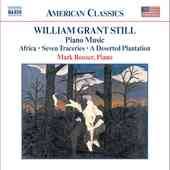
Smith, Hale
Smith, Irene Britton
Sowande, Fela
Still, William Grant
Walker, George Theophilus
White, José Silvestre
Williams. Julius Penson
AfriClassical Blog
Companion to AfriClassical.com
Guest Book
William J. Zick, Webmaster,
wzick@ameritech.net
©
Copyright 2006-2022
William J. Zick
All rights reserved for all content of AfriClassical.com
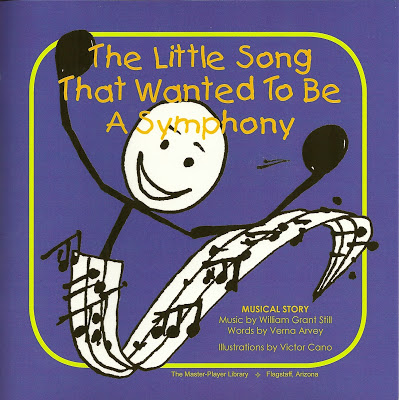
The Little Song That Wanted To Be A Symphony
Musical Story
Music by William Grant Still
Words by Verna Arvey
Illustrations by Victor Cano
The Master-Player Library
Flagstaff, Arizona
Eastman-Rochester Symphony Orchestra
Rochester, New York
Howard Hanson, Conductor
Ann Yervanian, Narrator and Mezzo-Soprano
Candace Wilson, Soprano
Introduction by David Peter Coppen
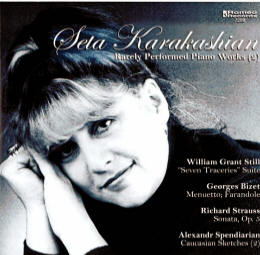
Rarely Performed Piano Works, Vol. 2;
William Grant Still: Seven Traceries Suite; Seta Karakashian,
Piano; Romeo Records RR 7298 (2013)
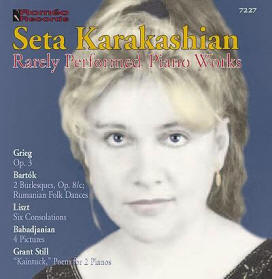
Rarely Performed Piano Works, Vol. 1; William
Grant Still: Kaintuck, Poem for Two
Pianos; Seta Karakashian, Piano; Romeo Records RR 7227 (2004)
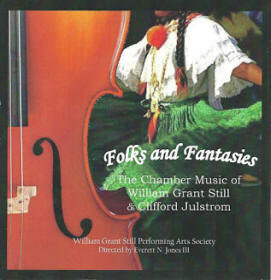
Folks and Fantasies:
The Chamber Music of William Grant Still & Clifford
Julstrom;
William Grant Still Performing Arts
Society;
Directed by Dr. Everett N. Jones
III;
William Grant Still Music WGSM CD4001
(2013)
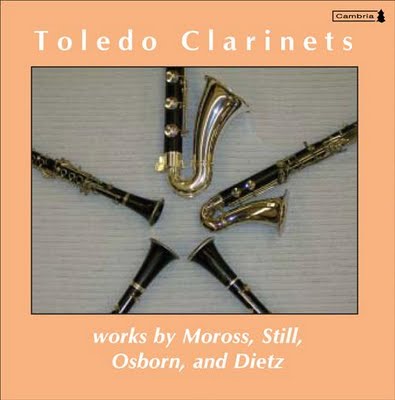
The Toledo Clarinets
Lyric Quartette (15:18)
Christmas in the Western
World (Las Pascuas) (18:51)
Shannon Ford, Georg Klaas,
Jocelyn Langworthy, Elliott
Ross, Kevin Schempf, Chelsea Tipton II,
clarinets;
Greg Kostraba, piano
Cambria CD-1190 (2009)
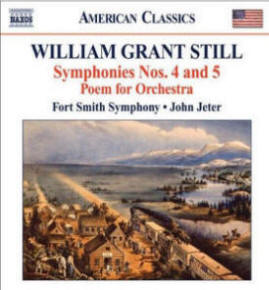
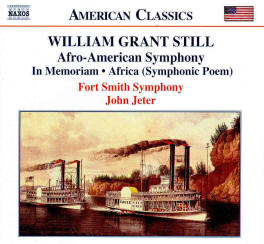
William Grant Still Symphonies Nos.
4 and 5; Poem for Orchestra
Fort Smith Symphony
John Jeter, Conductor
Cover Art: Currier & Ives
Naxos 8.559603 (2009)
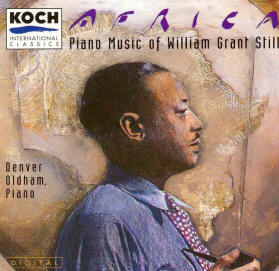
Africa: Piano Music of William Grant Still
Koch 3 7084 2H1 (1991)
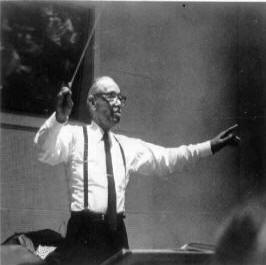
William Grant Still, Conducting
(Photo is the sole property of William Grant Still Music, and is
used with permission.)
www.williamgrantstill.com
|
Home ->
Composers -> Still, William Grant
Français
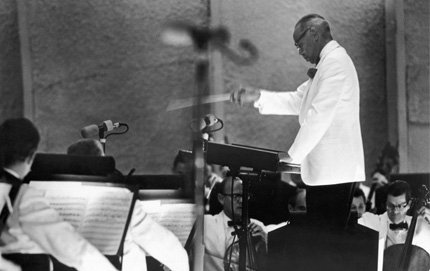
William Grant Still conducting
the Los Angeles Philharmonic at the Hollywood Bowl in a piece
titled Old California that he wrote for the city of Los Angeles’
Birthday Concert on Sept. 8, 1965. (http://dornsife.usc.edu/)
Audio Sample:
1
Cedille 90000 055 (2000); African Heritage Symphonic
Series,
Vol. I; Chicago Sinfonietta; Paul Freeman, Conductor
Symphony
No. 1 (Afro-American)
2 Koch International
Classics 3-7084-2 H1 (1991); Africa: Piano
Music of William Grant Still; Denver Oldham, piano
Blues From "Lenox
Avenue"
3 Koch International Classics 3-7192-2 H1 (1994); William
Grant
Still: Summerland; Alexa Still, flute; Susan DeWitt Smith,
piano;
New Zealand String Quartet
Summerland
4 Koch International Classics 3-7154-2 H1 (1993); William
Grant
Still: La Guiablesse, Danzas de Panama, Quit Dat Fool'nish,
Summerland; Berliner Symphoniker; Isaiah Jackson, Conductor
Danzas de Panama
1 Birth
Dominique-René de Lerma, Professor of Music at Lawrence
University, has specialized in African heritage in classical
music for four decades. He has kindly made his research
file on William Grant Still available to this site.
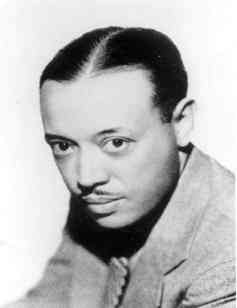
William Grant Still was born in Woodville, Mississippi on May
11, 1895. He was the son of two teachers, Carrie Lena
Fambro Still (1872-1927) and William Grant Still (1871-1895),
who was also a partner in a grocery store.
2 Youth
Young William was only three months old when his father died.
Carrie Still then took him to Little Rock, Arkansas, where they
lived with her mother. She taught high school English
there for 33 years. During William's childhood Carrie
married Charles B. Shepperson, a postal clerk. He bought
many 78 rpm records of opera, which the boy greatly enjoyed.
The two attended a number of performances by musicians on tour.
3
Instruments
William started violin lessons at age 14. Prof. De Lerma
notes that the youth also taught himself how to play the
clarinet, saxophone,
oboe, double bass, cello and viola, and showed a great interest
in music. His maternal grandmother introduced him to
African American spirituals by singing them to him. At age
16 he graduated from M. W. Gibbs High School in Little Rock.
4 Wilberforce
University
His mother wanted him to go to medical school, so Still pursued
a Bachelor of Science degree program at Wilberforce University
in Ohio from 1911 to 1915. He then dropped out of school.
On October 4, 1915 he married Grace Bundy, an acquaintance from
Wilberforce. Prof. De Lerma explains Still's
dissatisfaction with the school:
|
He was
unhappy at Wilberforce where he directed the band from
1911 to 1915 and made arrangements because there was no
music in the curriculum. First recital of his music in
1913. He moved to Oberlin in 1917, following two
years of work in Columbus where in 1914 he began playing
the oboe and cello professionally at the Athletic Club.
Also played oboe and violin in the tours of the National
Guard Band, 1915-1916. |
5 Oberlin College
Prof. De Lerma gives the details of Still's studies at Oberlin,
which were interrupted by service in the U.S. Navy:
|
He
studied at Oberlin with Maurice P. Kessler (violin),
George Whitfield Andrews (composition), Friedrich J.
Lehman (counterpoint and theory), and Charlotte Andrews
Stevens, and played in the student string quartet.
Made band arrangements. The lure of music was too strong.
Further study, made possible by an inheritance from his
father, was undertaken in 1917 and 1919 at Oberlin (where
he first heard an orchestra). His stay at Oberlin
was interrupted when he enlisted service in the Navy
(1918-1919).
Black sailors were restricted to aspects of food service
but, when it became known that Still was a trained
musician, he was engaged to play the violin for the
meals of officers on the U.S.S. Kroonland. |
6 W.C. Handy
We learn from the research file that
Still returned to Oberlin only briefly before moving to New York
City to work for W.C. Handy:
|
Released from the Navy with the end of the war, he
returned briefly to Oberlin and then in 1919 moved to
New York, resuming his work with W.C. Handy as
performer, arranger, and road manager and in Pace and
Handy Music Company Band (he originally began working
for Handy, who was then in Memphis, for the summer of
1916 as arranger and cellist). Then freelanced in
Columbus for the fall of 1916.
|
7 Musical Training
Still's Afro-American Symphony has been
recorded by the Detroit Symphony Orchestra, under Neeme Jarvi,
Conductor, on Chandos 9154 (1993). Michael Fleming writes
of Still's musical training in the liner notes:
|
His musical training was
twofold, embracing the European tradition at Oberlin
College, and the African-American in his work with W. C.
Handy in New York. He earned his living playing
the oboe in the pit band for the musical
Shuffle Along.
|
8
Shuffle Along
Shuffle Along was produced by
Noble Sissle and Eubie Blake. Some of its musical
arrangements were done by Still. The show featured an
African American cast and was so successful that it ran for 504
performances in New York City before going on tour.
Still's studies with the composer George Chadwick were without
charge. They took place at the New England Conservatory of
Music, where Chadwick was Director, beginning in 1921. A
scholarship enabled him to study composition with the avant
garde composer Edgar Varese in New York City for two years.
He also received a Guggenheim and a Rosenwald
fellowship. Prof. De Lerma explains that Still later
turned away from the techniques of Varese:
|
He
subsequently abandoned the influence so that he could
turn his attention to the folkloric.
...
He also played in the pit orchestra of Dixie to
Broadway (1924 and the summer of 1926). Played
in Leroy Smith Orchestra 1926, managed Earl Carroll’s
Vanities (1926). |
9 Harlem
Renaissance
The "Harlem Renaissance", also called the "New Negro Movement",
began about the time of Still's arrival in New York City, and
continued into the early 1930s. It proved that African
Americans had a rich and vibrant culture which was fast becoming
a prominent cultural feature of the United States and the world.
Two leading authors who influenced the movement were W. E. B.
DuBois, who wrote
The Souls of Black Folk, and Alain Locke, author of
The New Negro. Still was a firm believer and an active
participant in the "Harlem Renaissance", and his music showed
its influence for the rest of his life.
He
also performed classical music as an oboist with the
Harlem Orchestra.
10 Genres
Aaron Myers is a contributor to Africana Encyclopedia. He
characterizes William Grant Still as an:
|
...American composer whose
musical works included African American themes and
spanned jazz, popular, opera, and classical genres.
...
He created over 150 musical works including a series of
five symphonies, four ballets, and nine operas. |
11 Classical
Composer
Still became a classical composer while working in the record
business. Black Swan Records was a label owned by African
Americans. Prof. De Lerma tells us that Still was the
director of
Black Swan's classical division from 1921-1922, and was the
label's music director from 1922-1924.
The first
performance of a classical work by Still took place on February
8, 1925. The ensemble was the International Composer's
Guild and the work was From the Land of Dreams.
Still's Darker America was performed in both 1926
and 1927.
12 Darker America
Verna Arvey, Still's second wife, writes in her book, In One
Lifetime, published by the
University of Arkansas Press in 1984, that the composer had not
yet settled on his own style of composing when he wrote
Darker America:
|
Yet Darker
America won a
publication prize at the Eastman School of Music in
Rochester (which was to play an important part in
Still's life) and was described as the “high spot” of
its New York concert by the Musical Courier,
which told its readers that “there is no doubting the
man's power.”
The Eastman School of Music and its distinguished
director, Dr. Howard Hanson, became increasingly
important in Still's life. |
The author adds
that William Grant Still asked the jazz singer Florence Mills if
she would sing a work with a classical orchestra if he were to
write one for her. When she agreed, he wrote Levee Land,
with four songs for singer and orchestra. Eugene
Goosens conducted the International Composer's Guild in the
premiere of the work on January 4, 1926. Still and the
critics were very pleased, and the audience insisted that the
performance be repeated on the spot.
13 Arranger
Still had played a variety of instruments to make a living.
When a conductor named Don Voorhees hired Still to do all the
arranging for a radio program, Arvey writes, he no longer needed
to take jobs as an instrumentalist. She continues:
|
Don
Voorhees and Still were linked through a couple of
historic occasions. When the Columbia Broadcasting
System network started, Voorhees broadcast an entire
program of Still arrangements on the opening day.
And it was Voorhees who recorded (on a Columbia disc)
Still's Fantasy on the “St. Louis Blues,”
the first such arrangement of what is now an American
classic ever to be recorded.
...
He scored a number of shows, including Rain or Shine,
one edition of J. P. McEvoy's Americana,
and Runnin' Wild,
the show that contained
the first Charleston. Jimmy Johnson and Cecil Mack
wrote the tune; Still was the first to orchestrate it. |
14 John
Alden Carpenter
Still's friendship with the prominent American composer John
Alden Carpenter also furthered his career, Verna Arvey writes:
|
Through him and his
artistic friends in Chicago, Still also became
acquainted with that famous dancer and ballet master,
Adolph Bolm, and with the latter's pupil, Ruth Page. It
was from this
association that Still's “La Guiablesse” was born. |
Prof. De Lerma notes that Still
also composed the music for Paul Whiteman's 1929 film The
King of Jazz.
15 Artistic Maturity
Still's successes in
1930 were evidence of his artistic maturity as a composer.
In that year his African ballet Sahdji
made use of a scenario by Alain
Locke, Arvey relates. Though the play lasted nearly an
hour, the music was composed within a month. She
elaborates:
|
Sahdji,
which Still dedicated to Howard Hanson, became the first
ballet produced as a part of the American Music
Festivals in Rochester, and starred Thelma Biracree as
choreographer and soloist. Its success paved the
way for productions of other ballets by other American
composers at the Eastman School.
Buoyed by an October 24
(1930) performance of Africa, in Rochester, Still
launched another ambitious venture, his now-famous
Afro-American Symphony, which he constructed on an
original theme in the blues idiom.
...
He started work on this symphony on October 30, 1930.
Ideas came to him so rapidly that he could hardly record
them. |
At the same time that Still found
emotional fulfillment in composing, his relationship with his
wife grew more strained.
16
Deep River Hour
Verna Arvey relates that the composer's concentration was
interrupted by awareness that because of the Depression, he was
unable to pay his bills. Money was owed him, but he could
not collect it, she writes. A short time later, Don
Voorhees asked him to do some arranging for the Maxwell House
Coffee radio show he conducted. The author continues:
|
The
orchestrations so pleased Willard Robison, the guest
soloist on the show, that he asked Still to orchestrate
his new radio program, the “Deep River Hour.” Still
agreed. The “Deep River Hour” gained an immediate
and enthusiastic following among musicians, partly
because of the unique orchestral effects. What few
of them realized was that its orchestrator was using it
as a musical training ground: trying out new tone
combinations, experimenting with harmonies and rhythms,
and in general bringing to it the freshness of his youth
and his creative ideas.
...
Still's work on the songs involved actual
composing, and was far more than what is usually meant
by “arrangements.” |
17
Conductor
We learn from the author that the program had trouble finding a
suitable conductor, so the musicians suggested Still for the
position. She continues:
|
It
seemed to Still to be a workable solution.
...
So Still became the first Negro ever to conduct a white
radio program.
...
Still had no formal training in conducting, therefore
very little knowledge of baton technique. All he
knew was what he wanted to hear from the orchestra, so
the orchestra members became his teacher. Move by move,
they showed him what they had to see him do in order to
get the effects he wanted.
Learning to conduct also helped him in composing; he had
never before known how things look to a conductor.
It was an entirely different point of view.
...
Eventually the “Deep River” moved from CBS to NBC, where
the officials adamantly refused to have a Negro conduct
the orchestra, so someone else was called to do it. |
18
Afro-American Symphony
Dominique-René de Lerma comments on Still's
Afro-American Symphony in Africana Encyclopedia:
|
A
contemporary of Work and Dawson, William Grant Still
based his first symphony, the Afro-American Symphony
(1930), on the blues and his experience as a jazz
arranger. |
Michael Fleming
quotes the composer in the liner notes for Chandos 9154 (1993):
|
I knew
I wanted to write a symphony; I knew that it had to be
an American work; and I wanted to demonstrate how the
blues, so often considered a lowly expression, could be
elevated to the
highest musical level. |
Other
noteworthy recordings of the Afro-American Symphony
include one by the Royal Philharmonic Orchestra, conducted by
Karl Krueger, on Bridge 9086 (1999).
19 Symphonic Debut
The first performances of the Afro-American Symphony
were given by the Rochester Philharmonic, with Howard Hanson
conducting, on Oct. 28 and 29, 1931. The liner notes
explain the significance of the composer's symphonic debut:
|
Howard
Hanson [1896-1981], who conducted the premiere with the
Rochester Philharmonic in 1931, was a noted exponent of
contemporary American music. Once he had paved the
way, others moved quickly to take up Still's cause: the
New York Philharmonic gave the New York premiere of the
symphony in 1935 at Carnegie Hall. |
Verna Arvey
emphasizes the impact of a national tour of the
Philadelphia Orchestra:
|
Possibly Still's symphonic music received its greatest
North American publicity when Leopold Stokowski played
the fourth movement of the Afro-American Symphony
on his cross-country tour with the Philadelphia
Orchestra, for this tour was advertised extensively. |
20
Recognition
By 1931, William Grant Still's music was being heard and
appreciated in a growing number of venues, the author tells us:
|
Thanks
to Howard Hanson, Still didn't lack performances of his
work, and the results were gratifying. After the first
rehearsal of Sahdji in May of 1931, Hanson wrote
to say that the orchestra members put down their
instruments and applauded, as the audience applauded
after the performance. In the 1931-1932 season, Hanson
also played the Afro-American Symphony and then
repeated it at a subsequent concert, after which its
composer was given a standing ovation by the audience. |
21 Grace
Bundy Still
Verna Arvey writes that in 1932 Grace Bundy Still moved to
Canada with their son and three daughters as well as her mother:
|
Around this time (1932) Still's wife,
obviously as discontented as he, took her four children
and her mother and went to live in Canada. She was going
there, she said, to write for a magazine, though the job
never materialized. Still never saw her again, but he
did continue
to see the children. |
22 Europe
Arvey tells of two performances of Still's compositions in
Europe in 1933. One movement of the
Afro-American Symphony
was played in Berlin, and a concert in Paris included
Africa:
|
In January of 1933,
Hanson played the Third (Scherzo) Movement of the
Afro-American Symphony
with the Berlin Philharmonic Orchestra, where the
audience ignored tradition and refused to let the
concert continue until the Scherzo was repeated.
That same year,
Africa was
played to a thunderous ovation by Richard Lert and the
Pasdeloup Orchestra in Paris. |
23
La Guiablesse
We learn from Verna Arvey's biography that the
American composer Randall Thompson was among those who remarked
on the manner in which African American musical influences
appeared in Still's music in an original form. She says the
ballet La Guiablesse is an excellent example:
|
It was this way in the West Indian
ballet, La Guiablesse, which Still had completed
in the intervening months and for which, lacking
material from Martinique, he developed his own idiom. He
later found it to be completely true to the drama,
characters and locale. Both Howard Hanson and Thelma
Biracree in Rochester – as well as Ruth Page in Chicago
– produced this ballet successfully in 1933, Ruth
Page repeating it at the Chicago Grand Opera the
following year, with Katherine Dunham as soloist - her
first major opportunity. |
24
Song of a New Race
For several years after his successful debut as a symphonist,
Still continued to be regarded as primarily an arranger.
Michael Fleming has also written the liner notes for Still's
Symphony No. 2 in G Minor (Song of a New Race)
(29:22). It was recorded by the Detroit Symphony Orchestra
and Neeme Jarvi, Conductor, on Chandos 9226 (1993).
Fleming recounts:
|
Yet he persisted, and on
10 December 1937, Leopold Stokowski conducted the
Symphony in G Minor with the Philadelphia
Orchestra.
|
The
composer provided subtitles for the four movements of the
symphony: Yearnings, Sorrow, Humor and
Aspiration.
25
Guggenheim
We learn from Verna Arvey that Still had been frustrated in his
attempts to compose opera, so he applied for a fellowship, but
was unsuccessful at first:
|
He had
applied for a Guggenheim Fellowship so that he could
have a year free in which to work on an opera, but he
had been refused. Dr. Hanson was visibly surprised
to learn of the refusal, and suggested that he try again
the following year. He did, and this time he was
awarded one.
On May 22, 1934, he did walk away from Robison and the "Deep
River Hour," drove to Los Angeles, and settled down to
composing his new opera.
Here we met and began to work together. |
Verna
Arvey was a 24-year-old journalist and concert pianist with
interests in dance, film music, and music of the Americas.
Her articles were published in such magazines as Etude, Opera,
Concert and Symphony, and American Dancer.
26 Los
Angeles
Dominique-René de Lerma provides an overview of Still's first 20
years in Los Angeles:
|
He
moved to Los Angeles in 1934, having won the first of
two consecutive Guggenheim Fellowships (third in 1938),
followed by two years on a Rosenwald Fellowship
(1939-1940), soon after sound was introduced to the
cinema, and was engaged in writing music for such early
films as Lost Horizon (1935), Pennies From
Heaven (1936), and Stormy Weather
(1943). Later he served as composer for television,
writing music for Gunsmoke and the original
Perry Mason Show (1954). All the
while, however, he gave serious attention to his
symphonic, chamber, and operatic interests. |
27 Public
Relations
We learn from Verna Arvey that public relations tasks soon cut
into the time Still had for composing:
|
It
seemed to me that my own talents might be of use here,
so I volunteered to handle the public relations and
promotional side of the work. Still (who by then
was called Billy by his West Coast friends) agreed, so I
started to work. In addition to the secretarial
and literary aspects of my labors, I often played over
what he had written when his day's composing was over,
because, although he could find his notes and chords on
the piano, he was still far from
being a performing artist on that instrument. I
also included some of his music in my own piano recitals,
often lecturing about him and his compositions
in the process.
He paid me for all this, but not very much, since he was
keeping only fifteen
dollars a week for himself and sending the major part of
his Guggenheim Fellowship money for the support of his
family in the East. |
He also
started writing piano works specifically for performance by
Verna Arvey.
28
Columbia Pictures
Still's work with Columbia Pictures was short-lived, the author
explains:
|
Publicity in the Los Angeles papers brought Still a
contract with Columbia Pictures for six months, and an
option which was never picked up, for understandable
reasons. Billy was out of his element in the
studios. The man who brought him in (Howard
Jackson, an old friend) soon lost his job as head of the
studio music department.
Time and time again during the six months, the new
studio music director would ignore Still and call in
outside composers to do the work. |
Verna
Arvey adds that other studios were falsely told Still had been
unable to do the work. Also, she writes, a coworker loudly
exclaimed in Still's presence, "A n____ in this line of work?"
29 Opera
When Still completed his first opera, Blue Steel, he set
it aside, Verna Arvey writes. His second was
Troubled Island, set in Haiti, with text mainly by Langston
Hughes and partly by Verna Arvey. It was the only opera
for which she did not write most of the libretto. It was
also the only one of Still's operas to have the honor of being
staged by a major opera company, the New York City Opera.
The website
http://www.williamgrantstill.com lists his operas, some of
which were set aside or left incomplete:
Blue Steel
Troubled Island
A Bayou Legend
Costaso
From the Furnace of the Sun
Highway 1, USA
Minette Fontaine
Mota
The Pillar
A Southern Interlude |
Just Tell
The Story: Troubled Island is a book about the
historic performance by the New York City Opera. It is
edited by Judith Anne Still and Lisa M. Headlee, and is
published by The Master-Player Library (2006). A
companion website is
www.troubledisland.com
Highway 1,
USA is available on a CD by Phillip Brunelle and the
Vocalessence Ensemble, Albany Records 734 (2005).
30
Kaintuck'
After he wrote Blue Steel, Still received a commission
for an instrumental work to be performed by the Cincinnati
Symphony Orchestra under the direction of Eugene Goosens.
He responded by producing two works for piano and orchestra,
Dismal Swamp and Kaintuck'. Goosens chose
Kaintuck', and allowed Verna Arvey
and another pianist to perform it first on two pianos at a Los
Angeles Pro Musica concert. Howard Hanson conducted both
works in Rochester.
31
Hollywood Bowl
One of the proudest and most historic
moments of Still's career took place on July 23, 1936, when he
conducted the Los Angeles Philharmonic in a performance of his
own compositions at
the Hollywood Bowl. Verna Arvey writes that
this was the first time an African American conductor led a
major symphony orchestra in concert in the United States.
32
Lenox Avenue
We learn the origin of the 1936 ballet
Lenox Avenue from Verna Arvey, who wrote the script:
|
A new
kind of music was requested for Still's next composition
when CBS, under Deems Taylor's guidance, decided to
commission six leading American composers to write
compositions especially for radio. It was a
relatively new medium for serious music, so the project
was considered experimental. Still composed a
series of pieces - actually a suite - for orchestra,
piano soloist, chorus and narrator, inspired by street
scenes in Harlem. |
CBS opened the
series of broadcasts with
Lenox Avenue. Verna Arvey says Still
subsequently received letters, postcards and telegrams from
about 130 listeners, and fewer than half a dozen
of them were unfavorable.
33 1939 World's Fair
Verna Arvey tells of another result of
the commission for Lenox Avenue:
|
Indirectly, this led to another commission, for when Kay
Swift and the other members of the New York World's Fair
in 1939-40 Theme Committee wanted to select a composer
to write their theme music, they went to the CBS offices
and there heard airchecks of all the serious American
composers' work which CBS had in its files. None
of the composers were aware of this at the time.
The Theme Committee itself did not know the names of the
composers of any of the works. They found two (A
Deserted Plantation and Lenox Avenue) and
agreed that whoever wrote either one of them could be
their composer. William Grant Still had written
both. |
Still composed
the theme and it was continuously played in the Fair Perisphere,
the author notes:
|
All the
while (1939-40) the William Grant Still Theme Music was
grinding away in the New York World Fair's Fair
Perisphere, performance after performance daily, until
at the Fair's end it was estimated to have been played
about fifty or sixty thousand times. |
34 A New Family
William
Grant Still and Grace Bundy Still were divorced in 1939.
Still and
Verna Arvey married on February 8, 1939, according to In One
Lifetime. The book also indicates that the couple's
son Duncan Allan Still was born about a year later, and their
daughter Judith Anne Still was born when her brother was two and a half.
35 Dances
The African American Conductor Isaiah Jackson and the Berliner
Symphoniker [Berlin Symphony Orchestra] have recorded two of
Still's major dance works on Koch 3 7154 2H1 (1993). The
first is La Guiablesse (18:35), consisting of nine
brief dances. The second major composition is
Danzas de Panama [Dances of Panama] (14:00). The
four dances are titled: Tamborito,
Mejorana, Punto and Cumbia.
Perna notes:
|
Still took these dance
themes and cast them for string quartet, quintet or, as
heard on this recording, for string orchestra. He
made every effort to approximate the sounds of native
instruments thereby giving this piece an arresting
character. |
36
Sunday Symphony
Still's Symphony No. 3 (Sunday Symphony)
(20:48) has been recorded by the North Arkansas Symphony
Orchestra, led by Carlton R. Woods, Conductor. The CD is
Cambria 1060 (1996). The liner notes explain:
|
It is the only symphony
which was not performed during Still's lifetime.
In fact the William Grant Still Festival performance in
1984 and this recording were world premieres. |
37
Africa
Rhapsody in Black and White is an Italian CD on
which Marco Fumo, piano, performs Still's symphonic poem,
Africa (22:49). The disc is Dynamic CDS 351
(2000). The liner notes analyze the work and its form:
|
Africa is a
symphonic poem in three movements, a little in the
fashion of the symphonic suites by Rimskji-Korsakov.
...
Still here draws the picture of an imaginary Africa -
not much was known about it in those days - using the
music material at hand: the work's fabric is woven with
beautiful themes, often in the fashion of blues or
spirituals yet very idiomatic and showing right from the
first measure those iridescent polytonal juxtapositions
that can be considered his trademark. |
A
symphonic version of Africa (27:51) was recorded by the
Fort Smith Symphony Orchestra under John Jeter, Conductor, on
Naxos 8.559174 (2005).
38 In
Memoriam
The 2005 Naxos CD also includes Still's Afro-American
Symphony (24:57) and another 1930 work, In
Memoriam: The Colored Soldiers Who Died for Democracy
(7:22). It had been commissioned by
the League of Composers, and was premiered on Jan. 5, 1944 by
the New York Philharmonic under Artur Rodzinski. David Ciucevich,
Jr.
writes in the liner notes:
|
The New York
Times critic Olin Downes remarked on its powerful 'simplicity
and feeling, without affectation or attitudinizing'. The
wording of the title does carry an ironic aspect,
reflecting the fact that African-Americans were fighting
for world freedom and civilisation abroad while being
denied those very freedoms at home. |
39 Poem for Orchestra
Poem for Orchestra
(10:27) dates from 1944 and joins the 4th and 5th Symphonies on
Naxos 8.559603 (2009), recorded by the Fort Smith Symphony and
conducted by John Jeter. The liner notes are by David
Ciucevich, Jr.:
|
Poem for Orchestra
was commissioned by the Kulas American Composers' Fund
for the Cleveland Orchestra at the suggestion of then
music director Erich Leinsdorf.
. . .
The
Poem,
'one of Still's key works' in the words of Robert
Bartlett Haas, is an extensive symphonic poem... |
40
Symphony
No. 4
Symphony No. 4 (Autochthonous)
(26:15) is dated 1947. In contrast to his first two
Symphonies, Afro-American and Song of a New Race,
the Autochthonous Symphony is a work whose subject is all
of the people of the United States The liner notes explain:
|
Regarding the
Fourth Symphony,
Still remarked: 'As the subtitle indicates, the
Fourth Symphony
has its roots in our own soil, but rather than being
aboriginal or indigenous, it is intended to represent
the spirit of the American people.
...
The symphony is dedicated to one of the composer's early
teachers, Maurice Kessler of Oberlin. It was given
its premiere by Victor Alessandro and the Oklahoma City
Symphony Orchestra on 18th March, 1951. |
41
Symphony No. 5
As its subtitle
indicates, Symphony No. 5 (Western Hemisphere) (19:37)
expresses the composer's thoughts on the natural and human
resources of all of the countries of the Americas.
The liner notes by
David Ciucevich, Jr. tell us the work which became Still's
Fifth Symphony was first conceived as his Third.
It was completed as the Fifth Symphony in 1945, and
was revised in 1970. The liner notes continue:
|
The revised work was given its premiere by the Oberlin
College Orchestra under the direction of Robert Baustian
at the celebration of the composer's 75th
birthday on 9th
November, 1970. |
42
Skyward My People Rose
Skyward My People Rose: Music of William Grant Still,
Clarion CLR 905 CD (2004) combines original vocal pieces with
music adapted from Stephen Foster. Soloists include Hilda
Harris, mezzo soprano, and Yolanda Williams, soprano. The
groups are the VocalEssence Ensemble and the VocalEssence
Orchestra. Philip Brunelle is both organist and Conductor.
The CD is one of four Clarion discs in a VocalEssence collection
called Witness, devoted to music by African
American composers. The works are:
Wailing Woman (1946), Swanee River (Old
Folks at Home), And They Lynched Him on a Tree (1940),
Miss Sally's Party: A Ballet for string orchestra (1940),
Reverie (1962) and Elegy (1963).
43 Piano Music
William Grant Still Piano Music was recorded by the
African American pianist Mark Boozer, who is an Associate
Professor at Clark Atlanta University. He has made a
specialty of the music of William Grant Still. The CD is
Naxos 8.559210 (2005). It opens with Three Visions,
continues with Seven Traceries, Lenox Avenue, The Blues,
and A Deserted Plantation, before concluding with a piano
arrangement of Africa.
44 Romance
The Works list tells us William Grant Still wrote Romance,
for saxophone and piano, in 1954. It was
published in New York by Bourne in 1966, with a dedication to Sigurd Rascher:
|
Originally intended to be
a movement of a larger work. Duration: 3:00. Library: Library of
Congress. |
Romance
has been recorded many times.
It is included in the CD
But Not Forgotten: Music by African-American Composers,
by clarinetist Marcus Eley and pianist Lucerne DeSa, Sono
Luminus DSL-92156 (2012). The time is 5:13. Marcus Eley
writes in the liner notes:
|
This
composition, originally composed for alto saxophone, has
been arranged for clarinet and piano. It is
essentially a love song without words |
45 Lyric Quartette
The Toledo Clarinets is Cambria CD-1190 (2009). Greg
Kostraba, D.M.A. is founder and pianist of the ensemble of the
same name. The clarinetists on the works of William Grant
Still on the CD are Shannon Ford, Georg Klaas, Jocelyn
Langworthy and Kevin Schempf. William Grant Still composed
Lyric Quartette (15:18) in 1960, the liner notes by Greg
Kostraba tell us:
|
Dedicated to his friend Joachim Chassman, this string
quartet shows the intimate side of the composer.
The piece is subtitled Musical Portraits of Three
Friends, and is comprised of The Sentimental One,
The Quiet One (based on an Inca melody), and The
Jovial One. |
46 Christmas Songs
Christmas in the Western World (Las Pascuas) (18:51) is
described in the liner notes of The Toledo Clarinets,
Cambria CD-1190, as follows:
|
Composed in 1967, this set can be performed in a variety
of combinations...
...
Nine of the songs in this compilation are adapted from
authentic Christmas folk tunes from various countries in
the Western Hemisphere, including
Jesous Ahatonia, the first Christmas carol
composed in the Western Hemisphere. The climactic
tenth song in the set,
Sing! Shout! Tell the Story! is an original
William Grant Still song with text by Verna Arvey. |
47 Death
The Epilogue of In One Lifetime tells us that
William Grant Still was in a nursing home for the final three
years of his long and productive life:
|
The last three years of Billy's life were spent in a
nursing home as a result of a series of strokes and
heart attacks. Death came on December 3, 1978, at
age 83. |
48 Legacy
William Grant Still was so much more successful than other African American
classical composers of his time that he was often referred to as
the Dean of African American Composers. He left a rich legacy of
instrumental and vocal works of classical music, jazz, blues,
and popular music. His works are available on a huge
number of recordings. The compositions and CDs discussed
on this page are only a fraction of those in the Works list
below. Prof. De Lerma notes:
|
His
materials are held by his daughter, Judith Anne Still,
manager of William Grant Still Music, which moved to
Flagstaff, Arizona.
|
The
Website of William
Grant Still Music can be found at:
http://www.williamgrantstill.com
49 Resources
Interview www.umich.edu/~afroammu/standifer/still.html
- African American Music Center, University of Michigan School
of Music. Interviewer Jim Standifer spoke with William Grant
Still and Verna Arvey Still at their home in Los Angeles in
1974. When asked about the racial situation in his early
life, Still replied, in part: "Oh, I have seen incidents that I
abhorred. For instance, I saw a Negro being beaten up by a
couple policemen. I saw the old Negro man, poor old fellow,
he was coming out of a market, in Memphis, I'll never forget
this, this deputy right behind him, shot him and killed him."
Dr. Estrella's
Incredibly Abridged Dictionary of Composers
www.stevenestrella.com/composers/composerfiles/still1978.html
- Biographical data, recommended CDs, books and sheet music,
bibliography, and links from Dr. Estella's Incredibly Abridged
Dictionary of Composers. Essay contributed by Celeste Anne
Headlee, granddaughter of William Grant Still.
Wikipedia
http://en.wikipedia.org/wiki/William_Grant_Still -
Entry on William Grant Still in Wikipedia, the free encyclopedia.
Life, career, compositions, bibliography and links.
Excerpt: "He was the first African-American to conduct a major
American orchestra, the first to have an opera performed by a
major opera company, and the first to have an opera performed on
national television. He is often referred to as the dean
of African-American composers."
50 Works
Prof. Dominique-René de Lerma
CD: William Brown, tenor; Ann Sears, piano. Albany TROY (1999;
Fi-yer!; A century of African-American song).
Orphans
AC: Albert Dominguez, piano. WGMS CASM-1002 (1988).
AC: William Grant Still PAS [Performing Arts Society] of the
National Association of Negro Musicians. WGMS M-1003 (1989;
William Grant Still; Voices and piano).
CD: Fritz Gearhart, violin; Paul Tardif, piano. Koch
International Classics 3-7268-2 (1996). Still work; Suite,
violin & piano. A first mvt originally for flute & piano, arr.
by composer.
CD: Koch 7602
CD: Northern Arizona University Wind Symphony; Patricia J. Hoy,
conductor. NAUW 0001 (1994, From the delta).
CD: Oral Moses, bass-baritone; George Morrison Bailey, piano.
Albany TROY (2001; Amen!; African-American composers of the
20th century).
CD?: Lois Adele Craft, harp; Annette Kaufman, piano; Kaufman
String Quartet [Louis Kaufman, George Berres, violins; Alexander
Neiman, viola; Terry King, cello]. WGS MCA 1001 (1988).
CD?: William Grant Still PAS [Performing Arts Society] of the
National Association of Negro Musicians. WGMS M-1003 (1989;
William Grant Still; Voices and piano).
LP: Albert Dominguez, piano. WGMS MCA-1002 (1988).
LP: New England Conservatory Jazz Repertory Orchestra; Gunther
Schuller, conductor. Golden Crest CRSQ 31043 (1976; Happy
feet).
LP: Westphalian Symphony Orchestra; Paul Freeman, conductor.
Turnabout TVS-34536 (1974, The contemporary Black composer in
the USA).
A bayou legend, opera in 3 acts for soprano,
mezzo-soprano, 4 tenors, 2 baritones, 2 basses, chorus &
orchestra, in 3 sets
(1941). Mission Viejo CA: WGS Music. Text: Verna Arvey.
Dedication: John Barbirolli. Instrumentation: 3232, Eh (p);
3321; timp; perc; cel; harp; strings Première: 1974/XI/15;
Jackson MS, Jackson State University; Opera South; Donald Door,
director; Leonard dePaur, conductor. Library of Congress (184p.
piano-vocal score). Duration: 120:00. == Telecast PBS 1981.
VC: Cambria WGM BL-3003/ H1-3004 (2000). Includes Highway 1
USA.
VC: Cambria WGSM4-3002-4 (2000). Includes A bayou legend;
Highway 1, U.S.A.; Minette Fontaine; Troubled island.
----- Because faint whisperings of practices, for
2 tenors, baritone, bass & piano, in Arias, duets, and scenes
from the operas, ed. by Beverly Soll. Flagstaff:
Master-Player Library, 2003, vol. 3.
----- Calm as the waters of the bayou, for
soprano, tenor, SATB & piano, in Arias, duets, and scenes
from the operas, ed. by Beverly Soll. Flagstaff:
Master-Player Library, 2003, vol. 3.
----- Children of the world, for tenor & piano, in
Arias, duets, and scenes from the operas, ed. by Beverly
Soll. Flagstaff: Master-Player Library, 2003, vol. 2.
----- In ages past, for soprano & piano, in
Arias, duets, and scenes from the operas, ed. by Beverly
Soll. Flagstaff: Master-Player Library, 2003, vol. 1.
----- More lovely than my imagining, for tenor &
piano, in Arias, duets, and scenes from the operas, ed.
by Beverly Soll. Flagstaff: Master-Player Library, 2003, vol. 2.
----- Now they will be coming to the tree, for
mezzo-soprano & piano, in Arias, duets, and scenes from the
operas, ed. by Beverly Soll. Flagstaff: Master-Player
Library, 2003, vol. 1.
A deserted plantation, for chamber orchestra
(1933). New York: Robbins, 1934. 4p. 1. Spiritual; I want
Jesus to walk with me; 2. Young Missy; 3. Dance. Première:
1933/XII/15; New York; Metropolitan Opera House; Paul Whiteman,
conductor. Duration: 15:00
----- for piano. New York: Robbins Music, 1936. Library:
Spingarn.
CD: Denver Oldham, piano. Altarus AIR-CD-9013 (1996).
A look at jazz; songs, a medley, for instrumental
ensemble (1922?).
A psalm for the living, for SATB & orchestra
(1954). New York: Bourne. Text: Verna Arvey. Dedication: Dr.
Bessie Arvey. Duration: 10:00.
----- piano-vocal score. New York: Bourne, 1965 (#825). 20p.
Library: Library of Congress (LC 66-40550/M).
AC: National Association of Negro Musicians [young adults].
Cambria CA-1003 (1994).
A song at dusk, for orchestra (1936). Dedication:
Judith Anne Still[-Headlee] and Larry Headlee. Duration: 9:00.
Original title: Beyond tomorrow.
A song for the lonely, for medium voice & piano
(1953). Los Angeles: WGS Music. Text: Verna Arvey. Duration:
3:48.
----- for medium voice & piano, in Song collection, ed.
by Celeste Headlee. Flagstaff: Master-Player Library, 2000.
AC: Claudine Carlson, mezzo-soprano; Georgia Akst, piano. Orion
ORS-633.
CD: CBS Symphony, the Standard Hour; Bay Cities BCD 1033 (1991).
CD: Claudine Carlson, soprano; Georgia Akst, piano. Cambria
CD-1121 (1999, Lenox Avenue). Liner notes: Tony Thomas.
CD: Robert Honeysucker, baritone; Vivian Taylor, piano. New
World Records NW 80399-2 (1990).
LP: Claudine Carlson, mezzo-soprano; Georgia Akst, piano. Orion
ORS-7278 (1972).
LP: Claudine Carlson, mezzo-soprano; Georgia Akst, piano. Orion
ORS-7152 (1972).
----- for flute & piano.
CD: Alexa Still, flute; ==, piano. Koch 3-7192-2H1 (1994).
----- for medium voice & string quartet with piano.
CD: Videmus [Robert Honeysucker, baritone; Lynn Chang, Lydia
Forbes, violins; George Taylor, viola; Mark Churchill, cello,
Vivian Taylor, piano]. New World Records 80399-2 (1990; Works by
William Grant Still).
-----for soprano & chamber orchestra.
----- for violin & piano.
CD: Louis Kaufman, violin; Annette Kaufman, piano. Cambria
CD-1121 (1999; The violin artistry of Louis Kaufman).
A Southern interlude, opera in 2 acts, for 4 soloists, SATB &
orchestra, in one scene (1942). Text: Verna Arvey. Duration:
60:00. Withdrawn and absorbed by other works, particularly
Highway 1 U.S.A. Library: Library of Congress (43-7632,
piano-vocal score, 107p.).
Adios, Mariquita linda.
CD: [Artie Shaw and His Orchestra?]. Pavillon Records CD-9779
(1986?; Cream)
After you’ve gone, by Turner Layton, Jr., arr. by William Grant
Still.
CD: Wade Woodward, baritone; Centennial Celebration Orchestra;
Ronnie Wooten, conductor (1998). Cambria A110 (The big broadcast).
Liner notes: Lance Bowling.
LP: Unidentified performers; Publisher’s Central Bureau (1977).
Africa; suite, for orchestra (1930). 1. Land of peace; 2. Land
of romance; 3. Land of superstition. Instrumentation: 3233 (p)
Eh bcl, 4331, timp, 3 perc, cel, harp, piano, strings. Première:
1930; New York; Little Symphony; Georges Barrère, conductor.
Dedication: Georges Barrère. Duration: 23:00-30:00. Withdrawn.
Library: Columbia (9p. lead sheet); Library of Congress
(74-226251; holograph, 101p., gift of Irving. Schwerké, March
1966; 3p. penciled note on stationery having monogram "RL"
mentioning the composer's invention of finger-nail pizzicato,
use of tom-toms and of Harmon and fibre mutes for trumpets and
trombones; also manuscript of 9p. dated 1934 and lead sheet of
5p. dated 1937); Robbins Music Corporation, manuscript
copyright, 1934.
----- 1931 reorchestration. Première: 1930; Rochester; American
Composers Concert, Eastman School of Music.
----- for piano (1928). Flagstaff: William Grant Still
Music. with commentaries by Grant Venerable and Kay Pace.
CD: Denver Oldham, piano. Koch International Classics 3-7084-2H1
(1991).
CD: Marco Fumo, piano. Dynamic 351 (2000; Rhapsody in black and
white)..
CD: Mark Boozer, piano (2001/III). Interntional Consortium for
the Music of Africa and its Diaspora. FESAAM 2001.
African dancer, for violin & orchestra. The violin
part was edited by Louis Kaufman.
----- for violin & string orchestra.
Ah got a home in-a dat rock, for high voice & piano. New York:
Handy Brothers, 1948. Library: Library of Congress.
All that I am, for SATB & organ (1965). Mission Viejo CA: WGS
Music. Text: Verna Arvey. Duration: 2:00.
----- for medium voice & piano, in Song collection, ed. by
Celeste Headlee. Flagstaff: Master-Player Library, 2000.
----- for SATB & orchestra, arr. by Ray Anthony Delia Lomita CA:
Cambria Publications. Première: 1984/X/22; cast of Minette
Fontaine.
----- for SATB & organ.
----- for soprano, alto, tenor, baritone, SATB & orchestra.
America; a vision, by Mabel Bean, orchestrated by William Grant
Still (1953). Flagstaff: WGS Music.
And they lynched him on a tree, for narrator, contralto, SATB
(Black chorus), SATB (White chorus) & orchestra (1940). Mission
Viejo CA: WGS Music: J. Fischer, 1941. 52p. Text: Katherine
Garrison Chapin (Mrs. Biddle). 1. We’ve swung him higher; 2.
Look dere; 3. Oh, sorrow; 4. He was her baby; 5. They took away
his freedom; 6. They left him hanging. Première: 1940/VI/24; New
York; Lewisohn Stadium; Schola Cantorum; Louise Burge,
contralto; New York Philharmonic; Artur Rodzinski, conductor.
Duration: 19:00. Instrumentation: 2222 (p Eh), 3331, perc, harp,
strings. Dedication: Henry Allen Moe.
78rpm: Unidentified ensemble; Leopold Stokowski, conductor (broadcast).
Leopold Stokowski Society CA 11 LSSA (available from William
Grant Still Music).
AC: Eva Jessye Choir; Collegiate Choir; Leopold Stokowski,
conductor. CMCA 11 LSSA.
CD: Marvin Hayes, narrator; Louise Burge, contralto; Lawrence
Winters, narrator; Eva Jessye Choir; Collegiate Choir; NBC
Symphony Orchetra; Leopold Stokowski, conductor & announcer
(1942). Cambria CD-A11IA (2000, A centennial retrospective).
CD: Hilda Harris, mezzo-soprano; William Warfield, narrator;
Leigh Morris Chorale; The Ensemble Singers, Chorus of the
Plymouth Music Series of Minnesota; Philip Brunelle, conductor.
Collins Classics 14542 (1996, Witness, vol. 2). Liner notes:
Dominique-René de Lerma.
CD: Hilda Harris, mezzo-soprano; William Warfield, narrator;
Leigh Morris Chorale; VocalEssence Ensemble Singers; Philip
Brunelle, conductor. Clarion CL 8905 CD (2004, Witness, Skyward
my people rose, Music of William Grant Still). Liner notes:
Dominique-René de Lerma.
----- piano-vocal score. Glen Rock: J. Fischer & Bro., 1941.
46p. (#J.F.&B. 0409-46). Library: Library of Congress
(45-25446).
----- 3. Oh, sorrow.
AC: National Association of Negro Musicians [young adults].
Cambria CA-1003 (1994).
5 Animal sketches, for piano (1951). Morristown: Silver Burdett,
1952 (Music for early childhood; New music horizon series). 1.
Camel; 2. Bear; 3. Horse; 4. Lamb; 5. Elephant. Manuscript
contents: 1. Swan (or Graceful swan); 2. Camel
(or Bear, or
Clumsy bear); 3. Chipmunk (or Busy chipmunk); 4. Horse
(or
Galloping horse); 5. Lamb (or Gamboling lamb); 6. Mischievous
monkey; 7. Elephant (or Pacing pachyderm).
Archaic ritual, for orchestra (1946). Los
Angeles: Delkas, 1946; WGS Music. 1. Chant; 2. Dance before
the altar; 3. Possession. Duration: 20:00.
Instrumentation: 2111 (p cbsn) Eh bcl, 4331, timp, perc. bells,
cel, harp, strings. Première: 1949/VIII/25; Hollywood Bowl, Los
Angeles; Los Angeles Philharmonic: Izler Solomon, conductor.
Aria, for accordion (1960). New York: Sam Fox, 1960. 7p.
Commission: American Accordionists Association, 1959. Première:
1960/V/15; New York; Town Hall; Myron Floren, accordion.
Duration: 5:00.
AT: Robert Young McMahon, accordion.
Arkansas, for medium voice & piano (ca. 1945?). Mission Viejo
CA: WGS Music. Text: Verna Arvey. Duration: 3:00.
----- . Flagstaff: Master-Player Library, 2000 (Song collection,
ed. by Celeste Headlee).
Bambelele e espin garda, for violin & piano. Duration: 2:21.
CD: Zina Schiff, violin; Cameron Grant, piano. 4 Tay CD 4005
(1997).
Bayou home, for medium voice & piano (1944). New York: Robbins
Music, 1944. 4p. (#SH 2786-4). Text: Verna Arvey. Based on I'm pickin' my last row of cotton. Duration: 3:00.
CD: Robert Honeysucker, baritone; Vivian Taylor, piano. Cambria
CD-1112 (1999, More Still). Liner notes: Vivian Taylor and Zora
Neale Hurston.
----- Flagstaff: Master-Player Library, 2000 (Song collection,
ed. by Celeste Headlee).
----- for flute & piano.
CD: Alexa Still, flute; ==, piano. Koch 3-7192-2H1 (1994).
CD: Carlyn Lloyd-Ford, flute; unidentified pianist. Ti-L-Comusic
TLC-990002 (1995).
CD: Donna Wissinger, flute; Jon Klibonoff, piano. Eroica JDT
3031 (2000, Amazing grace, an American tapestry).
CD: Keith Pettway, flute; Louis Hobbs, piano. Delta Classic
Records DC 0191 (2000, Mississippi classic).
Beale Street blues, by W. C. Handy, arr. by William Grant Still
Bells, for piano (1940). New York: MCA Music; Delkas, 1944.
1. Phantom chapel [dedication: Dolores Calvin]; 2. Fairy knoll [dedication: Philippa Schuyler]. Duration: 6:00.
CD: Denver Oldham, piano. Koch International Classics 3-7084-2H1
(1991).
LP: Albert Dominguez, piano. WSGM 1002 (1987).
LP: Richard Fields, piano. Orion ORS-82442 (1982).
----- for chamber orchestra.
----- for orchestra (1944). Los Angeles: Delkas, 1944. 21p.
Instrumentation: 2222 (p cbsn) Eh bcl, 4331, timp, 3 perc, harp,
piano, strings. Première: 1946/XI/29; St. Louis Symphony
Orchestra; Vladimir Golschmann, conductor. Library: Library of
Congress (44-47114).
----- 1. Phantom chapel. Duration: 6:40.
CD: Manhattan Chamber Orchestra; Richard Auldon Clark, conductor.
Newport Classic NPD 85596 (1995; The American scene).
Beyond tomorrow; poem, for orchestra (1936). Mission Viejo CA: WGS Music. 30p. Duration: 9:00. Library: Library of Congress.
Black bottom, for chamber orchestra (1922). Manuscript
(copyright, 1937, held by Robbins Music Corporation). Duration:
10:00. Withdrawn. Library: Columbia (1p. lead sheet)
Blue steel, opera in 3 acts, in 3 scenes, for soprano,
contralto, tenor, baritone & chorus (1934). Text: based by J.
Bruce Forsythe on a story Carlton Moss. Instrumentation: 3243,
Eh; 4331; timp; per, cel; harp; strings. Duration: 120:00.
Withdrawn following performance of excerpts; music absorbed
by later works. Library: Library of Congress (piano-vocal score,
59p.)
----- piano-vocal score.
----- Entrance of the priests and dance of the priestess.
Première: 1935/IV/03; Rochester; Eastman School of Music Little
Symphony; Karl van Hoesen, conductor.
----- Give me nobody without your soul, for soprano & piano, in
Arias, duets, and scenes from the operas, ed. by Beverly Soll. .
Flagstaff: Master-Player Library, 2003, vol. 1.
----- See the trees, for baritone & piano, in
Arias, duets, and
scenes from the operas, ed. by Beverly Soll. . Flagstaff:
Master-Player Library, 2003, vol. 2.
----- The drums weave the spell of death, for soprano,
contralto, baritone, SATB, percussion & piano, in Arias, duets,
and scenes from the operas, ed. by Beverly Soll. Flagstaff:
Master-Player Library, 2003, vol. 3.
Blues, arr. for jazz band by William Grant Still.
78rpm: Artie Shaw and His Orchestra (1940). His Master’s Voice
B-9259.
78rpm: Artie Shaw and His Orchestra (1940). Victor 27411.
Boston, by Ervin Schulhoff, arr. by William Grant Still.
CD: Centennial Celebration Orchestra; Ronnie Wooten, conductor
(1998). Cambria A110 (The big broadcast). Liner notes: Lance
Bowling.
Breath of a rose, for voice & piano (1926). New York: G. Schirmer, 1928. Text: Langston Hughes. Première: 1927/IV/26; New
York, School for Social Research; Jessie Zachary, soprano.
Duration: 5:00.
----- New York: G. Schirmer, 1942 (A new anthology of Americanm
songs).
----- New York: G. Schirmer (Romantic American art songs).
CD: Louise Toppin, soprano; Vivian Taylor, piano. Cambria
CD-1112 (1999, More Still). Liner notes: Vivian Taylor and Zora
Neale Hurston.
CD: William Brown, tenor; Ann Sears, piano. Albany (Fiyer!)
----- for saxophone & piano, arr. by Vivian Taylor.
CD: Sam Strickland, saxophone; Vivian Taylor, piano. Cambria
CD-1112 (1999, More Still). Liner notes: Vivian Taylor and Zora
Neale Hurston.
Brown baby, for medium voice & piano, by Willie M. Grant
[pseud.] (1923). New York: Edward B. Marks, 1923 (#9111). 5p.
Text: Paul Henry [pseud.]. Library: Spingarn.
----- Flagstaff: Master-Player Library, 2000 (Song collection,
ed. by Celeste Headlee).
2 Cameos, for flute or violin & piano. Flagstaff: William Grant
Still Music. 1. Picnic with Sheilah; 2. Procession of the
ants. Reconstructed by Judith Anne Still.
Can'tcha line 'em, for chamber orchestra (1940). Los Angeles: WGS Music. Duration: 5:00. Commission: CBS. Première: 1940/II/17;
American School of the Air, CBS radio.
Caribbean melodies, for medium voice & piano (1941).
Philadelphia: Oliver Ditson, 1941. Based on melodies collected
by Zora Neale Hurston. 1. Hand a' bowl; voodoo chant, from
Jamaica; 2. Baintown; serenade, from Bahamas; 3. Two banana;
jumping dance, from Bahamas; 4. Woman sweeter than man?, from
Bahamas; 5. Peas and rice; jumping dance, from Bahamas; 6.
Bellamina, from Bahamas; 7. Mama, I saw a sailboat, from
Bahamas; 8. Ah, la sa wu, from Bahamas; 9. Evalina, from
Bahamas; 10. Doo ma; jumping dance, from Bahamas; 11. Héla grand
père; rada chant, from Haiti; 12. Going to my old home; dance
song, from Bahamas; 13. Mister Brown; ring play, from Bahamas;
14. Ten poun' ten; dance song, from Jamaica; 15. Do an' Nannie;
jumping dance, from Bahamas; 16. Eh, bi nango, from Bahamas; 17.
Carry him along, from Bahamas.
----- 1. Hand a’ bowl, for contralto, baritone, piano & steel
band, arr. by Vivian Taylor.
CD: Ruth Hamilton, contralto; Robert Honeysucker, baritone; East
Carolina University Steel Band; Mark Ford, conductor. Cambria
CD-1112 (1999, More Still). Liner notes: Vivian Taylor and Zora
Neale Hurston.
----- 2. Baintown, for tenor, SATB & piano. Philadelphia:
Oliver Ditson, 1947 (#78751-62). 56p. Contains nos. 2, 4, 6, 9,
14, 15, 16, and 17.
----- 3. Two banana, for voice & steel band, arr.by Vivian
Taylor
CD: Videmus; East Carolina University Steel Band; Mark Ford,
conductor. Cambria CD-1112 (1999, More Still). Liner notes:
Vivian Taylor and Zora Neale Hurston.
----- 4. Woman sweeter than man?, for tenor & piano.
Philadelphia: Oliver Ditson, 1947 (#78751-62). 56p. Contains
nos. 2, 4, 6, 9, 14, 15, 16, and 17.
----- 5. Peas and rice, for soprano, contralto, baritone,
percussion & piano, arr. by Vivian Taylor.
CD: Videmus. Cambria CD-1112 (1999, More Still). Liner notes:
Vivian Taylor and Zora Neale Hurston.
----- 6. Bellamina, for contralto & piano. Philadelphia: Oliver Ditson, 1947
(#78751-62). 56p. Contains nos. 2, 4, 6, 9, 14, 15,
16, and 17.
----- for voice & piano, arr. by Vivian Taylor.
CD: Videmus; Vivian Taylor, piano. Cambria CD-1112 (1999, More
Still). Liner notes: Vivian Taylor and Zora Neale Hurston.
----- 7. Mama, I saw a sailboat, for soprano, SSAA, dancers,
tom-tom & piano. Philadelphia: Oliver Ditson, 1947 (#78751-62).
----- for soprano, steel band & piano, arr. by Vivian Taylor.
CD: Vivian Taylor, soprano & piano; East Carolina University
Steel Band; Mark Ford, conductor. Cambria CD-1112 (1999, More
Still). Liner notes: Vivian Taylor and Zora Neale Hurston.
----- 8. Ah, la sa wu, for piano & steel band, arr. by Vivian
Taylor.
CD: East Carolina University Steel Band; Mark Ford, conductor.
Cambria CD-1112 (1999, More Still). Liner notes: Vivian Taylor
and Zora Neale Hurston.
----- 9. Evalina, for baritone & piano. Philadelphia: Oliver Ditson, 1947
(#78751-62). 56p. Contains nos. 2, 4, 6, 9, 14, 15,
16, and 17.
----- for baritone & piano, arr.by Vivian Taylor.
CD: Robert Honeysucker, baritone; Vivian Taylor, piano. Cambria
CD-1112 (1999, More Still). Liner notes: Vivian Taylor and Zora
Neale Hurston.
----- 10. Doo Ma, for soprano, contralto, baritone & steel band,
arr. by Vivian Taylor.
CD: Vivian Taylor, soprano; Ruth Hamilton, contralto; Robert
Honeysucker, baritone; East Carolina University Steel Band; Mark
Ford, conductor. Cambria CD-1112 (1999, More Still). Liner
notes: Vivian Taylor and Zora Neale Hurston.
----- 11. Héla, grand père, for soprano, baritone & piano.
CD: Vivian Taylor, soprano & piano; Robert Honeysucker, baritone;
East Carolina Steel Orchestra; Mark Ford, conductor . Cambria
CD-1112 (1999, More Still). Liner notes: Vivian Taylor and Zora
Neale Hurston.
----- 12. Going to my old home, for steel band, arr. by Vivian
Taylor.
CD: East Carolina University Steel Band; Mark Ford, conductor.
Cambria CD-1112 (1999).
----- 14. Ten poun' ten, for tenor, percussion & piano.
Philadelphia: Oliver Ditson, 1947 (#78751-62). 56p. Contains
nos. 2, 4, 6, 9, 14, 15, 16, and 17.
----- 15. Do an’ Nannie, for men's chorus, percussion & piano.
Philadelphia: Oliver Ditson, 1947 (#78751-62). 56p. Contains
nos. 2, 4, 6, 9, 14, 15, 16, and 17.
----- for contralto, steel band & piano, arr. by Vivian Taylor.
CD: Ruth Hamilton, contralto; Vivian Taylor, piano; East
Carolina University Steel Band; Mark Ford, conductor. Cambria
CD-1112 (1999, More Still). Liner notes: Vivian Taylor and Zora
Neale Hurston.
----- 16. Eh, bi nango, for soprano or tenor & piano.
----- for SATB, piano & percussion. Philadelphia: Oliver Ditson,
1947 (#78751-62). 56p. Contains nos. 2, 4, 6, 9, 14, 15, 16, and
17.
----- 17. Carry him along, for SATB. Philadelphia: Oliver Ditson,
1947 (#78751-62). 56p. Contains nos. 2, 4, 6, 9, 14, 15, 16, and
17.
----- for soprano or tenor, dancers, percussion & piano.
Carmela, for violin & piano (1949?). Duration: 2:08. Written for
Louis Kaufman.
AC: Louis Kaufman violin; Anette Kaufman, piano. Orion ORS-633.
AC: Louis Kaufman, violin; Annette Kaufman, piano. WGS M-1001.
CD: Louis Kaufman, violin; Annette Kaufman, piano. Cambria
CD-1121 (1999; The violin artistry of Louis Kaufman).
CD: Louis Kaufman, violin; Annette Kaufman, piano. Cambria
CD-1121 (1999, Lenox Avenue). Liner notes: Tony Thomas.
CD: Louis Kaufman, violin; Annette Kaufman, piano. Ethnovibe
Productions (1999; Ebony rhythm).
CD: Zina Schiff, violin; Cameron Grant, piano (1994). 4-Tay CD
4005 (1997, Here’s one).
LP: Louis Kaufman, violin; Annette Kaufman, piano. Orion
ORS-7152 (1971).
LP: Louis Kaufman, violin; Annette Kaufman, piano. Orion
ORS-7278 (1971).
----- for flute & guitar, arr. by T. Smith.
----- for viola & piano.
----- for violin & orchestra, orchestrated by Marshall Fine
(1991).
Chantez-les bas.
CD: [Artie Shaw and His Orchestra?]. Pavillon Records CD-9779
(1986?; Cream)
Chloe, opera. Text: William Grant Still. Withdrawn.
Choreographic prelude, for flute, piano & string orchestra
(1970). Mission Viejo CA: WGS Music. Première: 1970/I/15; Los
Angeles County Museaum, Exposition Park; William Grant Still,
conductor. Duration: 5:00.
Christmas in the Western World; las pascuas, for SATB & string
orchestra and/or piano (1967). New York: Southern Music, 1967.
36p. Text: Christmas carols, in English, with narration. Text:
Verna Arvey. 1. A maiden was adoring God; 2. Ven, niño divino;
3. Aguinaldo; 4. Jesous ahatonhia; 5. Tell me shepherdess; 6. De
Virgin Mary had a baby; 7. Los reyes magos; 8. La piñata; 9.
Glad Christmas bells; 10. Sing, shout, tell the story!. Duration:
20:00. Library: Library of Congress (piano-vocal score,
68-47273/M), Lucks (11514).
----- unidentified excerpts.
AC: National Association of Negro Musicians [young adults].
Cambria CA-1003 (1994; William Grant Still; Voices and piano).
AC: William Grant Still PAS [Performing Arts Society?] of the
National Association of Negro Musicians. WGMS M-1003 (1989;
William Grant Still; Voices and piano).
CD?: William Grant Still PAS [Performing Arts Society?] of the
National Association of Negro Musicians. WGMS (1989; William
Grant Still; Voices and piano).
----- piano-vocal score. New York: Southern Music, 1967. 44p.
(#1069)
----- 12. Sing! Shout! tell the story, for SATB, 2
violins & piano.
Clouds, for orchestra by Arthur Lange, arr. by
William Grant Still.
Costaso, opera in 3 acts, for saoprno, mezzo-soprano; 4 tenors;
2 baritones; 3 basses; SATB, dancers & orchestra, in 4 scenes
(1949). Mission Viejo CA: WGS Music. Text: Verna Arvey.
Instrumentation: 2222, Eh (p); 3331’timp; perc; cel; harp;
strings. Première: 1981/IV; Opera South. Duration: 120:00.
Dedication: Donald Vorhees.
----- A wand’ring beggar came, for tenor & piano, in
Arias,
duets, and scenes from the operas, ed. by Beverly Soll.
Flagstaff: Master-Player Library, 2003, vol. 2.
----- Ave Maria.
----- for tenor, baritone & piano, in Arias, duets, and scenes
from the operas, ed. by Beverly Soll. Flagstaff: Master-Player
Library, 2003, vol. 3.
CD: Scott Piper, tenor; Richard Banks, baritone; Byron Burford,
piano. Videmus (1998, Fare ye well).
----- Dance, for piano.
CD: Denver Oldham, piano. Altarus AIR-CD-9013 (1996).
----- Golden days.
CD: Margaret Astrup, soprano; Manhattan Chamber Orchestra;
Richard Auldon Clark, conductor. Newport Classic NPD 85596
(1995; The American scene).
----- for soprano & piano, in Arias, duets, and scenes from the
operas, ed. by Beverly Soll. Flagstaff: Master-Player Library,
2003, vol. 1.
----- for soprano, harp & strings.
----- On the highway.
AT: Ben Holt, baritone; Cliff Jackson, piano (1984, Peabody
Conservatory of Music).
----- piano-vocal score.
3 Dances, orchestra.
Dances in the canebreaks, by Florence Price, arr. by William
Grant Still. 1. Nimble feet; 2. Tropical noon; 3. Silk hat and
walking cane.
CD: Centennial Celebration Orchestra; John McLaughlin Williams,
conductor (1998). Cambria A110 (The big broadcast). Liner note:
Lance Bowling.
Danse barbare from Congo sketches, by Will Donaldson,
orchestrated by William Grant Still (1928). New York: Carl
Fischer.
Danzas de Panamà, for string quartet (1948). New York: Southern
Music, 1953 (#197-31). 32p. 1. Tamborito; 2. Mejorana y sovacón;
3. Punto; 4. Cumbia y congo. After melodies collected by
Elisabeth Waldo. Première: 1948/V/21; Los Angeles County Museum;
Waldo Latin-American String Quartet. Duration: 15:00. Library:
Library of Congress (also photocopy of manuscript, 57p.,
48-39735), Lucks (11515).
----- New York: Southern Music, 1953. 26p. (236-24; miniature
score).
AC: Louis Kaufman, George Berres, violins; Alexander Neiman,
viola; Terry King, cello. WGS M-1001.
AC:Louis Kaufman, George Berres, violins; Alexander Neiman,
viola; Terry King, cello. Orion ORS-633.
CD: CBS Symphony, the Standard Hour; Bay Cities BCD 1033 (1991).
CD: Die Odeion Strykkwartet. Janus JNSD-73 (1997).
CD: Kaufman String Quartet [Louis Kaufman, George Berres,
violins; Alexander Neiman, viola; Terry King, cello]. Music &
Arts CD 638 (1990, 1972, Louis Kaufman, violin; historic
recordings of the 20th century).
CD: Oregon String Quartet [Kathryn Lucktenberg, Fritz Gearhart,
violins; Leslie Straka, viola; Steve Pologe, cello]. Koch
International 7546 (2002; Oregon festival of American music).
LP: Louis Kaufman, George Berres, violins; Alexander Neiman,
viola; Terry King, cello. Orion ORS-7152 (1972).
LP: Louis Kaufman, George Berres, violins; Alexander Neiman,
viola; Terry King, cello. Orion ORS-7278 (1972).
Orion ORS-7152 (1972). ORPHAN
----- 2. Mejorano y sovacón.
CD: Louis Kaufman, violin; Annette Kaufman, piano. Cambria
CD-1121 (1999; The violin artistry of Louis Kaufman).
CD: Louis Kaufman, George Berres, violins; Alexander Neiman,
viola; Terry King, cello. Cambria CD-1121 (1999, Lenox Avenue).
Liner notes: Tony Thomas.
----- 4. Cumbia y congo
CD: Louis Kaufman, violin; Annette Kaufman, piano. Cambria
CD-1121 (1999; The violin artistry of Louis Kaufman).
CD: Louis Kaufman, George Berres, violins; Alexander Neiman,
viola; Terry King, cello. Cambria CD-1121 (1999, Lenox Avenue).
Liner notes: Tony Thomas.
LP: Louis Kaufman, George Berres, violins; Alexander Neiman,
viola; Terry King, cello. Orion ORS-7278 (1972).
----- for 3 guitars, arr. by Thomas Smith. Flagstaff: WGS Music.
CD: Philadelphia Classical Guitar Trio [Marisol Rampolla, Thomas
Smith, Michael Simmons]. Jackson Avenue Music JAMG 3001 (2000;
Philadelphia classical guitar trio). Liner notes: unsigned.
----- for string orchestra.
CD: Berliner Symphoniker; Isaiah Jackson, conductor. Koch
International Classics 3-7154-2H1 (1993).
Dark madonna, by Will Donaldson, orchestrated by William Grant
Still (1928). New York: Carl Fischer.
Darker America, for orchestra (1925). Boston: C. C. Birchard,
for the Eastman School of Music, 1928. 4, 47p. Duration: 11:58.
Instrumentation: 2122 p, Eh, 1110, perc, piano, strings.
Première: 1926/XI/28; New York; Aeolian Hall; International
Composers’ Guild; Eugène Goossens, conductor. Won award from the
Eastman School of Music. Duration: 17:00.
CD: Music for Westchester Symphony Orchestra; Siegfried Landau,
conductor. Vox Box CSX 5157 (1996, The incredible flutist).
Liner notes: Shirley Fleming.
LP: Music for Westchester Symphony Orchestra; Siegfried Landau,
conductor. Turnabout TVS-34546 (1971; The contemporary composer
in the U.S.A.).
Deep river, for orchestra (ca. 1930).
Didn't ma Lawd deliver Daniel?, for medium voice & piano (by
1948). New York: Handy Brothers, 1948.
CD: Robert Honeysucker, baritone; Sam Strickland, saxophone;
Vivian Taylor, piano. Cambria CD-1112 (1999).
Dismal swamp, for piano & orchestra (1936). San Francisco: The
New Music Society of California, 1937 (New music orchestra
series, n2, January 1937) 32p. After the poem by Verna Arvey.
Instrumentation: 3232 Eh bcl cbsn, 4431, timp, vibraphones,
piano, strings. Première: 1936/X/30; Rochester; Eastman Theatre;
American Composers’ Concert; Howard Hanson, conductor. Duration:
15:00. Library: Library of Congress (A45-1269), Theodore
Presser.
CD: Richard Fields, piano; Cincinnati Philharmonia Orchestra;
Jindong Cai, conductor. Centaur CRC 2331 (1997).
Don’t fall asleep.
CD: [Artie Shaw and His Orchestra?]. Pavillon Records CD-9779
(1986?; Cream)
Down the Carolina lane (1932).
CD: Marvin Hayes, narrator; Deep River Hour Orchestra; William
Grant Still, conductor (1984). Cambria CD-A111 (2000, Centennial
retrospective).
Ebon chronicle, for orchestra (1933). Première: 1936/XI/03;
Fort Worth Symphony Orchestra; Paul Whiteman, conductor.
Duration: 9:00. Withdrawn. Library: Library of Congress (lead
sheet), Fleisher (2767).
Elegy, for organ (1963). Los Angeles: Avant Music, Western
International Music, 1963 (The California organist, 7; #A.V.
44). 4p. Written for the California chapters of the American
Guild of Organists. Duration: 5:25. Library: Library of Congress
(LC 66-86053/M)
CD: Philip Brunelle, organ. Collins Classics 14542 (1996,
Witness, vol. 2). Liner notes: Dominique-René de Lerma.
CD: Philip Brunelle, organ. Clarion CL 8905 CD (2004, Witness,
Skyward my people rose, Music of William Grant Still). Liner
notes: Dominique-René de Lerma.
CD: Lucius Weathersby, organ (Father Willis organ, 1864; St.
Michael and All Angels Church, Great Torrington, UK, 2003/IX/27).
International Society – African to American Music (2003).
CD: Lucius Weathersby, organ (Father Willis organ, 1864; St.
Michael and All Angels Church, Great Torrington, UK). Albany 440
(2001; Spiritual fantasy).
Ennanga, for harp (or piano) & orchestra (1956). Los Angeles: WGS Music. 36p.
1. Moderately fast; 2. Slow [originally:
Moderately slow]; 3. Majestically -- moderately fast. "Inspired
by African folk melodies." Instrumentation: 2222 (p Eh), 3221, timp, perc, cel, strings. Dedication: Lois Adele Craft.
Première: 1958/X/12; Los Angeles; Westside Jewish Community
Center; Lois Adele Craft, harp; Verna Arvey, piano. Duration:
15:00.
AC: Lois Adele Craft, harp; Annette Kaufman, piano; Kaufman
String Quartet [Louis Kaufman, George Berres, violins; Alexander
Neiman, viola; Terry King, cello]. WGS MCA 1001 (1988).
AC: Lois Adele Craft, harp; Annette Kaufman, piano; Louis
Kaufman, George Berres, violins; Alexander Neiman, viola; Terry
King, cello. Orion ORS-633 (1972?).
CD: Lois Adele Craft, harp; Annette Kaufman, piano; Louis
Kaufman, George Berres, violins; Alexander Neiman, viola; Terry
King, cello. Music & Arts CD 638 (1990, 1972, Louis Kaufman,
violin; historic recordings of the 20th century).
CD: Videmus [Ann Hobson Pilot, harp; Lynn Chang, Lydia Forbes,
violins; George Taylor, viola; Mark Churchill, cello; Vivian
Taylor, piano]. New World Records 80399-2 (1990; Works by
William Grant Still).
LP: Lois Adele Craft, harp; Annette Kaufman, piano; Louis
Kaufman, George Berres, violins; Alexander Neiman, viola; Terry
King, cello. Orion ORS-7278 (1972).
LP: Lois Adele Craft, harp; Annette Kaufman, piano; Louis
Kaufman, George Berres, violins; Alexander Neiman, viola; Terry
King, cello. Orion ORS-7251 (1972).
Ev'ry time I feel the spirit, for medium voice & piano (1938).
New York: Galaxy Music, 1948. (Negro spirituals for voice with
piano accompaniment; #G.M. 1724-2). 3p. Duration: 2:00.
----- for SATB. New York: American Book Co., (ABC choral art
series, v2)
Fanfare for American war heroes, for orchestra (1943). Première:
1991/II/09; Columbus IN; Indiana Pro-Musica; David Bowden,
conductor. Duration: 1:00. Written for the 99th Fighter Squadron.
----- for brass ensemble.
----- for piano. Library: Library of Congress (holograph).
Fanfare for the 99th Fighter Squadron, for winds (1945). Mission
Viejo CA: WGS Music. Duration: 1:00. Première: 1945/VII/22;
Hollywood Bowl; Los Angeles Philharmonic: Leopold Stokowski,
conductor.
Festive overture, for orchestra (1944). Glen Rock: J. Fischer &
Bro., 1949. Instrumentation: 2111 (p) Eh bcl, 4331, timp, 4 perc,
cel, harp, strings. Award: Jubilee Season Prize of the
Cincinnati Symphony Orchestra, 1944 (Jury: Pierre Monteux, Deems
Taylor, Eugene Goossens). Première: 1945/I/19; Cincinnati
Symphony Orchestra; Eugene Gooseens, conductor. Duration: 10:00.
Library: Library of Congress (45-19521, reproduction of
manuscript).
----- New York: Carl Fischer.
Fanfare for American war
heroes, for orchestra (1943). Première: 1991/II/09; Columbus IN;
Indiana Pro-Musica; David Bowden, conductor. Duration: 1:00.
Written for the 99th Fighter Squadron.
----- for brass ensemble.[34]
----- for piano. Library: Library of Congress (holograph).
Fanfare for the 99th Fighter Squadron, for winds (1945). Mission
Viejo CA: WGS Music. Duration: 1:00. Première: 1945/VII/22;
Hollywood Bowl; Los Angeles Philharmonic: Leopold Stokowski,
conductor.
Festive overture, for orchestra (1944). Glen Rock: J. Fischer &
Bro., 1949. Instrumentation: 2111 (p) Eh bcl, 4331, timp, 4 perc,
cel, harp, strings. Award: Jubilee Season Prize of the
Cincinnati Symphony Orchestra, 1944 (Jury: Pierre Monteux, Deems
Taylor, Eugene Goossens). Première: 1945/I/19; Cincinnati
Symphony Orchestra; Eugene Gooseens, conductor. Duration: 10:00.
Library: Library of Congress (45-19521, reproduction of
manuscript).
AC: North Arkansas Symphony Orchestra; Carlton R. Woods,
conductor (1984). NASO CA 1001 (1994).
AC: Charleston [WV] Symphony Orchestra; Leon Thompson, conductor
(1976/II/22).
AC: Royal Philharmonic Orchestra; Arthur Bennett Lipkin,
conductor. CRI CA-259 (1970).
CD: North Arkansas Symphony Orchestra; Carlton R. Woods,
conductor (1984). Cambria CD-1060 (1994).
CD: Royal Philharmonic Orchestra Arthur Bennett Lipkin,
conductor. Cambria CD-1060 (1996; A festive Sunday with William
Grant Still).
LP: Royal Philharmonic Orchestra; Arthur Bennett Lipkin,
conductor. CRI SD-259 (1970).
Florida blues, for chamber orchestra, by William King Philips,
arr. by William Grant Still (early 1920s). Flagstaff: WGSM-Handy
Music.
----- for piano.
Folk suite, no. 1, flute, piano & string quartet (1962). New
York: Southern Music. 11p. 1. Bambalele e espin garda; 2.
Sometimes I feel like a motherless child; 3. Two Hebraic songs.
Duration: 8:52. Library: Library of Congress (also reproduction
of holograph).
CD: Alexa Still, flute; New Zealand String Quartet. Koch
3-7192-2H1 (1994).
CD: Bridgehampypm Chamber. Bridgehampton 0. AMR index not
specific.
----- 1. Bambelele e espin garda, for violin & piano.[37]
CD: Zina Schiff, violin; Cameron Grant, piano (1994). 4-Tay CD
4005 (1997, Here’s one).
----- 2. Sometimes I feel like a motherless child.
CD: NYC (1994).
CD: Koch International Classics (1994).
Folk suite, no. 2, flute, clarinet, violoncello (or bassoon) &
piano (or harp) (1962). New York: Southern Music. 15p. 1. El zapatero; 2. Molé; 3. Mom'zelle Zizi; 4. Peruvian melody.
Duration: 9:00. Library: Library of Congress (also reproduction
of holograph).
CD: Sierra Winds [Richard Soule, flute; Felix Viscuglia,
clarinet; Bernard Kolle, bassoon; Carol Urban-Silvers, piano].
Cambria CD 1084 (1994).
CD: Sierra Winds [Richard Soule, flute; Felix Viscuglia,
clarinet; Bernard Kolle, bassoon; Kim de Libero, harp]. Cambria
CD 1083 (1995, Get on board!).
Folk suite, no. 3, flute, oboe, bassoon & piano (1962). New
York: Southern Music. 13p.: 1. An Inca dance; 2. An Inca song;
3. Bow and arrow dance song. Duration: 5:04. Library: Library of
Congress (also reproduction of holograph).
CD: Sierra Winds [Richard Soule, flute; Stephen Caplan, oboe;
Bernard Kolle, bassoon; Carol Urban-Silvers, piano]. Cambria CD
1084 (1994).
CD: Sierra Winds [Richard Soule, flute; Stephen Caplan, oboe;
Bernard Kolle, bassoon; Carol Urban-Silvers, piano]. Cambria CD
1083 (1995, Get on board!).
-----for flute, bass clarinet & strings.
Folk suite, no. 4, flute, clarinet, violoncello (or bassoon) &
piano (1962). 1. El monigote; 2. Anda buscando de rosa en rosa;
3. Tayeras. Duration: 5:30.
CD: Leonard Harrison, flute; Robert Umiker, clarinet; Samuel
Magill, violoncello; Arthur Tollefson, piano (1984). Cambria
CD-1060 (1996; A festive Sunday with William Grant Still).
CD: Sierra Winds [Richard Soule, flute; Felix Viscuglia,
clarinet; Bernard Kolle, bassoon; Carol Urban-Silvers, piano].
Cambria CD 1084 (1994).
CD: Sierra Winds [Richard Soule, flute; Felix Viscuglia,
clarinet; Bernard Kolle, bassoon; Carol Urban-Silvers, piano].
Cambria CD 1083 (1995, Get on board!).
----- for orchestra
AC: North Arkansas Symphony Orchestra; Carlton R. Woods,
conductor (1984). NASOCA 1001 (1996).
CD: North Arkansas Symphony Orchestra; Carlton R. Woods,
conductor (1984). Cambria CD-1060 (1996).
LP: North Arkansas Symphony Orchestra; Carlton R. Woods,
conductor (1984). NASOLP 1001 (1996).
----- for woodwind quintet. Richmond VA: International Opus
(WW5-9551).
----- 2. Anda buscando de rosa en rosa, for string
quartet.
Folk suite, band (1963). New York: Bourne, 1966 (Bourne
symphonic library). 44p. (condensed score, 5p.) 1. Get on board;
2. Deep river; 3. Medley: The old ak's a moverin', Sinner please
don't let this harvest pass [see also single title]. Duration:
8:00. Première: 1963/VIII/18; Los Angeles Bureau of Music
Symphonic Band; Dale Eymann, conductor. Library: Library of
Congress (LC 66-92147).
AC: North Arkansas Symphony Orchestra; Carlton R. Woods,
conductor (1984). NASO CA 1001 (1994).
CD: North Arkansas Symphony Orchestra; Carlton R. Woods,
conductor (1984). Cambria CD-1060 (1994).
LP: North Arkansas Symphony Orchestra; Carlton R. Woods,
conductor. NASO 1001 (1984).
CD: Northern Arizona Wind Symphony; Patricia Hoy, conductor.
NAUWS-001 (1994, From the Delta).
----- 1. Get on board, for flute, clarinet, bassoon,
strings & piano.
Frankie and Johnny, for orchestra Première: Deep River Hour
Frenesi.
CD: [Artie Shaw and His Orchestra?]. Pavillon Records CD-9779
(1986?; Cream)
From a lost continent, for SATB & orchestra (1948). Los Angeles:
WGS Music. 1. Song of worship; 2. Song for dancers; 3. Song
of yearning; 4. Song of magic. Text: William Grant Still. 1.
Song of worship; 2. Song for dancers; 3. Song of yearning; 4.
Song of magic. Text: textless. Dedication: the Gordons of
Berkeley. Duration: 15:00. Premiere (1, with piano): 1953/V/22;
Choral Guild of San José; LeRoy V. Brant, conductor; (2, with
orchestra): 1955/III/27; Bruxelles; I.N.R. Flemish Division.
Library: Library of Congress (also holograph of lead sheet,
M59-289).
From the Black belt, for chamber orchestra (1926). New York:
Carl Fischer, 1946. 15p. (piano score) 1. Li'l scamp; 2.
Honeysuckle; 3. Dance; 4. Mah bones is creakin'; 5. Blue; 6.
Brown girl; 7. Clap yo' han's. Instrumentation: 2222, 4321, timp,
perc, harp, strings. Première: 1927/III/20; New York, Henry
Miller Theatre; Little Symphony; Georges Barrère, conductor.
Duration: 11:14.
----- for orchestra
CD: Music for Westchester Symphony Orchestra; Siegfried Landau,
conductor. Vox Box CDX 5157 (1996, The incredible flutist).
Liner notes: Shirley Fleming.
LP: Music for Westchester Symphony Orchestra; Siegfried Landau,
conductor (1974). Turnabout TVS-34546 (1971; The contemporary
composer in the U.S.A.).
----- 6. Brown girl, for harp, arr. by M. Portanova.
From the Delta, for band (1945). New York: Leeds Music, 1947,
1945. (condensed score) (Moments in American music for band).
11p. 1. Work song; 2. Spiritual; 3. Dance. Duration: 5:00.
Première: 1947/III/17; New York, Central Park Mall; Central Park
Mall; Goldman Band; Richard Franco Goldman, conductor.
CD: Northern Arizona Wind Symphony; Patricia Hoy, conductor.
NAUWS-001 (1994; From the delta).
----- 1. Work song, for orchestra.
78rpm: Morton Gould and His Symphonic Band. Columbia 4519-M
(1948).
LP: Morton Gould and His Symphonic Band. Columbia ML-2029.
From the furnace of the sun, opera. Text: Sherwood Frank.
From the heart of a believer, for orchestra (1927). Duration:
10:00. Withdrawn.
From the heart of a woman, for medium voice & piano (1961).
Mission Viejo CA: WGS Music. 1. Little mother; 2. Midtide; 3.
Coquette; 4. Bereft. Text: Verna Arvey. Also known as From the
hearts of women. Duration: 9:00.
----- for soprano & string quartet. Mission Viejo CA: WGS Music.
Première: 1962/II/19; Los Angeles; Los Angeles County Museum;
Pearl Whitelow, soprano, with instrumental ensemble.
CD: Margaret Astrup, soprano; Manhattan Chamber Orchestra;
Richard Auldon Clark, conductor. Newport Classic NPD 85596
(1995; The American scene).
----- for soprano, flute, oboe, piano & string quartet. Mission
Viejo CA: WGS Music.
----- for soprano, alto flute (or clarinet) & 2 harps, arr. by
A. Griggs. Alternate title: La marée à midi.
From the journal of a wanderer, for orchestra (1925).
1.
Phantom’s trail; 2. Magic bells; 3. Valley of echoes; 4. Mystic
moon; 5. Devil's hollow. Duration: 20:00. Première: 1926; North
Shore Festival, Chicago; Chicago Symphony Orchestra; Frederick
Stock, conductor. Withdrawn. Library: Eastman School of Music (holograph);
Fleisher (2830).
From the land of dreams, for SSA & chamber orchestra (1924).
Textless. Duration: 8:00. Première: 1925/II/8; International
Composers Guild; Vladimir Shavitz, conductor. Withdrawn.
Get on board; The gospel train, for flute, oboe, bassoon, piano
& string quartet (1927?). Duration: 1:26.
CD: Sierra Winds [Richard Soule, flute; Stephen Caplan, oboe;
Felix Viscuglia, clarinet; Bernard Kole, bassoon; Terea Ling,
Rebecca Ramsey, violins; John Peskey, viola; Kelley Mikkelsen,
cello; Carol Urban-Silvers, piano]. Cambria CD 1084 (1994).
CD: Sierra Winds [Richard Soule, flute; Stephen Caplan, oboe;
Felix Viscuglia, clarinet; Bernard Kole, bassoon; Terea Ling,
Rebecca Ramsey, violins; John Peskey, viola; Kelley Mikkelsen,
cello; Carol Urban-Silvers, piano]. Cambria CD 1083 (1995, Get
on board!).
Glory to that new born king, for SATB, strings & piano.
Gloomy Sunday
CD: [Artie Shaw and His Orchestra?]. Pavillon Records CD-9779
(1986?; Cream)
God's goin' to set this world on fire, for medium voice & piano
(1968). New York: Holt, Rinehart & Winston (Exploring music, ed.
by Beth Landis) Duration: 1:00.
LP: Unidentified performers. Holt, Rinehart & Winston (1968).
----- for SAT & piano.
Good news, for medium voice & piano. New York: Handy Brothers,
1948. Library: Library of Congress.
Good night, for medium voice & piano (1917). Text: Paul Laurence
Dunbar. Dedication: William Service Bell. Première: 1921/X/30;
New York; St. Mark’s Hall; Revella Hughes, soprano.
Grief, for high voice & piano (1953). Bryn Mawr: Oliver Ditson,
Theodore Presser, 1955 (#Cl3l-4l053). 3p. Text: LeRoy V. Brant.
Duration: 3:00. Library: Library of Congress.
CD: Richard Heard, tenor; Pamela Howland, piano. HM Classics
(1998; Ain’t a that good news?).
----- Melville: Edward B. Marks, 1977 (Anthology of art songs by
Black American composers, ed. by Willis Patterson, p45-47).
----- New York: G. Schirmer (Romantic art songs). Duration:
3:00.
CD: Fleur de Son Classics (2000).
CD: Dina Cameryn Foy, soprano; Polly Brecht, piano. DCF Records
DCF-001 (1996, Remembrance; African-American songs).
AC: G. Carlton Hines, tenor; André Thomas, piano (1981/II/02,
University of Illinois).
CD: Robert Honeysucker, baritone; Vivian Taylor, piano. Cambria
CD-1112 (1999, More Still). Liner notes: Vivian Taylor and Zora
Neale Hurston.
LP: Susan Matthews, mezzo-soprano, with unidentified pianist.
University of Michigan SM-0015 (1980; Art songs by Black American composers).
----- for organ, arr. by A. Griggs.
Gunsmoke, incidental music for television.
Gwinter sing all along de way, for voice & piano.
CD: Robert Honeysucker, baritone; Vivian Taylor, piano. Cambria
CD-1112 (1999, More Still). Liner notes: Vivian Taylor and Zora
Neale Hurston.
----- for tenor, SATB & piano.
Hard times, for SATB. New York: Bourne. (#B205310).
Hard trials, for voice & piano, by D. McNair, arr. by William
Grant Still.
CD: Louise Toppin, soprano; Vivian Taylor, piano. Cambria
CD-1112 (1999, More Still). Liner notes: Vivian Taylor and Zora
Neale Hurston.
----- for piano.
----- for voice & string quartet.
Here's one, for soprano, SATB & piano (1941). Philadelphia: John
Church, 1955, 1941 (American folksong choral series;
#322-40037-7). 8p. Text: Talk about a child that do love Jesus.
Duration: 3:55. Library: Library of Congress, Spingarn.
----- New York: Oxford University Press, 2002 (The Oxford book
of spirituals, ed. by Moses Hogan, p).
AC: National Association of Negro Musicians [young adults].
Cambria CA-1003 (1994 William Grant Still; Voices and piano).
CD: Northern Arizona University Chorale. CD NACCM 09 (1994).
----- for medium voice & piano. Philadelphia: John Church.
78rpm: Robert McFerrin, baritone, with unidentified pianist.
Riverside 812 (c1956).
AC: Edward Pierson, baritone; Donald Walker, piano
CD: Bridget Bazile, soprano; Moses Hogan Singers; Moses Hogan,
conductor. (2002; This little light of mine).
CD: Jewel Bleckinger, mezzo-soprano; Wallace Cheatham, piano
(2003/VIII/04, Churchill College, University of Cambridge).
LP: Bill Mann, tenor; Paul Mickelson, organ. Word Records W-3061
(1963).
----- for contralto, saxophone & piano, arr. by Vivian Taylor.
CD: Ruth Hamilton, contralto, Sam Strickland, saxophone; Vivian
Taylor, piano. Cambria CD-1112 (1999, More Still). Liner notes:
Vivian Taylor and Zora Neale Hurston.
----- for flute & piano.
CD: Keith Pettway, flute; Louis Hobbs, piano. Delta Classic
Records DC 0191 (2000, Mississippi classic).
CD: Alexa Still, flute;==, piano. Koch 3-7192-2H1 (1994).
----- for flute, strings & piano.
----- for soprano, SATB & piano.
----- for violin & piano, arr. by Louis Kaufman.
78rpm: Louis Kaufman, violin; Annette Kaufman, piano. Concert
Hall H-1640 (1950; Contemporary American violin music).
78rpm: Louis Kaufman, violin; Annette Kaufman, piano. Vox 667-5
(1948).
AC: Louis Kaufman, violin; Annette Kaufman, piano. WGS M-1001.
AC:Louis Kaufman, violin; Annette Kaufman, piano. Orion ORS-633.
CD: Louis Kaufman, violin; Annette Kaufman, piano. Cambria
CD-1121 (1999; The violin artistry of Louis Kaufman).
CD: Louis Kaufman, violin; Annette Kaufman, piano. Cambria
CD-1121 (1999, Lenox Avenue). Liner notes: Tony Thomas.
CD: Zina Schiff, violin; Cameron Grant, piano (1994). 4-Tay CD
4005 (1997, Here’s one).
LP: Louis Kaufman, violin [Annette Kaufman, piano?]. Discopedia
MB 1032 (1986?; The Kaufman legacy; Masters of the bow, vol.
2).
LP: Louis Kaufman, violin; Annette Kaufman, piano. Concert Hall
Society CHS-1140 (1950)
LP: Louis Kaufman, violin; Annette Kaufman, piano. Orion
MB-1032v2 (1971)
LP: Louis Kaufman, violin; Annette Kaufman, piano. Orion
ORS-7152 (1971).
LP: Louis Kaufman, violin; Annette Kaufman, piano. Orion
ORS-7278 (1971).
----- for voice & piano.
CD: Inetta Harris, soprano; Scott Lippoldt, piano. My Heritage
Sings (1998).
CD: Joanne Stephenson, soprano; Karen Laubengayer, piano (2001/VIII).
CD: Videmus [Robert Honeysucker, baritone; Vivian Taylor,
piano]. New World Records 80399-2 (1990; Works by William Grant
Still).
LP: Bill Mann, tenor; Paul Mickelson, organ. Word Records W-3061
(1963).
LP: Robert McFerrin, baritone. Riverside 812 (c1964).
----- for voice & string quartet.
Hesitating blues, for orchestra, by W. C. Handy, arr. by William
Grant Still (1916).
CD: Centennial Celebration Orchestra; Ronnie Wooten, conductor
(1998). Cambria A110 (The big broadcast). Liner notes: Lance
Bowling.
Hiking song. Not extant.
Highway 1 USA, opera in 1 act, for 4 soloists, SATB & orchestra,
in one scene (1962). Mission Viejo CA: WGS Music. Text: Verna
Arvey. Première: 1963/V/11; Coral Gables, University of Miami;
4th Annual Festival of Contemporary Music; Fabien Sevitzky,
conductor. Dedication: Judith Anne Still [Headlee], Larry
Headlee; Daniel Still, Daniel Headlee; Lisa Headlee. Duration:
60:00. Absorbed sections of A Southern interlude.
VC: Cambria WGM BL-3003/ H1-3004 (2000). Includes A bayou legend.
VC: Cambria WGSM4-3002-4 (2000). Includes A bayou legend;
Highway 1, U.S.A.; Minette Fontaine; Troubled island.
----- A dream wasted, for baritone & piano, in Arias, duets, and
scenes from the operas, ed. by Beverly Soll. Flagstaff:
Master-Player Library, 2003, vol. 2.
----- Once a little child, for mezzo-soprano & piano, in
Arias,
duets, and scenes from the operas, ed. by Beverly Soll.
Flagstaff: Master-Player Library, 2003, vol. 1.
----- What does he know of dreams?
LP: William A. Brown, tenor; London Symphony Orchestra; Paul
Freeman, conductor. Columbia M-32782 (1974; The Black composers
series, vol. 2).
LP: William A. Brown, tenor; London Symphony Orchestra; Paul
Freeman, conductor. P9-19424 (==; The Black composers series,
vol. 2).
----- for tenor & piano, in Arias, duets, and scenes from the
operas, ed. by Beverly Soll. Flagstaff: Master-Player Library,
2003, vol. 2.
----- You're wonderful, Mary.
LP: William A. Brown, tenor; London Symphony Orchestra; Paul
Freeman, conductor. Columbia M-32782 (1974; The Black composers
series, vol. 2).
LP: William A. Brown, tenor; London Symphony Orchestra; Paul
Freeman, conductor. P9-19424 (==; The Black composers series,
vol. 2).
Home in-a dat rock, for voice & piano.
CD: Joanne Stephenson, soprano; Karen Laubengayer, piano (August
2001).
I feel like my time ain't long, for SSATB & piano (1956). Bryn
Mawr: Theodore Presser, 1956 (#312-40304). 4p. Duration: 3:00.
Library: Library of Congress.
AC: Schola Cantorum of the University of Arkansas; Jack Groh,
conductor (1984). NASOCA 1001 (1996).
CD: Schola Cantorum of the University of Arkansas; Jack Groh,
conductor (1984). Cambria CD-1060 (1996).
LP: Schola Cantorum of the University of Arkansas; Jack Groh,
conductor (1984). NASOLP 1001 (1996).
I'm on my way, for 2 equal voices. Detroit: Board of Education,
City of Detroit, 1971 (Afro-America sings).
I'm pickin' my last row of cotton; The cotton picker's song,
for medium voice & piano (1941). Absorbed by Bayou home.
Library: Library of Congress (4p., lead sheet, M59-290).
In memoriam, the colored soldiers who died for democracy, for
orchestra (1943). Los Angeles: Delkas Music, 1943. 16p.
Instrumentation: 2111 (p) Eh bcl, 4331, timp, perc, harp,
strings. Commision: League of Composers. Duration: 6:00.
Première: 1944/I/5; New York Philharmonic: Artur Rodzinski,
conductor. Library: Belwin-Mills, Library of Congress (LC
44-36836), Spingarn.
AT: Boston Symphony Orchestra; George Szell, conductor
(1945/I/20).
In pastures green, by Willard Robinson, arr. by William Grant
Still.
CD: Centennial Celebration Orchestra; Ronnie Wooten, conductor
(1998). Cambria A110 (The big broadcast). Liner notes: Lance
Bowling.
Incantation and dance, oboe & piano (1942==1941?). New York:
Carl Fischer, 1955 (#29843; W1687) 9p. & part. Duration: 4:24.
Dedication: Betty and Loyd [sic] Rathbun. Première: 1942; Lloyd
Rathburn. Library: Library of Congress (46-18613; also holograph).
AC: Walter F. Lee, oboe; Patricia Springer, piano.
AC: Walter F. Lee, oboe; Mellasenah Morris, piano (1978/X/29,
Lois J. Wright Memorial Concert Series).
AC: Janice Smith, oboe; Diane Marsha, piano (1957/XIX/12).
CD: Sierra Winds [Stephen Caplan, oboe; Carol Urban-Silvers,
piano]. Cambria CD 1084 (1994).
CD: Sierra Winds [Stephen Caplan, oboe; Carol Urban-Silvers,
piano]. Cambria CD 1083 (1995, Get on board!).
CD: Videmus [Jean de Mart, flute; Vivian Taylor, piano]. New
World Records 80399-2 (1990; Works by William Grant Still).
4 Indigenous portraits, for flute & string quartet (1957).
Mission Viejo CA: WGS Music. 1. North American Negro; 2. South
American Negro; 3. South American Indian; 4. North American
Indian. Duration: 10:00. Withdrawn.
Is there anybody here?, for SATB & piano (1956). Bryn Mawr:
Theodore Presser, 1956 (#312-40305). 4p. Duration: 3:00. Library:
Library of Congress.
AC: National Association of Negro Musicians [young adults].
Cambria CA-1003 (1994 William Grant Still; Voices and piano).
Jungle drums, for chorus & orchestra (c1924). Piano-conductor
score. Text: Phil Boutelse.
Kaintuck'; Poem, for piano & orchestra (1935). Mission Viejo CA: WGS Music. 30p. Instrumentation: 3232 (p), 4331, timp, perc,
strings. Commission: League of Composers. Duration: 14:00.
Dedication: ´To my wife, Verna Arvey.” Library: Columbia (lead
sheet, 1937), Lerma, Library of Congress (lead sheet, 1937),
Yale (manuscript).
----- New York: Carl Fischer.
CD: Richard Fields, piano; Cincinnati Philharmonia Orchestra;
Jindong Cai, conductor. Centaur CRC 2331 (1997).
----- for 2 pianos (1935). Première: 1935/X/28; Los Angeles Pro
Musica. Verna Arvey, piano. The second pianist is not identified.
CD: Richard Fields, piano. Orion ORS-82442 (1982).
Keep me from sinkin’ down, for SATB & piano.
La guiablesse, ballet for dancers & orchestra, in one set
(1927). New York: Carl Fischer. Scenario: Ruth Page, after Lafcadio Hearn.
1. Prelude; 2. Children’s dance; 3. Yzore’s
waltz; 4. The bearers; 5. Pas de deux; 6. Gendarme; 7. Dance; 8.
La guiablesse; 9. Final scene. Instrumentation: 3222 (p) Eh bcl,
4331, timp, perc, harp, strings. Written for the Adolph Bohm
Ballet of New York. Première: c1933; Rochester, Eatman Theater;
Howard Hanson, conductor. Dedication: Adrian Michaelis. Duration:
30:00.
----- for piano (1941). 38p. Library: Fisk (holograph); Library
of Congress.
----- Suite. 27p. 1. First dance of the children; 2. Dance of Yzore and Adou; 3. Entrance of les porteuses.
---- 3. Yzore’s waltz. Première: 1933/V/05; Rochester; 3rd
Annual Festival of American Music; Thelma Biracree, solo dancer;
Howard Hanson, conductor.
CD: Berliner Symphoniker; Isaiah Jackson, conductor. Koch
International Classics 3-7154-2H1 (1993).
----- 3. Entrance of les porteuses.
AC: San Francisco Symphony Orchestra; William Grant Still,
conductor (1937). Glendale Legend GLCA-8011 (1984; William Grant
Still conducts William Grant Still).
LP: San Francisco Symphony Orchestra; William Grant Still,
conductor (1940?==). Glendale GLLP-8011 (1984; William Grant
Still conducts William Grant Still).
----- 4. The bearers.
CD: Berliner Symphoniker; Isaiah Jackson, conductor. Koch
International Classics 3-7154-2H1 (1993).
----- 5. Pas de deaux.
CD: Berliner Symphoniker; Isaiah Jackson, conductor. Koch
International Classics 3-7154-2H1 (1993).
----- [7.?] Dance of the porteuses.
AC: National Association of Negro Musicians [young adults].
Cambria CA-1003 (1994; William Grant Still; Voices and piano).
----- for piano.
CD: Denver Oldham, piano. Altarus AIR-CD-9013 (1996).
Lady of secrets, incidental music for film (1936).
Lament, for SSA & piano (1950). New York: Silver Burdett, 1951 (American
music horizons, ed. by Osourne McConathy et alia, New music
horizon series, p99-101). Text: Verna Arvey. Duration: 3:00.
----- for SSA & piano. Detroit: Board of Education, City of
Detroit, 1971 (Afro-America sings).
CD: Atlanta Young Singers of Callawolde. EM-30001 (1997).
Legend, for orchestra [?] (1959).
Lenox Avenue; Choreographic street scenes, dancers, narrator, SATB & orchestra (1937). New York: J. Fischer & Bro., 1938.
piano-vocal score, 41p. Scenario: Verna Arvey. Instrumentation:
2231, Eh bcl 5 saxophones, 3320, timp, 2 perc, piano, strings.
Commission: Columbia Broadcasting System. Première: 1937;V/23;
CBS Radio; Howard Barlow, conductor. Duration: 23:00. Library:
Library of Congress (43-21830), Schomburg.
AC: Los Angeles WPA Orchestra and Chorus; Verna Arvey, piano;
William Grant Still, conductor (1937). Glendale Legend GLCA-8011
(1984).
AC: Los Angeles WPA Orchestra and Chorus; Verna Arvey, piano;
William Grant Still, conductor (1937). Glendale Legend GLCA-8011
(1984; William Grant Still conducts William Grant Still).
CD: CBS Symphony, the Standard Hour; Bay Cities BCD 1033
(1991).
CD: Juano Hernandez, speaker; CBS Symphony Orchestra; Howard
Barlow, conductor. Includes introduction by Deems Taylor.
Cambria CD-1121 (1999, Lenox Avenue). Liner notes: Tony Thomas.
CD: Marvin Hayes, narrator; Juano Hernandez, speaker; CBS
Symphony Orchestra; Howard Barlow, conductor. Cambria CD-A11IA
(2000; A centennial retrospective).
LP: San Francisco Symphony Orchestra; William Grant Still,
conductor (1940?==). Glendale Legend GLLP-8011 (1984; William
Grant Still conducts William Grant Still).
----- for narrator, dancers, chorus, piano & chamber orchestra.
----- piano-vocal score. New York: J. Fischer & Bro., 1938. 41p.
(#J.F.&B. 0379) Library: Library of Congress, Spingarn.
----- for piano. Library: Duke University.
----- Blues, for piano. ===+:Keyboard Jr. Publication [multimedia
kit] (Pathways to music; From jazz to rock, ed. by N. Rossi,
includes LP recording by Verna Arvey, piano, c1972. Duration:
3:03.
78rpm: Gordon Manley, piano. Belwin-Mills (1952).
CD: Denver Oldham, piano. Koch International Classics 3-7084-2H1
(1991).
LP: Albert Dominguez, piano. WSGM 1002 (1987).
LP: Gordon Manley, piano. New Records NRLP-105.
----- for jazz band.
78rpm: Artie Shaw and His Orchestra. Victor 27411 (1941).
CD: Artie Shaw and His Orchestra. Bluebird AMX2/AXK2-5572 (1982;
The complete Artie Shaw, vol. 4).
----- for orchestra.
CD: Centennial Celebration Orchestra; Ronnie Wooten, conductor
(1998). Cambria A110 (The big broadcast). Liner notes: Lance
Bowling.
----- for string quartet.
CD: Oregon String Quartet [Kathryn Lucktenberg, Fritz Gearhart,
violins; Leslie Straka, viola; Steve Pologe, cello]. Issued as
Lyric quartet.
----- for violin & orchestra (by 1944)
CD: Louis Kaufman, violin; Columbia Symphony; Bernard Hermann,
conductor (1946). Cambria CD-1078 (1996; Pan-Americana).
----- for violin & piano, arr. by Louis Kaufman (1941).
78rpm: Louis Kaufman, violin; Annette Kaufman, piano. Concert
Hall H-1640 (1950; Contemporary American violin music).
78rpm: Louis Kaufman, violin; Annette Kaufman, piano. Vox 667-2
(1948).
AC: Louis Kaufman, violin; Annette Kaufman, piano. WGS M-1001.
AC:Louis Kaufman violin; Anette Kaufman, piano. Orion ORS-633.
CD: Fritz Gearhart, violin; Victor Steinhardt, piano. Koch
International 7546 (2002; Oregon festival of American music).
CD: Louis Kaufman, violin; Annette Kaufman, piano. Cambria
CD-1121 (1999; The violin artistry of Louis Kaufman).
CD: Louis Kaufman, violin; Annette Kaufman, piano. Bay Cities
BCD 1019 (1991).
CD: Louis Kaufman, violin; Annette Kaufman, piano. Orion ORS
7152.
CD: Zina Schiff, violin; Cameron Grant, piano (1994). 4-Tay CD
4005 (1997, Here’s one).
LP: Louis Kaufman, violin; Annette Kaufman, piano. Concert Hall
Society CHS-58.
LP: Louis Kaufman, violin; Annette Kaufman, piano. Discopedia MB
1032 (1986?; The Kaufman legacy; Masters of the bow, vol. 2).
LP: Louis Kaufman, violin; Annette Kaufman, piano. Orion
ORS-7152 (1971).
LP: Louis Kaufman, violin; Annette Kaufman, piano. Orion
ORS-7278 (1971).
LP: Louis Kaufman, violin; Annette Kaufman, piano. Vox 667-2
LP: Louis Kaufman, violin; Annette Kaufman, piano. Vox MB-1032v2
(1971).
LP: Louis Kaufman, violin; Annette Kaufman, piano. Concert Hall
Society CHS-1140
----- Choral episodes. Glen Rock: J. Fischer & Bro.
----- Flirtation.
78rpm: Hancock Ensemble; Loren Powell, conductor. Hancock
Foundation, University of South Carolina 395 (1942).
----- I’m gonna tell, for SATB & piano.
Levee land, for soprano & instrumental nonet (1925). Text:
William Grant Still. Contents: 4 songs==. Instrumentation: 2200,
tenor banjo, piano, perc, 2 violins. Première: 1926/I/24; New
York; Aeolian Hall; International Composers Guild Concert;
Florence Mills, soprano; orchestra; Eugène Goossens, conductor.
Duration: 10:00. Alternate title: Levee song. For a different
work bearing same title, see: The American scene, suite II.
CD: Celeste Anne Headlee, soprano; Northern Arizona Wind
Symphony; Patricia Hoy, conductor. NAUWS-003 (1995).
Lift every voice and sing, for voice, flute, piano & string
orchestra, by J. Rosamond Johnson (1899); arr. by William Grant
Still (early 1920s). Duration: 3:02.
CD: Videmus [Robert Honeysucker, baritone; Lynn Chang, Lydia
Forbes, violins; George Taylor, viola; Mark Churchill, cello,
Prentice Pilot, double bass; Vivian Taylor, piano]. New World
Records 80399-2 (1990; Works by William Grant Still).
Lilt, for accordion (1960). New York: Piero Diero, 1967. 6p.
Duration: 4:00.
AC: Robert Young McMahon, accordion.
Listen to de lambs.
AC: National Association of Negro Musicians [young adults].
Cambria CA-1003 (1994; William Grant Still; Voices and piano).
CD: Joanne Stephenson, soprano; Karen Laubengayer, piano. ==
(2001).
Little David, play on your harp, for SSATB & piano (c1945?).
Written for Anne Fambro, the composer’s maternal grandmother.
Little folk suite, no. 1, string quartet (1968). New York:
Southern Music, 1968. 1. Salangadou; 2. El capotin. Duration:
3:45.
----- 1. Salangadou.
----- for string quartet..
CD: Oregon String Quartet [Kathryn Lucktenberg, Fritz Gearhart,
violins; Leslie Straka, viola; Steve Pologe, cello]. Koch
International 7546 (2002; Oregon festival of American music).
Little folk suite, no. 2, string quartet. New York: Southern
Music, 1968. 1. El nido; 2. Sweet Betsy from Pike. Duration:
4:00.
Little folk suite, no. 3, string quartet. New York: Southern
Music, 1968. 1. Aurore pradère [&] Tant sirop est doux; 2. Wade
in the water. Duration: 3:00.
CD: Oregon String Quartet [Kathryn Lucktenberg, Fritz Gearhart,
violins; Leslie Straka, viola; Steve Pologe, cello]. Koch
International 7546 (2002; Oregon festival of American music).
CD: Oregon String Quartet [Kathryn Lucktenberg, Fritz Gearhart,
violins; Leslie Straka, viola; Steve Pologe, cello]. Koch
International 7546 (2002; Oregon festival of American music).
Little folk suite, no. 4, string quartet. New York: Southern
Music, 1968. 1. Los indios [&] Yaravi; 2. The crawdad song.
Duration: 3:30.
----- 1. Los indios and Yaravi.
CD: Oregon String Quartet [Kathryn Lucktenberg, Fritz Gearhart,
violins; Leslie Straka, viola; Steve Pologe, cello]. Koch
International 7546 (2002; Oregon festival of American music).
Little folk suite, no. 5, string quartet. New York: Southern
Music, 1968. 1. Tutu maramba; 2. La varsoviana. Duration: 4:00.
Little folk suite from the Western Hemisphere, for brass quintet
(1968). New York: Southern Music, 1968. 1. Where shall I be when
the great trumpet sounds?; 2. En roulant ma boule.
Instrumentation: 1211. Duration: 2:30.
----- 1. Where shall I be?
AC: National Association of Negro Musicians [young adults].
Cambria CA-1003 (1994; William Grant Still; Voices and piano).
----- En roulant ma boule, for steel drums, arr. by A. Griggs.
Little red schoolhouse, for orchestra (1956). 1. Little
conqueror; 2. Egyptian princess; 3. Captain Kidd, Jr.; 4.
Colleen Bawn; 5. Petey. Première: 1957/III/30; Redlands
University; Edward Tritt, conductor. Duration: 15:00. RELATE TO
PAGES FROM A MOTHER’S DIARY
----- for band, arr. by Bucky Steele. New York: Peer-Music.
CD: Northern Arizona Wind Symphony; Patricia Hoy, conductor.
NAUWS-001 (1994; From the delta).
Log cabin ballads, for orchestra (1927). 1. Long to'ds night; 2.
Beneaf de willers; 3. Miss Malindy. Duration: 10:00. Première:
1928/III/15; New York; Booth Theatre; Little Symphony; Georges Barrère, conductor. Withdrawn.
----- 3. Miss Malindy.
CD: Centennial Celebration Orchestra; Ronnie Wooten, conductor
(1998). Cambria A110 (The big broadcast).
Los alnados de España, for narrator & orchestra (1962). Mission
Viejo CA: WGS Music. 1. Prólogo y narración; 2. El valle
esondido; 3. Serenata; 4. Danza. Dedication: to the composer’s
maternal grandfather and to the memory of Clarence Cameron
White. Première: 1994/X/29; Sequehanna Symphony Orchestra;
Sheldon Bair, conductor. Duration: 12:00. Library: Library of
Congress (29p. condensed score).
Lost horizon, incidental film music (1937).
VHS: Ronald Coleman; Jane Wyatt; Frank Capra. Chicago: Facets
Multimedia (S02919 [restored version]). Duration: 132:00.
Lyric suite, string quartet (1960). Mission Viejo CA: WGS Music.
1. The sentimental one; Moderately; 2. The quiet one; Moderately
slow; 3. The jovial one; Moderately fast. Dedication: Joachim Chassman. Duration: 9:00. Alternate title:
Lyric quartette.
Withdrawn.
CD: Oregon String Quartet [Kathryn Lucktenberg, Fritz Gearhart,
violins; Leslie Straka, viola; Steve Pologe, cello]. Koch
International 7546 (2002; Oregon festival of American music).
----- for saxophone quartet, arr. by Rudy Volkmann.
Mandy Lou, for voice & piano (c1926). Première: 1927/IV/26; New
York, School for Social Research; Jessie Zachary, soprano.
March-finale, for SATB & orchestra (1942). Library: Library
of Congress (holograph).
Marinella.
CD: [Artie Shaw and His Orchestra?]. Pavillon Records CD-9779
(1986?; Cream)
Marionette, for piano (1946). New York: MCA Music, 1946
(Compositions for piano by contemporary American composers, vl).
5p. Dedication: Adelaide and Kenneth Winstead. Duration: 1:00.
AC: Hildred Roach, piano (1977/V/01).
CD: Denver Oldham, piano. Altarus AIR-CD-9013 (1996).
Memphis man, medium voice & piano, by Willy Grant [pseud.],
(1923). New York: Edward B. Marks, 1923 (#8193). 5p. Text: Paul
Henry [pseud.]. Library: Spingarn.
----- for medium voice & piano, in Song collection, ed. by
Celeste Headlee. Flagstaff: Master-Player Library, 2000.
----- for organ, arr/ by H. Bert Coleman.
Men of the army, for voice & piano (1952). Text: Verna Arvey.
Based on Mississippi. Duration: 2:00.
Minette Fontaine, opera in 3 acts, for 10 soloists, SATB &
orchestra, in 5 scenes (1958). Mission Viejo CA: WGS Music. Text:
Verna Arvey. Première: 1984/X/22; Baton Rouge; Centroplex
Theater; Baton Rouge Opera Company; Donald Door, director.
Dedication: Joan Palevsky. Duration: 120:00. Library: Library of
Congress (piano-vocal score, 174p., 1959).
VC: Cambia WGMS MF-3002 (2000).
VC: Cambria WGSM4-3002-4 (2000). Includes A bayou legend;
Highway 1, U.S.A.; Minette Fontaine; Troubled island.
----- Act II, scene 2
CD: Tiffany Jackson, soprano (Minette Fontaine); Jean Reed,
soprano (Clarice); Judith Ellis, mezzo-soprano (Felice);
Kimberly Haynes, mezzo-soprano (Mme. De Noyan); Scott Piper,
tenor (Diron); Richard Banks, baritone (Claude); Jean Schneider,
piano; David Morrow, conductor. Videmus (1998, Fare ye well).
----- I have two loves, for soprano & piano, in Arias, duets,
and scenes from the operas, ed. by Beverly Soll. Flagstaff:
Master-Player Library, 2003, vol. 1.
----- I knew why you were coming, for soprano, contralto, TTBB
(or SATB) & piano, in Arias, duets, and scenes from the operas,
ed. by Beverly Soll. Flagstaff: Master-Player Library, 2003,
vol. 3.
----- piano-vocal score.
Miniature overture, for orchestra (1965). Mission Viejo CA: WGS
Music. Première: 1965/X/17; Greater Miami Philharmonic
Orchestra; Fabien Sevitsky, conductor. Duration: 2:00.
Miniatures, for flute, oboe & piano (1948). London: Oxford
University Press, 1963. 19p. & parts. 1. I ride old paint (USA);
2. Adolorido (Mexico); 3. Jesus is rock in the weary land (USA);
4. Yaravi (Peru); 5. A frog went a-courtin' (USA). Dedication:
Sir John and Lady Barbirolli. “This suite is based on folk songs
of the Americas, and is a souvenir of the visit to America of
Sir John and Lady Barbiolli, and of the many friends made by
them during their stay.” Duration: 12:14. Library: Library of
Congress (64-33197/M; holograph, 48-22855).
AC: Peter Christ, oboe; Gretel Shanley, flute; Sharon Davis,
piano. Crystal CRCA-321 (1979).
CD: Peter Christ, oboe; Gretel Shanley, flute; Sharon Davis,
piano. Crystal CRCD-321 (1979).
CD: Stephen Capland, oboe; unidentified pianist. University of
Nevada MA-104 (1999).
CD: Sierra Winds [Richard Soule, flute; Stephen Caplan, oboe;
Carol Urban-Silvers, piano]. Cambria CD 1983 (1994).
CD: Sierra Winds [Richard Soule, flute; Stephen Caplan, oboe;
Carol Urban-Silvers, piano]. Cambria CD 1083 (1995, Get on
board!).
LP: Peter Christ, oboe; Gretel Shanley, flute; Sharon Davis,
piano. Crystal CRLP-321 (1979).
----- for flute, oboe, bassoon & piano, arr. by Fred Thayer.
Minorities and majorities, for SATB & piano 1971). New York:
American Book Co. (ANC choral arts series, v1). Text: Verna Arvey. Originally to have been within
4 Octavo songs.
Miss Sally's party, ballet for 7 solo dancers, ballet corps &
orchestra, in one scene (1940). Mission Viejo CA: WGS Music.
Scenario: Verna Arvey. 1. Introduction; 2, The square dance; 3. Tias’ dance; 4. Toby and Tip’s dance; 5. The country dance; 6.
Miss Sally’s dance; 7. Jim Slick’s dance; 8. The cake walk
contest. Première: 1941/V/02; Rochester; 11th Festival of
American Music; Thelma Biracree, dancer; Howard Hanson,
conductor. Dedication: Thelma Biracree. Duration: 19:42. Library:
Library of Congress (piano-vocal score, 37p.).
CD: The Orchestra of the Plymouth Music Series of Minnesota;
Philip Brunelle, conductor. Collins Classics 14542 (1996,
Witness, vol. 2). Liner notes: Dominique-René de Lerma.
CD: VocalEssence Ensemble String Orchestra; Philip Brunelle,
conductor. Clarion CL 8905 CD (2004, Witness, Skyward my people
rose, Music of William Grant Still). Liner notes: Dominique-René
de Lerma.
----- Boy’s dance
----- for flute, oboe, strings & piano.
----- for piano.
Mississippi, for medium voice & piano (1942). Mission Viejo CA: WGS Music. Text: Verna Arvey. Written for Mark Warnow and the
United States Army’s Sound off (ABC radio). Première: 1948/VII/26;
ABC radio network, Sound off. Original title: Mississippi march;
March-finale. Duration: 3:00.
----- for medium voice & piano, in Song collection, ed. by
Celeste Headlee. Flagstaff: Master-Player Library, 2000.
Mota, opera in 3 acts, 4 scenes, for 8 soloists, SATB &
orchestra, in 2 scenes (1951). Mission Viejo CA: WGS Music. Text:
Verna Arvey. Première [projected]: 1996; North Carolina A & T
University; Clifford Watkins, conductor [?]. Duration: 129:00.
Library: Library of Congress.
----- Must I die for my boldness?, for tenor & piano, in
Arias,
duets, and scenes from the operas, ed. by Beverly Soll.
Flagstaff: Master-Player Library, 2003, vol. 2.
----- This strange awakening, for soprano & piano, in Arias,
duets, and scenes from the operas, ed. by Beverly Soll.
Flagstaff: Master-Player Library, 2003, vol. 1.
----- Who can tell what fate?, for mezzo-soprano & piano, in
Arias, duets, and scenes from the operas, ed. by Beverly Soll.
Flagstaff: Master-Player Library, 2003, vol. 1.
----- vocal score.
My brother American, for medium voice & piano (1971). New York:
American Book Co. (Sound, beat, and feeling; ed. by Choate,
Kaplan & Standifer; New dimensions in music, 7th grade). Text:
Verna Arvey. Duration: 2:00.
My Lawd says he's goin' to rain down fiah, for medium voice &
piano. New York: Handy Bros., 1948. Library: Library of Congress.
CD: Jewel Bleckinger, mezzo-soprano; Wallace Cheatham, piano
(2003/VIII/04, Churchill College, University of Cambridge).==
3 Negro songs, for medium voice & chamber orchestra (1921).
1.
Negro love song; 2. Death song; 3. Song of the backwoods.
Duration: 10:00. Withdrawn.
12 Negro spirituals, for medium voice & piano, arr. by William
Grant Still, preface by Wellington Adams, includes "William
Grant Still, Afro-American composer" by Verna Arvey and "Literary
treatments" for each song by Ruby Berkley Goodwin, illustrated
by Albert Barbelle epicting Negro life at the timethey were
inspired (1937). New York: Handy Brothers, 1937, 1948. 2 vols (6
spirituals in each, also published separately, for SATB if with
asterisk): 61, 40p. Vol l: 1. *Gwinter sing all along de way; 2.
All God's chillun got shoes; 3. Lis'en to de lam's; 4. *Keep me
f'om sinking down; 5. *Lord, ah wants to be a Christian; 6.
Great camp meeting; Vol. 2: 7. Great day; 8. Ah gotta home in-a
dat rock; 9. Peter, go ring dem bells; 10. Good news; 11. Didn't
ma Lawd deliver Daniel; 12. Ma Lawd gonna rain down fish.
Duration: 25:00. Library: British Library; (1937 imprint);
Library of Congress (37-22232); Schomberg, Spingarn (v1).
----- London: Francis, Day & Hunter, 1937. 2 vols. Contents (reordered):
8, 2, 6, 11, 10, 7, 1, 4, 3, 5, 12, 9. Library: Spingarn.
----- 1. Gwinter sing all along de way.
CD: Jewel Bleckinger, mezzo-soprano; Wallace Cheatham, piano
(2003/VIII/04, Churchill College, University of Cambridge).
----- 4. Keep me f'om sinkin' down, for SATB (1937). New York:
Handy Brothers. Duration: 5:00.
----- 5. Lawd, ah wants to be a Christian, for SATB. New York:
Handy Brothers.
----- for voice & piano. Duration: 3:56.
CD: Inetta Harris, soprano; Scott Lippoldt, piano. My Heritage
Sings (199?).
LP: John Patton, tenor; C. Edward Thomas, piano. Narthex
Recording N-69085 (c1969; Black spirituals and art songs).
----- 8. Ah gotta home in dat rock.
CD: Jewel Bleckinger, mezzo-soprano; Wallace Cheatham, piano
(2003/VIII/04, Churchill College, University of Cambridge).
----- 9. Peter go ring dem bells.
CD: Jewel Bleckinger, mezzo-soprano; Wallace Cheatham, piano
(2003/VIII/04, Churchill College, University of Cambridge).
----- 11. Didn’t mah Lawd deliver Daniel?
CD: Jewel Bleckinger, mezzo-soprano; Wallace Cheatham, piano
(2003/VIII/04; Churchill College, University of Cambridge).
----- 12. Mah Lawd says he’s doin’ to rain down fiah.
CD: Jewel Bleckinger, mezzo-soprano; Wallace Cheatham, piano
(2003/VIII/04, Churchill College, University of Cambridge).
No matter what you do, for medium voice & piano (1916). New
York: Handy Brothers. Text: Grace Bundy. Withdrawn.
4 Octavo songs, for SATB (1971). New York: Gemini Press.
1. Ev'ry time I feel the spirit; 2. The blind man; 3. Toward
distant shores [text: Judith Anne Still]; 4. Where shall I be?
Duration: 10:00.
----- 2. The blind man.
AC: National Association of Negro Musicians [young adults].
Cambria CA-1003 (1994; William Grant Still; Voices and piano).
CD: Duke University Chorale. NC 27708-0065 (1997; In these
delightful, pleasant groves).
Old California, for orchestra (1941). New York: Carl
Fischer, 1942. 1. Indian; 2. Spanish; 3. American. Instrumentation:
2222 (p Eh bcl cbsn), 4331, timp, 2 perc, harp, strings.
Commission: Werner Janssen, for the 160th anniversary of Los
Angeles. Dedication: George Fischer. Première: 1941/X/30; Los
Angeles; Wilshire-Ebell Theatre; Janssen Symphony Orchestra;
Werner Janssen, conductor. Duration: 10:00. Library: Library of
Congress (holograph, M59-291).
AT: New York Philharmonic: Pierre Monteux, conductor
(1944/XI/05).
CD: New York Philharmonic; ==, conductor. (1999, An American
celebration, vol. 1).
----- for band.
Pages from a mother's diary, for orchestra. Instrumentation:
2222 (p bcl), 4330, timp, 2 perc, cel, harp, strings. Première:
1954/I/08; Santa Clara County Symphonette; Edward Azhderian,
conductor. Duration: 14:30.
Pages from Negro history, for orchestra (1943). Boston: Carl
Fischer, 1943 (Music of our time; 12 orchestral compositions by
American contemporaries, ed. by Karl Duane van Hosen, p33-48 [reduced
score]). (#29407-80; 03195) 1. Africa; 2. Slavery;
3.
Emancipation. After a text by Verna Arvey. Dedication: Duncan
Still. Première: 1944/III/17; Westminster MD; Western Maryland
College Orchestra. Duration: 10:00. Instrumentation: 2222, 4221,
timp, perc, harp, piano, strings.
----- 1. Africa.
AT: NBC Concert Orchestra; Henri Nosco, conductor. (==)
Parted, for medium voice & piano. Text: Paul Laurence Dunbar.
Pastorela, for violin & piano (1946). New York: Witmark & Sons,
1947. 15p. & part. (#20603-19). The violin part edited by Louis
Kaufman. Dedication: Louis and Annette Kaufman. Première: 1947/III/14’New
York; Town Hall; Louis Kaufman, violin. Duration: 8:22. Library:
Library of Congress.
AC: Louis Kaufman, violin; Annette Kaufman, piano. WGS M-1001.
AC:Louis Kaufman violin; Anette Kaufman, piano. Orion ORS-633.
AT: Vincent Esposito, violin; Pablo Singer, piano.
CD: Fritz Gearhart, violin; Victor Steinhardt, piano. Koch
International 7546 (2002; Oregon festival of American music).
CD: Louis Kaufman, violin; Annette Kaufman, piano. Cambria
CD-1121 (1999; The violin artistry of Louis Kaufman). Liner
notes: Tony Thomas.
WGMS Music 1001
LP: Louis Kaufman, violin; Annette Kaufman, piano. Orion
ORS-7152 (1971).
LP: Louis Kaufman, violin; Annette Kaufman, piano. Orion
ORS-7278 (1971).
----- for flute & string quartet.
CD: Alexa Still, flute; New Zealand String Quartet. Koch
3-7192-2H1 (1994).
----- for violin & orchestra. Instrumentation: 3222 (Eh) bcl,
4331, timp, harp, strings. Dedication: Samuel Marti.
CD: CBS Symphony, the Standard Hour == Bay Cities BCD 1033
(1991).
Path of glory, for bass-baritone & orchestra (1962). Los
Angeles: WGS Music. Text: Verna Arvey. 1. Prologue; 2.
Invocation; 3. Call to battle; 4. Judgment; 5. Elegy. Duration:
15:00. Library: Library of Congress (piano-vocal score).
Patterns, for chamber orchestra (1960). Mission Viejo CA: WGS
Music. 1. Magic crystal; 2. A lone teardrop; 3. Rain pearl; 4.
Tranquil cove; 5. Moon gold. Première: 1961/IV/23; Inglewood
Symphony Orchestra; Ernest Gebert, conductor. Duration: 15:00.
Library: Library of Congress.
Pennies from heaven, incidental film music for the Columbia
Pictures production.
Perry Mason, incidental music for the (original) television
series.
Peter go ring dem bells, for medium voice & piano. New York:
Handy Bros., 1948. Library: Library of Congress.
7 Pieces, flute & piano ==
CD:Alexa Still, flute; Susan De Witt Smith, piano;. Koch 7192.
Plain chant for America, for baritone & organ or orchestra
(1941). New York: Carl Fischer, 1941(Fischer edition 7800). 34p.
Text: Katherine Garrison Chapin. Instrumentation: 3222 Eh bcl,
4331, timp, 2 perc, harp, organ, strings. Written for the
centennial of the New York Philharmonic. Dedication: The
President of the United States and Mrs. Franklin Delano
Roosevelt. Première: 1941/X/23; Wilbur Evans, baritone; New York
Philharmonic: John Barbirolli, conductor. Duration: 8:30.
Library: Library of Congress (58-1896; photocopy, 45-29593),
Spingarn.
LP: Paine College Choirs, Augusta GA (1972/IV/16). Century 40598
(1972).
----- piano-vocal score. New York: Carl Fischer, 1941. 14p.
(J.F.&B. 7800-14) Library: Library of Congress.
----- for SATB & orchestra (c1965). Première: 1968/IV/16;
Dillard University Choir; New Orleans Philharmonic Orchestra;
Werner Torkanowsky, conductor.
Poem, for orchestra (1944). Los Angeles: Delkas Music, 1945.
40p. Instrumentation: 3222, (cbsn) Eh bcl, timp, 3 perc, cel,
harp, strings. Commission: Fynette H. Kulas American Composer's
Fund for the Cleveland Orchestra. Dedication: Arthur Judson.
Prefatory text: Verna Arvey. Première: 1944/XII/7; Cleveland
Orchestra; Rudolph Ringwall, conductor. Duration: 12:30. Library:
Library of Congress (45-22168; photocopy, 45-19520).
Pompous march, for treble instruments & piano.
Prelude, piano. New York: Scribner's (The new Scribner music
library, v4).
Preludes, flute, piano, & string orchestra (1962). 1. Moderately
fast [Briskly]; 2. Moderately slow [Placidly]; 3. Delicately;
4. Moderately [Smooth and sustained]; 5. Energetically [Liltingly].
Première: 1968/V/26; Los Angeles; Georges Barrère, flute;
Westchester String Symphony; George Berres, conductor.
Dedication: Consuelo Pappy. Duration: 12:00.
----- for flute & piano.
CD:Alexa Still, flute; Susan De Witt Smith, piano. Koch
3-7192-2H1 (1994).
----- for piano (1971). New York: Scribner's, 1972 (The new
Scribner music library, v4, ed. by Howard Hanson).
CD: Denver Oldham, piano. Koch International Classics 3-7084-2H1
(1991).
CD: Roy Eaton, piano. Summitt DCD-318 (2002; Preludes of Chopin,
Gershwin and Still).
Preludes, piano & strings (1967).
Promised land, cantata (early 1920s). Text: Frederick Martens.
Unfinished.
Puritan epic, for orchestra.
Quit dat fool'nish, for piano (1935). New York: J. Fischer & Bro.,
1938 (#J.F.&B. 7460-3). 5p. Dedication: “Shep, my mischievous
dog.” Première [?]: 1935; Los Angeles; Verna Arvey, piano.
Duration: 2:00. Library: Library of Congress (lead sheet),
Spingarn.
CD: Denver Oldham, piano. Altarus AIR-CD-9013 (1996).
LP: Albert Dominguez, piano. WSGM 1002 (1987).
LP: Richard Fields, piano. Orion ORS-82442 (1982)
----- for instrumental ensemble.
CD: Alexa Still, flute; New Zealand String Quartet. Koch
3-7192-2H1 (1994).
----- for flute & piano.
CD: Alexa Still, flute; Susan de Witt Smith, piano. Koch
International Classics 3-7154-2H1 (1993).
CD: Keith Pettway, flute; Louis Hobbs, piano. Delta Classic
Records DC 0191 (2000, Mississippoi classic).
----- for saxophone & chamber ensemble.
----- for saxophone & piano.
CD: Sierra Winds [Felix Viscuglia, saxophone; Carol
Urban-Silvers, piano]. Cambria CD 1084 (1994).
CD: Sierra Winds [Felix Viscuglia, saxophone; Carol
Urban-Silvers, piano]. Cambria CD 1083 (1995, Get on board!).
----- for orchestra.
----- for violin & piano, arr. by Louis Kaufman.
CD: Fritz Gearhart, violin; Victor Steinhardt, piano. Koch
International 7546 (2002; Oregon festival of American music).
CD: Zina Schiff, violin; Cameron Grant, piano (1994). 4-Tay CD
4005 (1997, Here’s one).
Radiant night, ==
AC: National Association of Negro Musicians [young adults].
Cambria CA-1003 (1994; William Grant Still; Voices and piano).
Ralph Bunche; An American odyssey, incidental film music. New
York: Filmakers Library, c2001. Film by William Greaves;
narrator: Sidney Poitier; based on the biography of Brian
Urquhart; additional music by Kermit Moore. Duration: 117:00.
Video: Filmakers Library, c2001.
Reverie, for organ (1962). Los Angeles: Avant Music, Western
International Music, 1962 (A.G.O prelude book). Première:
1962/III/12; Pasadena; Pasadena Presbyterian Church; Robert
Pritchard, organ. Duration: 3:56. Library: Library of Congress (holograph).
CD: Nancy Cooper, organ (Richard L. Bond Op. 27, Holy Spirit
Episcopal Church, Missoula MT). Pro Organo CD 7139 (2001).
CD: Lucius Weathersby, organ (Great Torrington Parish Church,
Father Willis organ; 2003/IX/27). International Society –
African to American Music (2003).
CD: Lucius Weathersby, organ (Father Willis organ, 1864; St.
Michael and All Angels Church, Great Torrington, UK). Albany 440
(2001; Spiritual fantasy).
CD: Philip Brunelle, organ. Collins Classics 14542 (1996,
Witness, vol. 2). Liner notes: Dominique-René de Lerma.
CD: Philip Brunelle, organ. Clarion CL 8905 CD (2004, Witness,
Skyward my people rose, Music of William Grant Still). Liner
notes: Dominique-René de Lerma.
Rhapsody, soprano & orchestra (1955). Mission Viejo CA: WGS
Music. 1. Pastorale; 2. Romance; 3. Lullaby; 4. Paen. Text:
Verna Arvey. 1. Pastorale; 2. Romance; 3. Lullaby; 4. Paean.
Duration: 15:00. Commission: Southside Conference, for Mattiwilda Dobbs. Dedication: Larry Allyn Headlee, in memoriam.
AC: National Association of Negro Musicians [young adults].
Cambria CA-1003 (1994; William Grant Still; Voices and piano).
3 Rhythmic spirituals, for SATB & piano (1956). Duration: 9:00.
----- for voice & chamber orchestra. Flagstaff: WGS Music.
----- Lord, I looked down the road, for SATB & piano (1956). New
York: Bourne, 1961. (807; #2951; B204886). 11p.
AC: Schola Cantorum of the University of Arkansas; Jack Groh,
conductor (1984). NASOCA 1001 (1996).
CD: Marvin Hayes, narrator; Schola Cantorum of the University of
Arkansas; Jack Groh, conductor (1984). Cambria CD-A111 (2000,
Centennial retrospective).
CD: Schola Cantorum of the University of Arkansas; Jack Groh,
conductor (1984). Cambria CD-1060 (1996; A festive Sunday with
William Grant Still).
LP: Schola Cantorum of the University of Arkansas; Jack Groh,
conductor (1984). NASOLP 1001 (1996).
----- Hard trials for SATB & piano (1956). New York: Bourne,
1961 (808; #2952). 6p.
AC: Schola Cantorum of the University of Arkansas; Jack Groh,
conductor (1984). NASOCA 1001 (1996).
CD: Marvin Hayes, narrator; Schola Cantorum of the University of
Arkansas; Jack Groh, conductor (1984). Cambria CD-A111 (2000,
Centennial retrospective).
CD: Schola Cantorum of the University of Arkansas; Jack Groh,
conductor (1984). Cambria CD-1060 (1996).
LP: Schola Cantorum of the University of Arkansas; Jack Groh,
conductor (1984). NASOLP 1001 (1996).
----- Holy spirit, don't you leave me, for SATB & piano (1956).
New York: Bourne, 1961 (809; #1953; 10566). 9p.
AC: Schola Cantorum of the University of Arkansas; Jack Groh,
conductor (1984). NASOCA 1001 (1996).
CD: Marvin Hayes, narrator; Schola Cantorum of the University of
Arkansas; Jack Groh, conductor (1984). Cambria CD-A111 (2000,
Centennial retrospective).
CD: Schola Cantorum of the University of Arkansas; Jack Groh,
conductor (1984). Cambria CD-1060 (1996).
LP: Schola Cantorum of the University of Arkansas; Jack Groh,
conductor (1984). NASOLP 1001 (1996).
Ring play, for piano (1962). New York: J. Fischer & Bro., 1964
(Twentieth-century
piano music, ed. by Bernice Frost). Duration: 1:00.
Rising tide, for SSATTBB & piano (1939). Glen Rock: J. Fischer &
Bro., 1951. (Fischer edition, 7809; #J.F.&B. 7809-7) 8p. Text:
Albert Stillman. Commission: World’s Fair Committee. Selected as
theme music for the New York World’s Fair, 1939. Duration: 3:00.
Also known as Victory tide and Song of a city. Performed on
loudspeakers within the Perisphere Library: Library of Congress
(also holograph).
----- for chorus & 2 pianos.
CD: Marvin Hayes, narrator (1939). Cambria CD-A11IA (2000, A
centennial retrospective; New York World’s Fair music).
----- for TTBB & piano. Glen Rock: J. Fischer & Bro., 1951.
----- for medium voice & piano. New York: J. Fischer & Bro.,
1939. 5p. (#7525)
----- for medium voice (optional) & orchestra. New York: J.
Fischer & Bro., 1939. 3p. & 20 parts. (#7526). Library: Spingarn.
----- for piano.
CD: Denver Oldham, piano. Altarus AIR-CD-9013 (1996).
Romance, for saxophone & piano (1954). New York: Bourne, 1966
(#B211193) Dedication: Sigurd Rascher. Originally intended to be
a movement of a larger work. Duration: 3:00. Library: Library of
Congress.
AC: Robert Umiker, alto saxophone; Arthur Tollefson, piano
(1984). NASOCA 1-1001 (1996); Roncorp EMS-007.
CD: Bill Perconti, saxophone; James Marsh, piano. Centaur 2335.
CD: Lawrence Gwozdz, alto saxophone; Lois Leventhal, piano.
Crystal Records CD 652 (1994, An American tribute to Sigurd
Rascher).
CD: Robert Umiker, alto saxophone; Arthur Tollefson, piano
(1984). Cambria CD-1060 (1996; A festive Sunday with William
Grant Still).
CD: Sierra Winds [Felix Viscuglia, saxophone; Carol
Urban-Silvers, piano]. Cambria CD 1983 (1995, Get on board!).
CD: Sierra Winds [Felix Viscuglia, saxophone; Carol
Urban-Silvers, piano]. Cambria CD 1083 (1994).
LP: Robert Umiker, alto saxophone; Arthur Tollefson, piano
(1984). NASO LP 1-1001 (1996).
----- for saxophone & chamber orchestra. New York: International
Music.
AC: Performer not identified. CANA 1001 (1984).
CD: Kenneth Tse, saxophone; == (2002).
CD: Lawrence Gwozdz, alto saxophone; Bohuslav Martinu
Philharmonic; Kirk Trevor, conductor. Albany TROY 331 (1999).
CD: Wildy Zumwalt, saxophone; Centennial Celebration Orchestra;
Ronnie Wooten, conductor (1998). Cambria A110 (The big broadcast).
Liner notes: Lance Bowling.
LP: Performer not identified. NASO 1001 (1984).
----- for trombone & piano, arr. by Douglas Yeo.
Sahdji, for dancers, bass, SATB & orchestra, in 1 scene (1930).
New York: Carl Fischer. Scenario: Richard Bruce Nugent [pseud.
Richard Bruce] and Alain Locke. Instrumentation: 2222 (2p)
Eh Ebcl bcl, 4221, timp, 3 perc, strings. Première: 1931/V/22;
Rochester; Eastman Theatre; Thelma Biracree, solo dancer; Howard
Hanson, conductor. Dedication: Howard Hanson. Duration: 45:00.
Library: Columbia (incomplete lead sheet, 2p.), Library of
Congress (LC 65-80155/M), Yale (manuscript).
AC: Kenneth Billups Chorus; Indianapolis Symphony Orchestra;
Everett Lee, conductor (1976/VIII/13).
AC: Morgan State University Choir; Baltimore Symphony Orchestra;
Paul Freeman, conductor (1973/IX/30).
CD: Eastman School of Music Chorus; Eastman-Rochester Symphony
Orchestra; Howard Hanson, conductor (1960) . Philips Classics
Mercury Living Presence 434 324-2 (1992, Fiesta in hi-fi).
LP: Eastman School of Music Chorus; Eastman-Rochester Symphony
Orchestra; Howard Hanson, conductor. Mercury MG-50257 (1960).
LP: Eastman School of Music Chorus; Eastman-Rochester Symphony
Orchestra; Howard Hanson, conductor. Mercury SR 90-50257 (1960).
LP: Morgan State University Choir; London Symphony Orchestra,
Paul Freeman, conductor. Columbia M-33433 (1975; The Black
composers series, vol. 7).
----- Suite. Duration: 20:30.
AC: Morgan State University Choir; Nathan Carter, conductor
(1976/IX, Carbondale IL).
LP: Morgan State University Choir; Annette Houston, piano;
George Gray, percussion; Nathan Carter, conductor. Audio House
AHS-30F75 (1975).
----- piano-vocal score. New York: Carl Fischer, 1941. 63p.
Library: Library of Congress.
----- New York: Carl Fischer, 1961, 1941. 47p. (American
composers edition). Library: Columbia (incomplete), Library of
Congress (65-80155/M; also reproduction of holograph).
----- typescript scenario. Library: Columbia.
---- 4 Dances, for piano & strings.
----- Finale
CD: Marvin Hayes, narrator; Eastman-Rochester Symphony
Orchestra; Howard Hanson, conductor (1951). Cambria CD-A111
(2000, Centennial retrospective).
----- Suite. Duration: 20:30.
LP: Eastman School of Music Chorus; Eastman-Rochester Symphony
Orchestra; Howard Hanson, conductor. Mercury MG-50257 (1960).
LP: Eastman School of Music Chorus; Eastman-Rochester Symphony
Orchestra; Howard Hanson, conductor. Mercury SR-90257 (1960).
Saint Louis blues, by W. C. Handy, arr. by William Grant Still
(1919?).
CD: Marvin Hayes, narrator; 369th Infantry Band; James Reese
Europe, conductor (1984). Cambria CD-A111 (2000, Centennial
retrospective).
Sea pieces: Song, by Edward MacDowell, arr. by William Grant
Still.
CD: Centennial Celebration Orchestra; Ronnie Wooten, conductor
(1998). Cambria A110 (The big broadcast). Liner notes: Lance
Bowling.
Sentimental song, for orchestra (1953). Instrumentation: 2222, p
Eh bcl, 4331, timp, cel, harp, strings. Duration: 10:00.
Library: Library of Congress.
Serenade, for flute, clarinet, harp & orchestra (1957). Mission
Viejo CA: WGS Music. Duration: 8:00. Originally to have been
part of a cello concerto on the suggestion of Gregor Piatigorsky.
Commission: Great Falls High School, MT. Première: 1958/V/07;
Great Falls High School Orchestra; Paul Schull, conductor.
Duration: 7:16.
CD: Manhattan Chamber Orchestra; Richard Auldon Clark, conductor.
Newport Classic NPD 85596 (1995; The American scene).
----- for flute, clarinet, harp, piano & strings.
----- for orchestra, arr.by George Berres [?] for the
Westchester String Symphony.
----- for treble instruments & piano.
Sinner, please don't let this harvest pass, for SATB (1950).
Sacramento: California State Department of Education (Let music
ring, ed. by Peter W. Dykema). Duration: 3:00. See also Folk
suite, band.
----- for medium voice & piano, in Song collection, ed. by
Celeste Headlee. Flagstaff: Master-Player Library, 2000.
AC: National Association of Negro Musicians [young adults].
Cambria CA-1003 (1994; William Grant Still; Voices and piano).
Sipping cider through a straw, for SATB & piano (c1945?).
----- for SAT & piano.
Song for the lonely, for medium voice & piano (1953). Los
Angeles: WGS Music. Text: Verna Arvey. Duration: 3:48. Recorded:
LP: Claudine Carlson, mezzo-soprano; Georgia Akst, piano. Orion
ORS-7278 (1972).
Song for the valiant, for low voice & piano (1952). Boston:
Richard D. Row, 1952 (#R.D.R. 794-6). 7p. Text: Verna Arvey.
Dedication: Jerome Hines. Première: Marie Powers. Duration:
3:00. Library: Library of Congress, Spingarn.
----- for low voice & piano, in Song collection, ed. by Celeste
Headlee. Flagstaff: Master-Player Library, 2000.
----- for low voice & orchestra.
Song of a city, for voice, SATB & orchestra (1938). New York: J.
Fischer & Bro., 1939. Text: Albert Stillman. Instrumentation:
3222 Eh bcl, 4331, timp, 2 perc, harp, piano, strings. Based on
Rising tide. Duration: 10:00. See also: Victory tide.
----- for medium voice & piano.
----- for piano.
----- for SSATBB & piano.
----- for TTBB & piano.
Song of the hunter, for medium voice & piano (1968). New York:
Holt, Rinehart & Winston (Exploring music, ed. by Beth Landis).
Text: Verna Arvey. Duration: 1:00.
Songs; A medley, for instrumental ensemble (1927?). Includes
Song of the rivermen; Slave chant; Oh! Dem golden slippers; I’m
goin’ where nobody knows my name; Medley of Ain’t misbehavin’and
Sweet Georgia Brown; Some of these days; Love will find a way;
St. Louis blues.
Songs of separation, for medium voice & piano (1949). New York:
Leeds, 1949 (#658-11). 12p. 1. Idolatry [text: Arna Bontemps;
dedication: Frieta Shaw]; 2. Poème [text: Philippe
Thoby-Marcelin; dedication: Hannah Bierhoff]; 3. Parted [text:
Paul Laurence Dunbar]; 4. If you should go [text: Countee
Cullen; dedication: Joyce Hansen); 5. A Black Pierrot [text:
Langston Hughes; dedication: Muriel Rawn]. Première: 1946/II/19;
Concert time (ABC broadcast); Herta Glaz, soprano. Duration:
7:16. Library: Columbia, Library of Congress, Spingarn (1949
imprint & manuscript of no. 5).
----- Flagstaff: William Grant Still Music, ==. With an
introduction by Darryl Taylor.
CD: JoAnne Stephenson, soprano; Lora Young-Wright, piano (2003/VIII/04;
Churchill College, University of Cambridge).
AC: Claudine Carlson, mezzo-soprano; Georgia Akst, piano. Orion
ORS-633.
AC: Bernadine Oliphint, soprano; Carl Henry, piano (1971/VI/28,
Indiana University).
CD: Claudine Carlson, mezzo-soprano; Georgia Akst, piano.
Cambria CD-1121 (1999, Lenox Avenue). Liner notes: Tony Thomas.
CD: Claudine Carlson, mezzo-soprano; Georgia Akst, piano. Music
& Arts OC 633 (1972).
CD: Dina Cameryn Foy, soprano; Polly Brecht, piano. DCF Records
DCF-001 (1996, Remembrance; African-American songs).
CD: Oral Moses, bass; [Ann Sears, piano?]. Albany TROY-459
(2001; Amen!).
CD: Videmus [Robert Honeysucker, baritone; Vivian Taylor,
piano]. New World Records 80399-2 (1990; Works by William Grant
Still).
LP: Claudine Carlson, mezzo-soprano; Georgia Akst, piano. Orion
ORS-7152 (1972).
LP: Claudine Carlson, mezzo-soprano; Georgia Akst, piano. Orion
ORS-7278 (1972).
----- for medium voice, string quartet & piano.
----- for low voice & orchestra. Instrumentation: 2222, 4000,
timp, perc, cel, harp, strings.
LP: Cynthia Bedford, mezzo-soprano; Oakland Youth Orchestra;
Robert Hughes, conductor. Desto DC-7107.
CD: CBS Symphony, the Standard Hour == Bay Cities BCD 1033
(1991).
----- 1. Idolatry
CD: Fleur de Son Classics (2000).
-----. 2. Poème.
CD: Fleur de Son Classics (2000).
----- 3. Parted.
AT: Joan Forde, mezzo-soprano; Judy May, piano.
CD: Fleur de Son Classics (2000).
----- 4. If you should go.
AC: George Shirley, tenor; Christina Dahl, piano (1995/III/31,
Lawrence University, Ben Holt Memorial Concert Series).
AT: Joan Forde, mezzo-soprano; Judy May, piano.
AC: George Shirley, tenor; Wayne Sanders, piano (1976/VI/23,
Westminster Choir School).
----- for flute & piano.
CD: Alexa Still, flute; ==, piano. Koch 3-7192-2H1 (1994).
----- 5. A Black Pierrot.
AT: Joan Forde, mezzo-soprano; Judy May, piano.
CD: Darryl Taylor, tenor; Maria Corley, piano; William Warfield,
narrator. Naxos 8.559136 (2002; Dreamer; A portrait of Langston
Hughes). Liner notes: “Langston Hughes and music” by Arnold Rampersand (German translation: Tilo Kittel; French translation:
Pierre-Martin Juban); Dominique-René de Lerma. 8p.
-----for medium voice & orchestra. Instrumentation: 2222, 4000,
timp, perc, cel, harp, strings. Dedication: Frieta Shaw, Hannah
Bierhoff, Edyth and Eugene Pearson, Joyce Hansen and Muriel Rahn.
LP: Cynthia Bedford, mezzo-soprano; Oakland Youth Orchestra;
Robert Hughes, conductor. Desto DC-7107 (1970; The Black
composer in America).
----- for violin & piano [?].
CD: Louis Kaufman, violin; Annette Kaufman, piano. Cambria
CD-1121 (1999; The violin artistry of Louis Kaufman).
Spirituals; A medley (1927?). Perhaps the final version of
The
devotion of a people and/or From the heart of a believer.
Withdrawn.
AC: North Arkansas Symphony Orchestra; Carlton R. Woods,
conductor (1984). NASO CA 1001 (1994). QUESTIONABLE ENTRY
CD: North Arkansas Symphony Orchestra; Carlton R. Woods,
conductor (1984). Cambria CD-1060 (1994). QUESTIONABLE ENTRY
Steal away to Jesus, for soprano, SAT & piano (1945?).
CD: Duke University Chorale. NC 27708-0065 (1997; In these
delightful, pleasant groves).
Stormy weather, incidental film music.
----- Stock sketches, or Short sketches.
Suite, violin & piano (1943). Los Angeles: Delkas Music, 1945.
28p. & part (violin part ed. by Louis Kaufman). 1. African
dancer, after the bronze sculpture by Richard Barthe;
majestically; vigorously;
2. Mother and child, after the
lithograph by Sargent Johnson; slowly and expressively; 3.
Gamin, after the bronze sculpture by Augusta Savage;
rhythmically and humorously. Dedication: Louis and Annette
Kaufman. Première: 1944/IV/15; Boston; Jordan Hall; Louis
Kaufman, violin. Duration: 11:22.
AC: Louis Kaufman, violin; Annette Kaufman, piano. WGS M-1001.
AC: Mary Louise Boehm, violin; unidentified pianist (1985;
American Music Inaugural concert). Pantheon CA-PFN 2231 (1985).
AC: Melissa White, violin; Michael Kim, piano (1997/X/04,
Lawrence University, Ben Holt Memorial Concert Series).
AC: Louis Kaufman violin; Anette Kaufman, piano. Orion ORS-633.
CD: Fritz Gearhart, violin; Paul Tardif, piano. Koch 3-7268-2
(1996).
CD: Linda Rosenthal, violin; Lincoln Mayorga, piano. Town Hall
THCD-45 (c1999, Fiddle-de-bop).
CD: Portia Hawkins, violin; Felix Farrar, piano. Wavetree (2001,
African-American sampler).
CD: Videmus [Lynn Chang, violin; Vivian Taylor, piano]. New
World Records 80399-2 (1990; Works by William Grant Still).
LP: Louis Kaufman, violin; Annette Kaufman, piano. Orion
ORS-7152 (1971).
LP: Louis Kaufman, violin; Annette Kaufman, piano. Orion
ORS-7278 (1971).
VC: Melissa White, violin; Michael Kim, piano (1997/X/04,
Lawrence University, Ben Holt Memorial Concert Series).
----- for violin & orchestra. New York: Leeds. Instrumentation:
1122 (p Eh) bcl, 3221, timp, perc, cel, harp, strings. Première:
1946/III/25; Louis Kaufman, violin; WOR Symphony; Emerson
Buckley, conductor.
CD: Louis Kaufman, violin; Standard Symphony Orchestra; Henry
Svedrofsky, conductor (1947). Cambria CD-1121 (1999; The violin
artistry of Louis Kaufman).
CD: CBS Symphony, the Standard Hour == Bay Cities BCD 1033
(1991).
CD: Louis Kaufman, violin; Standard Symphony Orchestra; Henry
Svedrofsky, conductor (1947). Cambria CD-1121 (1999, Lenox
Avenue). Liner notes: Tony Thomas.
----- 2. Mother and child.
CD: Louis Kaufman, violin; Standard Symphony Orchestra; Henry
Svedrofsky, conductor (1947). Cambria CD-A111 (2000, A centennail retrospective).
----- for flute & piano.
CD: Alexa Still, flute; Susan De Witt Smith, piano. Koch 7192.
CD: Keith Pettway, flute; Louis Hobbs, piano. Delta Classic
Records DC 0191 (2000, Mississippi classic).
----- for string orchestra.
CD: Manhattan Chamber Orchestra; Richard Auldon Clark, conductor.
Newport Classic NPD 85596 1995; The American scene).
----- for violoncello [and piano?], arr. by T. Holley.
----- 1. African dancer.
----- for flute, piano & string orchestra.
----- 3. Gamin, for flute & piano.
CD: Keith Pettway, flute; Louis Hobbs, piano. Delta Classic
Records DC 0191 (2000, Mississippi classic).
CD: Alexa Still, flute; Susan De Witt Smith, piano. Koch
3-7192-2H1 (1994).
CD: Carlyn Lloyd-Ford, flute; unidentified pianist. Ti-L-Comusic
TLC-990002 (1995).
----- for flute, piano and string orchestra.
----- for string orchestra.
Swanee River; Old folks at home, for piano (1939). New York:
Robbins, 1939. (29 modern piano interpretations of Swanee
River). Duration: 2:56.
CD: Denver Oldham, piano. Koch International Classics 3-7084-2H1
(1991).
----- for SATB; arr. by Dana Paul Pena. Aylesbury UK: Bardic
Editions.
CD: The Ensemble Singers of the Plymouth Music Series of
Minnesota; Philip Brunelle, conductor. Collins Classics 14542
(1996, Witness, vol. 2).
CD: VocalEssence Ensemble Singers; Philip Brunelle, conductor.
Clarion CL 8905 CD (2004, Witness, Skyward my people rose, Music
of William Grant Still). Liner notes: Dominique-René de Lerma.
Swanee River, for piano (1939). New York: Robbins, 1939. (29
modern piano interpretations of Swannee River). Duration: 2:00.
Symphony, no. 1 (1930, Afro-American symphony). New York: J.
Fischer & Bro., 1935 (no. 0318). 88p. 1. Moderato assai; longing
[7:15]; 2. Adagio; sorrow [5:14]; 3. Animato; humor
[4:00];
4.
Lento con resoluzione; aspiration [7:15]. Dedication: Irving Schwerké.
Première: 1931/X/29; Rochester; Eastman School of Music;
American Composers’ Concert; Howard Hanson, conductor.
Duration: 23:45. Instrumentation: 3222 (p) Eh bcl, 4331, 3 perc,
cel, harp, tenor banjo, strings. Text: Paul Laurence Dunbar [prefaced].
Library of Congress (holograph, 101p. 74-226255).
LP [?]: Vienna State Opera Orchestra; Karl Krueger, conductor.
New Records NRLP 105 (1952).
LP: Royal Philharmonic Orchestra; Karl Krueger, conductor.
Society for the Preservation of the American Musical Heritage
MIA-118 (1965).
----- rev. 1969. London: Novello, 1970, 1962, 1935 (Novello
orchestral scores) 71p. Instrumentation: 2232, p Eh bcl, 4331,
timp, 2 perc, harp, tenor banjo, strings. Library: Library of
Congress (70-263895).
AC: Royal Philharmonic Orchestra; Karl Krueger, conductor
(1965). Library of Congress CA 106.
AT: NBC Symphony Orchestra; Max Reiter, conductor.
CD: Chicago Sinfonietta; Paul Freeman, conductor. Cedille CDR
90000 055 (2000, African heritage symphonic series, vol. 1).
CD: Cincinnati Philharmonia Orchestra; Jindong Cai, conductor.
Centaur CRC 2331 (1997).
CD: Detroit Symphony Orcestra; Neemi Järvi, conductor. Chandos
CHAN 9154 (1993).
CD: Royal Philharmonic Orchestra; Karl Krueger, conductor
(1965). Bridge 9086 (1999).
CD: Royal Philharmonic Orchestra; Karl Krueger, conductor
(1965). Library of Congress CD 106
LP: London Symphony Orchestra; Paul Freeman, conductor. Columbia
M-32782 (1974; The Black composers series, vol. 2). Liner notes:
Dominique-René de Lerma.
LP: London Symphony Orchestra; Paul Freeman, conductor. ==
P9-19424 (==; The Black composers series, vol. 2). Liner notes:
Dominique-René de Lerma.
----- 1. Moderato assai, for band, arr. by Melvin Miles. Thesis
(M.A., music education) Morgan State University, 1978 (A
transcription for concert band of the first movement from
William Grant Still's Afro-American Symphony). Library: Morgan
State University.
----- 3. Animato; Humor. New York: W. W. Norton, ==
78rpm: Eastman-Rochester Symphony Orchestra; Howard Hanson,
conductor. Victor 20549-B (1941).
78rpm [?]: NBC Symphony Orchestra; Max Reiter, conductor..
78rpm: All American Youth Orchestra; Leopold Stokowski,
conductor (1940/XI/13). Columbia 11992 (1944).
----- for reduced orchestra. New York: J. Fischer, 1937
(#J.F.&B. 0366). 7p., piano score. Library: Spingarn.
CD: Marvin Hayes, narrator; Detroit Symphony Orchestra; Neemi
Järvi, conductor. Cambria CD-A111 (2000, Centennial
retrospective).
CD: Detroit Symphony Orchestra; Neemi Järvi, conductor. Sony
Music A12 26638 (1996; Norton recorded anthology of Western
music).
LP: Vienna Symphony; Karl Kreuger, conductor. New Records
NRLP-105.
LP: All American Youth Orchestra; Leopold Stokowski, conductor
(1940/XI/13). LSSA 6
LP: Unidentified performers. Keyboard Publications (1972?;
Pathways to music; From jazz to rock).
----- for 2 pianos.
Symphony, no. 2, G minor (1936; Of a new race). New York: J.
Fischer & Bro., 1937. 105p. 1. Slowly, yearnings; 2. Slowly and
deeply expressive, sorrow; 3. Moderately fast, humor; 4.
Moderately slow, aspiration expressed through religious fervour.
Première: 1937/XII/10; Philadelphia Orchestra; Leopold Stokowski, conductor. Dedication: Isabel Morse Jones. Duration:
25:00. Library: Library of Congress (1941 imprint).
CD: Detroit Symphony Orchestra; Neeme Järvi, conductor. Chandos
CHAN 9226 (1993, American music series, v5). Liner notes:
Michael Flemming (German translation: Inge Moore; French
translation: Paulette Hutchinson). 19p.
LP: San Francisco Symphony Orchestra; William Grant Still,
conductor (1940?==). Glendale Legend GLLP-8011 (1984; William
Grant Still conducts William Grant Still).
----- unidentified excerpt.
AC: Los Angeles WPA Orchestra and Chorus; Verna Arvey, piano;
William Grant Still, conductor (1937). Glendale Legend GLCA-8011
(1984; William Grant Still conducts William Grant Still).
Symphony, no. 3 (1958; Sunday symphony). Mission Viejo CA: WGS
Music. 1. Awakening; moderately; 2. Prayer; very slowly;
3.
Relaxation; gaily; 4. Day’s end an a new beginning; resolutely.
Instrumentation: 3222 (p) Eh bcl, 4331, timp, 3 perc, cel, harp,
strings. Dedication: Christian Dupriez. Première: 1984/II/12;
Harrison AK; North Arkansas Symphony; Carlton R. Woods,
conductor. Duration: 28:00. The original third symphony,
following revision, was numbered five.
AC: North Arkansas Symphony Orchestra; Carlton R. Woods,
conductor. CANA 1001 (1984).
AC: North Arkansas Symphony Orchestra; Carlton R. Woods,
conductor (1984). NASO CA 1001 (1994).
CD: North Arkansas Symphony Orchestra; Carlton R. Woods,
conductor (1984). Cambria CD-1060 (1994).
CD: North Arkansas Symphony Orchestra; Carlton R. Woods,
conductor. Cambria CD-1060 (1996; A festive Sunday with William
Grant Still.
LP: North Arkansas Symphony Orchestra; Carlton R. Woods,
conductor. NASO 1001 (1984).
LP: North Arkansas Symphony Orchestra; Carlton R. Woods,
conductor (1984). NASO LP 1001 (1996).
Symphony, no. 4 (1947; Autochthonous). Mission Viejo CA: WGS
Music. 1. Moderato; 2. Slowly; 3. With a graceful lilt; 4.
Slowly and reverently. Instrumentation: 3222 (p) Eh bcl, 4331,
timp, 3 perc, cel, harp, strings. Dedication: Maurice Kessler.
Première: 1951/III/18; Oklahoma City Symphony Orchestra; Victor
Alessandro, conductor; Mutual Radio broadcast. Library: Library
of Congress (reproduction of holograph, 73p.). Duration: 29:00.
AC: Denver; National Association of Educational Broadcasters
(1959, UNESCO concert); William Grant Still, conductor.
Available from William Grant Still Music.
LP: William Grant Still, conductor. National Association of
Educational Broadcasters (UNESCO Concert, Denver (1959).
Symphony, no. 5 (1945, 1958; Western Hemisphere). Mission Viejo
CA: WGS Music. 1. Briskly -– the vigorous, life-sustaining
forces of the Hemisphere; 2. Slowly with utmost grace – the
natural beautiful of the Hemisphere; 3. Energetically – the
nervous energy of the Hemisphere; 4. Moderately – the
overshadowing spirit of kindness and justice in the Hemisphere.
Dedication: Victoria Juarez Burke. Première: 1970/XI/09; Oberlin
College; Robert Baustian, conductor. Prior to revision of 1958,
this was regarded as the composer's third symphony. Duration:
25:00.
Terrible trailer, for treble instruments & piano.
Texas moaner blues, by Clarence Williams, arr. by William Grant
Still (early 1920s). New York: MCA Music.
The American scene: 5 suites for young Americans, for orchestra
(1959). Mission Viejo CA: WGS Music. Duration: 50:00.
----- selections, arr. for band. 1. Tomb of the unknown soldier;
2. A New Orleans night; 3. Berkshire night; 4. Tribal dance;
5.
Grand Teton.
CD: Northern Arizona Wind Symphony; Patricia Hoy, conductor.
NAUWS-003 (1995).
The American scene, Suite I; The East, for orchestra
(1957).
1. On the village green; 2. Berkshire night; 3. Manhattan
skyline. Première: 1990/XI/18; Memphis; Rhodes Civic Orchestra;
Jack Abel, conductor.
CD: Manhattan Chamber Orchestra; Richard Auldon Clark, conductor.
Newport Classic NPD 85596 (1995; The American scene).
----- 2. Berkshire night. Première: 1964/X; Rochester Civis
Symphony; Paul White, conductor.
----- for band.
----- for 2 oboes, 2 clarinets, 2 bassoons & piano.
The American scene, Suite II; The South, for orchestra (1957).
1. Florida night; 2. Levee land; 3. A New Orleans street.
Première: 1990/XI/18; Memphis; Rhodes Civic Orchestra; Jack
Abel, conductor.
----- 1. Florida night. Première: 1960/III/31; Standard School
Broadcast, NBC Radio Network.
----- 2. Levee land. Première: 1959/II/05; Standard School
Broadcast, NBC Radio Network.
----- 3. A New Orleans street. Première: 1959/II/05; Standard
School Broadcast, NBC Radio Network.
----- for band.
The American scene, Suite III; The old West, for orchestra
(1957). 1. Song of the plainsmen; 2. Sioux love song; 3. Tribal
dance. Première: 1990/XI/18; Memphis; Rhodes Civic Orchestra;
Jack Abel, conductor.
----- 1. Songs of the plainsmen.
LP: All-State Group, National Music Camp, Interlochen (1971).
----- 2. Sioux love song.
LP: All-State Group, National Music Camp, Interlochen (1971).
----- 3. Tribal dance. Première: 1964/X; Rochester Civic
Symphony; Paul White, conductor.
----- for band.
The American scene, Suite IV; The far West, for orchestra
(1957). 1. The plaza; 2. Sundown land; 3. Navaho country. Première: 1990/XI/18; Memphis; Rhodes Civic Orchestra; Jack
Abel, conductor.
CD: Manhattan Chamber Orchestra; Richard Auldon Clark, conductor.
Newport Classic NPD 85596 (1995; The American scene).
The American scene, Suite V; A mountain, a memorial, and a song,
for orchestra (1957). 1. Grand Teton; 2. Tomb of the unknown
soldier; 3. Song of the rivermen. Première: 1990/XI/18; Memphis;
Rhodes Civic Orchestra; Jack Abel, conductor.
CD: Manhattan Chamber Orchestra; Richard Auldon Clark, conductor.
Newport Classic NPD 85596 (1995; The American scene).
----- 1. Grand Teton. Première: 1960/III/31; Standard School
Broadcast, NBC Radio Network.
----- for band.
----- 2. Tomb of the unknown soldier. Première: 1962/II/19; Bevery Hills Symphony Orchestra; Herbert Weiskopf, conductor.
----- for band.
The Black man dances; Suite, for piano & orchestra (1935).
1.
Moderato assai; 2. [no tempo indication]; 3. Moderato assai;
4.
Allegro moderato. Duration: 10:00. Text: Bruce Forsythe.
Commission: Paul Whiteman. Withdrawn.
CD: Richard Fields, piano; Centennial Celebration Orchestra;
Ronnie Wooten, conductor (1998). Cambria A110 (The big broadcast).
Liner notes: Lance Bowling.
The blind man, for SSA & piano. New York: American Book Co.
(ABC
choral art series, v3).
----- for tenor & piano.
The breath of a rose, medium voice & piano (by 1928). New York:
G. Schirmer, 1928 (#33804). 5p. Text: Langston Hughes. Library:
Columbia, Library of Congress, Schomburg, Spingarn.
----- New York: G. Schirmer (A new anthology of American songs;
25 songs by native composers).
AT: Helene Oatts, soprano; Robert L. Morris, piano. (1969,
Indiana University).
CD: == Cambria CD-1112 (1999).
CD: Dina Cameryn Foy, soprano; Polly Brecht, piano. DCF Records
DCF-001 (1996, Remembrance; African-American songs).
The citadel, medium voice & piano (1956). Mission Viejo CA: WGS
Music. Text: Virginia Brasier Perlee. Duration: 2:00. Withdrawn.
----- for medium voice & piano, in Song collection, ed. by
Celeste Headlee. Flagstaff: Master-Player Library, 2000.
----- for medium voice & string orchestra.
AC: National Association of Negro Musicians [young adults].
Cambria CA-1003 (1994; William Grant Still; Voices and piano).
CD: Margaret Astrup, soprano; Manhattan Chamber Orchestra;
Richard Auldon Clark, conductor. Newport Classic NPD 85596
(1995; The American scene).
CD: Videmus [Robert Honeysucker, baritone; Lynn Chang, Lydia
Forbes, violins; George Taylor, viola; Mark Churchill, cello,
Vivian Taylor, piano]. New World Records 80399-2 (1990; Works by
William Grant Still).
The devotion of a people; Spirituals, medium voice & orchestra
(1961). 33p.
The dark madonna, for orchestra, by Will Donaldson, arr. by
William Grant Still.
The devotion of a people; Spirituals, for medium voice &
orchestra (1961). 33p. Library: Library of Congress.
The land of dreams, for 3 female sings & chamber orchestra.
Première [?]: 1925/II/8; New York, Aeolian Hall; Vladimir Shavitch.
The little red schoolhouse, for orchestra (1957). New
York: Southern Music, 1977. 1. Little conqueror; 2. Egyptian
princess; 3. Capt. Kidd, Jr; 4. Colleen Bawn; 5. Petey.
Instrumentation: 2222 (p Eh bcl), 3321, timp, 2 perc, cel,
strings. Première: 1957/III/20; University of Redlands; Edward
Tritt, conductor. Adapted from From a mother's diary. Duration:
15:30. Library: Library of Congress (also 1957 manuscript).
----- for band. New York: Southern Music, 1977. 43p. Library:
Library of Congress (78-770094).
CD: Northern Arizona Wind Symphony; Patricia Hoy, conductor.
NAUWS-001.
The little song that wanted to be a symphony, for male narrator,
women's trio (or string quartet) & orchestra (1953). New York:
Carl Fischer, 1974. (American composers' edition) 37p. Text:
Verna Arvey. Instrumentation: 2222, 3220, timp, 2 perc, harp,
strings. Duration: 19:00. Première: 1955/II/15; Jackson (MS)
Symphony Orchestra; Theodore Russell, conductor. Library:
Library of Congress (LC 74-228146).
----- piano-vocal score. New York: Carl Fischer, 1974. 26p. (American
composers' edition). Library: Library of Congress (LC 74-228150)
The path of glory, for bass-baritone & orchestra (1962).
Duration: 15:00. 1. Prologue; 2. Evocation; 3. Interlude; 4.
Call to battlke; 4. Interlude; 5. Judgment; 6. Interlude; 7.
Elegy. Text: Verna Arvey. Written for Jerome Hines. Première:
1990/IV/22; Grand Forks ND; Holy Family Church; Herbert V. R. P.
Jones, bass-baritone; Grand Forks Symphony; John Deal, conductor.
----- for voice & piano.
The peaceful land, for orchestra (1960). 9p. New York:, Theodore
Presser (American music edition). 9p. Instrumentation: 2222,
3221, harp, strings. Dedication: United Nations. Première:
1961/X/22; University of Miami Symphony Orchestra; Fabien
Sevitsky, conductor. Won: National Federation of Music Clubs
award, and Aeolian Music Foundation award. Duration: 9:00-10:00.
Library: Library of Congress.
The pillar, opera in 3 acts, for dancer, 10 soloists, SATB &
orchestra (1955). Mission Viejo CA: WGS Music. Text: Verna Arvey.
Duration: 120:00. Dedication: Leiland Atherton Irish.
Library: Library of Congress (piano-vocal score, 200p., 1965)
----- Hear me, hear my plea!, for tenor & piano, in
Arias, duets,
and scenes from the operas, ed. by Beverly Soll. Flagstaff:
Master-Player Library, 2003, vol. 2.
The prince and the mermaid suite, incidental music to the play
by Carol Stone, for soloists, chorus & chamber orchestra (1965).
Mission Viejo CA: WGS Music. 1. Song of the flea; 2. Waltz; 3.
Minuet; 4. Scherzo; 5. Summerland [see also 3 Visions].
Première: 1966/III/04; San Fernando Valley State College; Carol
Stone, director. Duration: 20:00.
CD: Oregon String Quartet [Kathryn Lucktenberg, Fritz Gearhart,
violins; Leslie Straka, viola; Steve Pologe, cello]. Koch
International 7546 (2002; Oregon festival of American music).
----- for chamber ensemble.
----- Song of the sea, for string quartet.
The sorcerer, ballet (1933). Text: Bruce Forsythe. Withdrawn
----- for piano.
The voice of the Lord; Mizmor Ledovid, for tenor, SATB & organ
(1946). New York: M. Witmark, 1946 (#20552). 10p. Text: Psalm
29. Commission: Park Avenue Synagogue, New York. Dedication:
Edwin R. Embree. Première: 1946/V/10; New York; Park Avenue
Synagogue; David J. Patterman, cantor. Duration: 5:00. Library:
Library of Congress, Schomburg.
----- New York: G. Schirmer (Synagogue music by contemporary
composers).
Threnody; In memory of Jan Sibelius, for orchestra (1965).
Mission Viejo CA: WGS Music. 11p. Instrumentation: 2222 (p),
3221, timp, 2 perc, harp, strings. Commission: Fabien Sevitsky.
Première: 1965/III/14; University of Miami Symphony Orchestra;
Fabien Sevitsky, conductor. Duration: 4:00. Library: Library of
Congress.
Theodora goes wild, incidental film music for the Columbia
Pictures production.
Those who wait, for mezzo-soprano, baritone, SATB & orchestra
(1942). Text: Verna Arvey. Duration: 9:00. Dedication: Nimrod
Allen and Clara Allen. Première: 1992/XI/29; Milwaukee; St.
Mark’s Church; Evelyn Jones, mezzo-soprano; Byron Jones,
baritone; Nathaniel Dett Chorus [Wallace Cheatham, conductor];
Wisconsin Civic Orchestra; Monte Perkins, conductor. Library:
Library of Congress (reproduction of holograph of piano-vocal
score, 31p.)
To you, America, for band (1951). New York: Southern
Music, 1956. 36p. Commission: U.S. Military Academy, West Point,
for the its sesquicentennial. Dedication: Francis E. Resta and the
United States Military Academy Band. Première: 1952/II/17;
United States Military Academy Band; William Grant Still,
conductor. Won: Freedom Foundation award, 1952. Duration: 11:00.
78rpm: United States Military Academy Band; Francis E. Resta,
conductor; Pittsburgh International Contemporary Music Festival.
ASCAP CB-177 (1952). Library of Congress (also 16p. condensed
score).
LP: United States Military Academy Band; Francis E. Resta,
conductor. Pittsburgh Festival of Contemporary Music ASCAP
CB-177.
Tomorrow's city, for narrator, SATB & orchestra. (1938).
Library: Library of Congress (19p., condensed score; also 16p.,
condensed score, second 1938 revision).
Toward distant shores, for SATB. New York: American Book Co.
(ABC choral art series, v3). Text: Judith Anne Headlee [Still],
7 Traceries, for piano (1939). New York: J. Fischer & Bro., 1940
(Fischer edition, 7632; #7632-24). 24p. 1. Cloud cradles [dedication:
Helen and Allan]; 2. Mystic pool [dedication: Josephine Harreld
Love]; 3. Muted laughter [dedication: Jessie, Marge, Adrian,
and Charles]; 4. Out of the silence [dedication: William Duncan
Allen]; 5. Woven silver [dedication: Kay Swift];
6. Wailing dawn
[dedication: Militza and James]; 7. A bit of wit [dedication:
Florence and James]. Duration: 17:00. Library: Library of
Congress (LC 53-43), Spingarn.
----- Flagstaff: William Grant Still Music, 1999. xxii, 23p.
(S1810). Edited and with an introduction by Richard Crosby, and
an essay by Judith Anne Still.
CD: Denver Oldham, piano. Koch International Classics 3-7084-2H1
(1991).
CD: Maxine Franklin, piano (August 2001/VIII).
CD: Monica Gaylord, piano. Music & Arts CD-737 (1992, Black
piano; A treasury of works for solo piano by Black composers).
Liner notes: Monica Gaylord.
CD: Richard Crosby, piano. Capstone 8671 (1999).
CD: Richard Crosby, piano. RAC 001 (1994).
CD: William Cerny, piano. Wilmarc Records (1998; Explorations in
piano literature).
LP: Albert Dominguez, piano. WSGM 1002 (1987).
LP: Frances Walker, piano. Orion ORS-78305/306 (1978).
----- for piano & strings.
----- 1. Cloud cradles.
LP: Gordon Manley, piano. NRLP-105.
----- 2. Mystic pool.
LP: Gordon Manley, piano. NRLP-105.
----- 3. Muted laughter. New York: J. Fischer & Bro.
(Piano
repertoire, ed. by Bernice Frost).
LP: Gordon Manley, piano. NRLP-105.
LP: Ruth Norman, piano. Opus One 39 (1978).
----- 4. Out of the silence. Duration: 4:50.
LP: Gordon Manley, piano. NRLP-105.
----- for flute. string quartet & piano. New York: J. Fischer &
Bro. Duration: 6:00.
CD: Videmus [Jean de Mart, flute; Lynn Chang, Lydia Forbes,
violins; George Taylor, viola; Mark Churchill, cello, Vivian
Taylor, piano]. New World Records 80399-2 (1990; Works by
William Grant Still).
----- for orchestra.
----- 5. Woven silver.
LP: Gordon Manley, piano. NRLP-105.
----- 6. Wailing dawn.
LP: Ruth Norman, piano. Opus One 39 (1978).
----- 7. A bit of wit, for guitar, arr. By T. Smith.
----- excerpts, not identified.
78rpm: Gordon Manley, piano. Belwin-Mills (1952).
78rpm: Verna Arvey, piano. Co-Art 5037 (1941).
Troubled island, opera in 3 acts, for dancers, 8 soloists, SATB
& orchestra, in 4 scenes (1938). New York: Leeds Music, 1949. Text: Langston Hughes (originally written for
Clarence Cameron White, as Drums of Haiti) with additions by
Verna Arvey after Hughes left to participate in the Spanish
Civil War. Première: 1949/III/31; New York City Center;
Robert Weede, baritone (Dessalines); Marie Powers, soprano (Azelia);
Laszlo Halasz, conductor. The production was encouraged by New
York’s mayor, Fiorello LaGuardia, and the president’s wife,
Eleanor Roosevelt. Dedication: Leopold Stokowski. Duration:
160:00. Library: Library of Congress (piano-vocal score of
p184-251, 4th act [sic]; also holograph of piano-vocal score,
247p., M61-1734), Schomburg.
AC: New York; Marie Powers, soprano (Azelia); Richard Charles,
tenor; Robert Weede, baritone (Dessalines); Helena Bliss; Oscar
Natska, bass (Martel); Laszlo Halasz, conductor (1949). WGSM
T1-CA-3001 (2000)..
VC: New York; Marie Powers, soprano; Robert Weede, baritone;
Laszlo Halasz, conductor (1949). WGSM T1-CD-3001 (2000)..
VC: Cambria WGSM4-3002-4 (2000). Includes A bayou legend;
Highway 1, U.S.A.; Minette Fontaine; Troubled island.
----- Excerpts of a rehearsal, with an interview with William
Grant Still
AT:
----- Libretto. New York: Leeds Music, 1949. 38p.
----- Act II, love duet
CD: Marvin Hayes, narrator; Helena Bliss, soprano; Richard
Charles, tenor; New York City Center Opera; Laszlo Halasz,
conductor (1949 dress rehearsal). Cambria A111 (2000, A
centennial retrospective).
----- I dream a world, for bass & piano, in Arias, duets, and
scenes from the operas, ed. by Beverly Soll. . Flagstaff:
Master-Player Library, 2003, vol. 2.
----- Drums in the court for baritone & piano, in Arias, duets,
and scenes from the operas, ed. by Beverly Soll. . Flagstaff:
Master-Player Library, 2003, vol. 2.
----- Little Black slave child, for mezzo-soprano & piano, in
Arias, duets, and scenes from the operas, ed. by Beverly Soll.
Flagstaff: Master-Player Library, 2003, vol. 1.
----- Now you lie still in death, for voice & piano.
----- To polish and shine, for soprano, mezzo-soprano, 2
contraltos & piano, in Arias, duets, and scenes from the operas,
ed. by Beverly Soll. Flagstaff: Master-Player Library, 2003,
vol. 3.
----- Why do you laugh, Vuval?, for baritone & piano, in
Arias,
duets, and scenes from the operas, ed. by Beverly Soll. .
Flagstaff: Master-Player Library, 2003, vol. 2.
Up there, for medium voice & piano (1950). Morristown: Silver
Burdett (World music horizons, ed. by MacConathy). Text: Verna
Arvey. Duration: 1:30.
----- Detroit: Board of Education, City of Detroit, 1971 (Afro-America
sings).
Victory tide, for SATB & piano (1939). New York: J. Fischer &
Bro., 1942. (J. Fischer & Bro. choral series, F.E.C. 7831;
#J.F.&B. 7831-7). 8p. Text: Albert Stillman. Duration: 2:30.
Library: Library of Congress.
----- Detroit: Board of Education, City of Detroit, 1971 (Afro-America
sings).
LP: Morgan State University Choir; Nathan Carter, conductor.
Sable Records KM-2272 (1978).
----- for medium voice & piano. New York: J. Fischer & Bro.
----- for SATB & band.
----- for SATB & orchestra.
----- for TTBB & piano.
Vignettes, for oboe, bassoon & piano (1962). New York: Southern
Music. 17p. 1. Winnebago moccasin game; 2. Carmela;
3. Peruvian
melody; 4. Clinch Mountain; 5. Garde piti mulet la; 6. M'sieu
Banjo. Witten for Evelyn Barbirolli. Duration: 11:30. Library:
Library of Congress.
CD: Sierra Winds [Stephen Caplan, oboe; Bernard Kolle, bassoon;
Carol Urban-Silvers, piano]. Cambria CD 1084 (1994).
CD: Sierra Winds [Stephen Caplan, oboe; Bernard Kolle, bassoon;
Carol Urban-Silvers, piano]. Cambria CD 1083 (1995, Get on
board!).
----- for violin & piano.
LP: Louis Kaufman, violin; Annette Kaufman, piano. Orion
ORS-7152 (1971).
3 Visions, for piano (1935). New York: J. Fischer & Bro.,
1936(#7119). 12p. 1. Dark horseman; 2. Summerland; 3.
Radiant pinnacle. Première [?]: 1936; Los Angeles; Verna Arvey,
piano. Duration: 11:00.
----- Flagstaff: William Grant Still Music, ==. With an essay by
Mark Boozer.
AC: Mildred K. Ellis, piano
CD: Mark Boozer, piano (1998/VI/27). International Society –
Africa to American Music (2002).
CD: Althea Waites, piano. Cambria CD-1097 (1993, Black diamonds).
CD: Denver Oldham, piano. Altarus AIR-CD-9013 (1996).
CD: Monica Gaylord, piano. Music & Arts CD-737 (1992, Black
piano; A treasury of works for solo piano by Black composers).
Liner notes: Monica Gaylord.
CD: Natalie Hinderas, piano. CRI CD 629 (1992; Piano music by
African American composers). composers). Liner notes:
Dominique-René de Lerma, 19p.
LP: Albert Dominguez, piano. WSGM 1002 (1987).
LP: Gordon Manley, piano. NRLP-105.
LP: Felipe Hall, piano. Da Camera Magna SM-93144 (1975).
LP: Natalie Hinderas, piano. Desto DC-7102/3 (1971).
LP: Richard Fields, piano. Orion ORS-82442 (1982)
----- 1. Dark horseman.
CD: Denver Oldham, piano. Altarus 9013 (1996).
----- 2. Summerland. Duration: 3:46.
CD: Althea Waites, piano. Cambria CD A111 (2000; A centennial
retrospective).
CD: Louis Kaufman, violin; Annette Kaufman, piano. Cambria
CD-1121 (1999; The violin artistry of Louis Kaufman).
CD: Denver Oldham, piano. Koch International Classics 3-7084-2H1
(1991).
CD: Vivian Taylor, piano. Cambria CD-1112 (1999, More Still).
Liner notes: Vivian Taylor and Zora Neale Hurston.
LP: Ruth Norman, piano. Opus One 39 (1978).
----- for flute, harp, violin, cello & piano.
----- for orchestra. Instrumentation: 1121, 2210, perc, piano,
strings. Library: Spingarn.
----- for organ, arr. by Edouard Nies-Berger. New York: J.
Fischer, 1944 (#J.F.&B. 8039). 5p.
----- for piano & orchestra.
----- for string quartet.
----- for violin & piano. Duration: 3:22. Recorded: Orion
ORS-7152 (Louis Kaufman, violin; Annette Kaufman, piano) 1971.
Library: Lerma.
----- for violoncello [& piano?], arr. by T. Holley.
----- excerpts, not identified
78rpm: Gordon Manley, piano. Belwin-Mills (1952).
----- for band.
CD: Northern Arizona Wind Symphony; Patricia Hoy, conductor.
NAUWS-003 (1995).
----- for instrumental ensemble.
----- for chamber orchestra.
----- for flute & piano.
CD: Alexa Still, flute; Susan de Witt Smith, piano. Koch
International Classics 3-7154-2H1 (1993).
CD: Keith Pettway, flute; Louis Hobbs, piano. Delta Classic
Records DC 0191 (2000, Mississippi classic).
CD: Sierra Winds [Richard Soule, flute; Carol Urban-Silvers,
piano]. Cambria CD 1084 (1994).
CD: Sierra Winds [Richard Soule, flute; Carol Urban-Silvers,
piano]. Cambria CD 1083 (1995, Get on board!).
----- for flute, string quartet & harp.
CD: Alexa Still, flute; New Zealand String Quartet. Koch
3-7192-2H1 (1994).
CD: Videmus [Jean de Mart, flute; Lynn Chang, Lydia Forbes,
violins; George Taylor, viola; Mark Churchill, cello, Ann Hobson
Pilot, harp]. New World Records 80399-2 (1990; Works by William
Grant Still).
----- for lute & organ. Première: 2000/IV; Great Torrington UK;
Michael and All Angels Parish Church; Wendy Hymes, flute; Lucius
Weathersby, organ.
----- for orchestra.
----- for organ and flute, arr. by Lucius Weathersby. Duration:
4:05.
CD: Wendy Hymnes, flute; Lucius Weathersby, organ (Father Willis
organ, 1864; St. Michael and All Angels Church, Great
Torrington, UK). Albany 440 (2001; Spiritual fantasy).
----- for organ, arr. by Edouard Nies-Berger.
----- for 2 pianos.
----- for string quartet..
CD: Oregon String Quartet [Kathryn Lucktenberg, Fritz Gearhart,
violins; Leslie Straka, viola; Steve Pologe, cello]. Koch
International 7546 (2002; Oregon festival of American music).
----- for violin & piano.
AC: Louis Kaufman, violin; Annette Kaufman, piano. WGS M-1001.
AC:Louis Kaufman violin; Anette Kaufman, piano. Orion ORS-633.
CD: Portia Hawkins, violin; Felix Farrar, piano. Wavetree (2001,
African-American sampler).
CD: Louis Kaufman, violin; Annette Kaufman, piano. Cambria
CD-1121 (1999, Lenox Avenue). Liner notes: Tony Thomas.
CD: Louis Kaufman, violin; Annette Kaufman, piano. == Bay Cities
BCD 1033 (1991).
CD: Zina Schiff, violin; Cameron Grant, piano (1994). 4-Tay CD
4005 (1997, Here’s one).
LP: Louis Kaufman, violin; Annette Kaufman, piano. Orion
ORS-7152 (1971).
LP: Louis Kaufman, violin; Annette Kaufman, piano. Orion
ORS-7278 (1971).
----- for woodwind quintet. Richmond VA: International Opus
(WW5-9550).
----- 3. Radiant pinacle.
CD: Denver Oldham, piano. Altarus 9013 (1996).
Wailing woman, for soprano, SATB & orchestra (1946). Los
Angeles: WGS Music. Text: Verna Arvey. Instrumentation: 2222 Eh
bcl, 4331, harp, strings. Première: 1991/IV/21; Ames IA; Iowa
State University Chorus and Orchestra; Robert Molison, conductor.
Duration: 9:00. Library: Library of Congress.
CD: Yolanda Williams, soprano; The Chorus and Orchestra of the
Plymouth Music Series of Minnesota; Philip Brunelle, conductor.
Collins Classics 14542 (1996, Witness, vol. 2). Liner notes: Dominique-René de Lerma.
CD: Yolanda Williams, soprano; VocalEssence Ensemble Singers and
Chorus with orchestra; Philip Brunelle, conductor. Clarion CL
8905 CD (2004, Witness, Skyward my people rose, Music of William
Grant Still). Liner notes: Dominique-René de Lerma.
Wake up, chillun, wake up, by Willard Robinson, arr. by William
Grant Still.
CD: Centennial Celebration Orchestra; Ronnie Wooten, conductor
(1998). Cambria A110 (The big broadcast). Liner notes: Lance
Bowling.
We sang our songs: The Fisk Jubilee Singers, 1871-1971, for SATB
& piano (1971). Mission Viejo CA: WGS Music. Text: Verna Arvey.
Commission: Fisk University, for its centennial. Première: 6
October 1971; Fisk University, Nashville; Fisk Jubilee Singers;
Matthew Kennedy, conductor. Duration: 3:00.
LP: Fisk Jubilee Singers; Anne Gamble Kennedy, piano; Matthew
Kennedy, conductor. NR-2597 (1972; Eye of the storm).
Were you there?, for solo, SATB & piano (c1945?).
Western hemisphere, for orchestra. (1945) 93p. After a poem by
Verna Arvey. Library: Library of Congress (47-28011,
reproduction of manuscript).
What makes me believe you?, by Charles Lawrence, orchestrated by
William Grant Still (early 1920s).
Where shall I be?, for SATB. New York: American Book Co.
(ABC
choral arts series, v1).
----- for organ, arr. by A. Griggs.
Winter's approach, for high voice & piano (1926). New York: G.
Schirmer, 1928 (#33805). 5p. Text: Paul Laurence Dunbar.
Première: 1927/IV/26; New York, School for Social Research;
Jessie Zachary, soprano. Duration: 3:00. Library: Columbia,
Library of Congress, Spingarn.
----- New York: G. Schirmer (Romantic American art songs).
CD: Dina Cameryn Foy, soprano; Polly Brecht, piano. DCF Records
DCF-001 (1996, Remembrance; African-American songs).
Wood notes; Suite, for chamber orchestra (1947). New York:
Southern Music, 1959. (#451). ==+?6p. 1. Singing river; 2.
Autumn night; 3. Moon dusk; 4. Wippoorwill's shoes.
Instrumentation: 3222 (p) Eh bcl, 4331, timp, 2 perc, cel, harp,
strings. Dedication: F. J. Lehmann. Première: 1948/IV/22;
Chicago Symphony Orchestra; Artur Rodzinski, conductor. "Inspired
by poems of J. Mitchell Pilcher." Duration: 20:00 Library:
Library of Congress (59-1339).
----- for orchestra. n.p.: 1947. 78p. Library: Library of
Congress (reproduction of holograph).
Work song, for orchestra. Melville: Belwin-Mills.
Yamekraw; A Negro rhapsody, by James P. Johnson, arr. for
orchestra (early 1920s). New York: Alfred & Co., 1928. Library:
Library of Congress.
Your world, for SATB & piano (1968). Boston: Ginn, 1971
(The
magic of music, ed. by Walters, Wersen, et alia). Text: Georgia
Douglas Johnson. Duration: 3:00.
51 Bibliography
Prof. Dominique-René de Lerma
“A birthday offering to William Grant Still” in Black
perspective in music, v3n2 (1975) p131-240.
"Baton Rouge Opera opens third season” in Morning advocate [Baton
Rouge] (1984/X/25).
"Black music, lost in America?” in Chicago tribune (1989/XII/24),
section 13, p2.
"Catálogo cronológico clasificado de la obras del compositor
estadounidense William Grant Still; Classified cronological
[sic] catalog of the works by the United States composer William
Grant Still” in Boletín interamericano de música, n14 (1959/XI)
p18-29.
“Catálogo cronológico clasificado de la obras del compositor
estadounidense William Grant Still” in Compositores de América.
Washington: Pan American Union, v5.
"Danzas de Panamá” in Musical courier, v149 (1954/IV/01) p38.
"Danzas de Panamá” in Notes, v11 (1954/VI) p442.
“Duke University presents musical legacy of William Grant Still”
in American music teacher, v44n3 (1994-1995) p4.
"Hollywood Symphony closes season with world première" in
Music
of the West magazine, v16 (1961/VI) p14. [Patterns]
"Honors for members" in American Society of Composers, Authors,
and Publishers, v2n3 (1968) p40.
"In memoriam; William Grant Still, 1895-1978” in Black
perspective in music, v7n2 (1979/fall) p235-243.
"In retrospect; A pictoral survey” in Black perspective in
music, v3n2 (1975/V) p207-221.
"Jackson records W. G. Still ballet music” in Symphonium, v4n2
(1992/spring) p8.
"Jazz symphony” in Time, v30 (1937/XII/20) p44-45.
"Miami" in Opera, v14 (1963/VII) p462. [Highway 1, U.S.A.]
"New items re William Grant Still” in Music rap, v2n6 (1985/III)
p16-17.
"New native ballet and opera given in Rochester” in Musical America,
v51m11 (1931/VI) p13. [Sahdji]
"New opera given Miami première: Highway no. 1, U.S.A., William
Grant Still is heard" in New York times (1963/V/13).
"New Still opera premiered in Miami" in Musical leader, v95
(1963/VII) p23. [Highway 1, U.S.A.]
“News and notes; William Grant Still Music Society now known as
the International African to American Music Society” in CBMR
digest, v11 (1998/spring) p3.
"Note on William Grant Still" in Theatre arts, v26n8 (1942/VIII)
p517.
"Nueva opera en Miami" in Buenos Aires musical, v18n291 (1963)
p6. [Highway 1, U.S.A.]
"Opera in Mississippi" in Time (25 November 1974/XI/25) p84.
[Bayou legend]
"Poem for orchestra" in Chicago Symphony program notes
(1950/XI/2) p25.
"Premières" in International musician, v60 (1961/XII) p14.
[The
peaceful land]
"Serious music: new field for the Negro" in Variety, n197
(1955/I/5) p227.
"Still celebrations continue” in CBMR digest, v8n5 (1995/fall)
p3.
"Still centennial programs scheduled” in CBMR digest, v8n1
(1995/spring) p18-19.
"Still, William Grant” in Black perspective in music, v7n2
(1979/fall) p283.
"Still, William Grant” in Current biography 1941.
“Still, alive at 100” in Symphony magazine, v46n4 (1995) p29-30.
"The composer's creed" in Music of the West magazine, v17
(1961/X) p13-15.
"The peaceful land" in Showcase, v41n1 (1961) p6.
"The peaceful land, William Grant Still's composition, wins
Aeolian Music Foundation award" in Musical leader, v94 (1962/I)
p14.
"To you, America; for band" in Notes, v16 (1954/XII) p144.
"Ulysses Kay’s Juggler of Our Lady and William Grant Still’s
Highway 1, USA” in Opera news, v37 (1973/I/13) p23.
"University of Miami Symphony chosen to première The peaceful
land by William Grant Still" in American Symphony Orchestra
League newsletter, v13n2 (1962) p14.
"William Grant Still given National Federation award" in
Music
of the West magazine, v17 (1961/X) p9.
"William Grant Still opera premiers in Miami" in Music and dance,
v54 (1963/VIII) p15. [Highway 1, U.S.A.]
"William Grant Still" in Composers of the Americas, v5.
Washington: Pan-American Union, 1959.
"William Grant Still" in Negro history bulletin (1939/II) p36.
"William Grant Still" in Pan pipes, v43 (1950/XII) p131.
"William Grant Still" in Pan pipes, v44 (1952/I) p45.
"William Grant Still" in Pan pipes, v45 (1953/I) p67-68.
"William Grant Still" in Pan pipes, v47 (1955/I) p68-69.
"William Grant Still” in Flash! (1938/XI/15)
"William Grant Still” in Jet (1984/V/14) p19.
"William Grant Still” in Music journal (1949/I-II) p21.
"William Grant Still” in Sonorities in Black music: a concert
series, first concert, 12 December 1978, ed. by Dominique-René
de Lerma. Baltimore: Morgan State University, 1978. p4.
Abbott, Lynn. Out of sight; The rise of African American popular
music, 1889-1895, by Lynn Abbott and Doug Seroff. [n.p.]:
University Press of Mississippi, 2002.
Abdul-Rahim, Raoul. "Jazz with a Ph.D." in Blacks in classical
music. New York: Dodd, Mead, 1977, p28-32.
Abdul-Rahim, Raoul. "Operas by Black composers" in Blacks in classical music.
New York: Dodd, Mead, 1977, p123-126.
Abdul-Rahim, Raoul. “Reading the score: Panorama of symphonic
music” in New York Amsterdam news, v68n39 (1977/IX/24) pD6.
Abdul-Rahim, Raoul. Blacks in classical music. New York: Dodd,
Mead, 1977, p28-32, 124-125.
Adams, Stanley . "Birthday greetings to William Grant Still" in
Black perspective in music v3n2 (1975/V) p133-134.
Adams, Stanley. "Birthday greetings to William Grant Still" in
The Black perspective in music, v3n2 (May 1975) p133-134.
Adams, Stanley. “Birthday greetings to William Grant Still” in
Black perspective in music, v3n2 (1975/V) p133-134.
American music, v1n4, p82; v3n1, p102, 111 (Smith)
Ardoin, John. "A Black composers' concert" in American musical
digest, v1n5 (1970) p5-6.
Ardoin, John. “A Black composers’ concert” in Dallas morning
news (1970/I/31).
Ardoyno, Dolores. "William Grant Still" in High fidelity/Musical
America, v34 (1984/X) p18-20.
Arvey, Verna. "In memoriam: William Grant Still (1895-1978)" in
Black perspective in music, v7n 2 (1979/fall): 235-43 [messages
of condolence by various authors].
Arvey, Verna. “In memoriam: William Grant Still, 1895-1978” in
Black perspective in music, v7n2 (1979/fall) p235-243.
Arvey, Verna. “Is there a place for Negroes in classical music?”
in Upbeat (1939/I).
Arvey, Verna. “Still opera points the way” in Music forum and
digest (1949/VIII).
Arvey, Verna. “Symphonies in black” in Music journal, v32
(1974/IV) p28-29, 32-36.
Arvey, Verna. “The ballets of William Grant Still” in
Choreographic music. New York: Dutton, 1941.
Arvey, Verna. “The ballets of William Grant Still” in The`new
challenge; a literary Quarterly (1937/fall).
Arvey, Verna. “W. G. A., creator of indigenous American music”
in Chesterian, v20, n145 (1939/V-VI) p134-138.
Arvey, Verna. “William Grant Still, American composer” in Co-art
turntable [Beverly Hills CA] (1942/II).
Arvey, Verna. “William Grant Still, creator of indigenous
American music” in Chesterian (1939/V-VI)
Arvey, Verna. “William Grant Still; Creative aspects of his work”
in Dillard University arts quarterly, v1 (1938/I-III) p3-4, 22.
Arvey, Verna. “William Grant Still” in William Grant Still; a
study in contradictions, ed. by Catherine Parsons Smith.
Berkeley: University of California Press, 2000, p304-339.
Arvey, Verna. “With his roots in the soil” in International musician, v62 (1963/VII) p20-21, 41-42.
Arvey, Verna. Choreographic music. New York: E. P. Dutton, 1941.
523p.
Arvey, Verna. In one lifetime, with an introduction and notes by
B. A. Nugent. Fayetteville: University of Arkansas Press, 1984.
xii, 262p. LC 83-24226. ISBN 0-938626-31-0 (hardback);
0-938626-36-1 (paperback).
Arvey, Verna. In one lifetime. Fayetteville. University of
Arkansas Press, 1984. \
Arvey, Verna. Studies of contemporary American composers;
William Grant Still. New York: J. Fischer & Bro., 1941 == or
1939.
Arvey, Verna. Studies of contemporary American composers:
William Grant Still. New York: J. Fischer, 1939. 48p. With an
introduction by John Tasker Howard.
Arvey, Verna. William Grant Still, with an introduction by John
Tasker Howard. New York: J. Fischer, 1939. 48p. (Studies of
contemporary composers).
Arvey, Verna. “Still opera points the way” in Music forum and
digest (1949/VIII).
Baskerville, David Ross. Jazz influence on art music to mid-century. Graduate paper (Ph.D.) University of California,
Los Angeles, 1965. xiv, 535p. LC 65-15175.
Bedell, Kingsley. “Judith Anne Still; Advancing the Still legacy
of music” by Kingsley Bedell and Kym Bennett, in Intercultural
harp news; A news and information source for harpists, v2n1
(1996/spring) p3, 5, 6-7.
Bennett, Elsie M. "William Grant Still and accordion music" in
Black perspective in music, v3n2 (1975/V) p193-195.
Black music research journal, 1980, p5, 85, 92, 93; 1981-1982,
p51, 72, 74, 106, 145; v10n1, p89, 100, 124; v12n2, p16
Black perspective in music, v1p98, 99, 101, 202; v2p104, 105,
155; v3n1, p120, 121, 123; 124; 327; v3n3, p239, 346, 347; v4n1,
p103; v4n3, p337; v5n1, p33; v5n2, p237, 238, 239, 240, 242,
243; v6n1, p107, 110; v6n2, p148, 181, 239; v7n1, p107; 265;
270, 271; v7n2, p283; v8n1, p81; v8n2, p258; v9n1, p72, p111;
v9n2, p125, 198, 243, 245; v10n2, p207, 234, 235; v11n1, p58,
68, 93; v11n2, p220, 229, 232, 233; v12n1, p60, 146; v13n1, p53,
55, 61, 64, 75, 127; v14n1, p32, 45, 69, 74, 77; v14n2, p192;
v15n2, p199; v17, p18, 21, 192, 197; v18, p218, 238
Black sacred music v4n2, p74
Bogle 1992, p67
Bourne, Kay. “Centenary marked of composer Still” in Bay state
banner (1995/IV/13) p14.
Bowling, Lance. “William Grant Still” in The Maud Powell
signature, v2 (1997) p23.
Braithwaite, Coleridge Alexander. A survey of the lives and
creative activities of some Negro composers; A report of a Type
C project. Graduate paper (Ed.D.) Columbia University, Teachers
College, 1952. 185p.
Brown 1986, p185
Brown, R. Donald. William Grant Still; an interview. Fullerton:
California State University, 1984.
Brown, Rae Linda. “William Grant Still, Florence Price, and
William Dawson; Echoes of the Harlem Renaissance” in Black music
in the Harlem Renaissance, ed. by Samuel A. Floyd, Jr. Westport:
Greenwood Press, 1990, p71-86.
Bull, Storm. Index to biographies of contemporary composers,
vol. 3. Metuchen: Scarecrow Press, 1987. xxiv, 854p. ISBN
0-8108-1930-9.
Butler, Henry. “Still is grateful for Tin Pan Alley days” in
Indianapolis news (1970/III/6).
Caldwell, Hansonia La Verne. Black idioms in opera as reflected
in the works of six Afro-American composers. Graduate paper (Ph.D.,
musicology) University of Southern California, 1974. 285 p. DDM
Code: 71opCalH; DA no.: 35/09:6179; LC 74-23021; RILM no.:
76/0866dd; UM no.: 75-06,403. [Troubled island]
Calloway, Earl. “A great musician sleeps and this generation
never knew him” in Chicago defender (1978/XII/16)
Center for Black Music Research. Digest, v2n2, p48, v3n2, p2
Chase 1987, p356
Chasins, Abram. Leopold Stokowski; A profile. New York:
Hawthorn
Books, 1979.
Cobbs, Paul-Elliott. William Grant Still’s The Afro-American
symphony; A culturally inclusive perspective. Graduate paper
(D.M.A.) University of Washington, 1990.
Cody, Carlos Bernard. A study of selected band compositions of
three twentieth century composers: William Grant Still, Ulysses
Kay, and Hale Smith. Graduate paper (Ph.D.) University of
Southern Mississippi, 1990.
Cook, J. Douglas. “Visits to homes of famous composers; No. 3,
William Grant Still” in Opera, concert, and symphony (1946/XI).
Cowell, Henry, ed. American composers on American music. New
York: Frederick Unger, 1962, 1933.
Cox, Bette Yarbrough. “Verna Arvey Still and William Grant Still”
in Central Avenue; Its rise and fall, 1890-c1955, including the
musical renaissance of Black Los Angeles. Los Angeles: BEEM
Publications, 1993, 1993, p212-222.
Cunningham, Arthur. "Eclatette" in Black Perspective in Music
v3n2 (1975/V) p226-234.
Current biography 1941, 1979 obituary
Dabrishus, Michael J. William Grant Still; A bio-bibliography,
by Michael J. Dabrishus, Carolyn L. Quin, and Judith Anne Still.
Westport: Greenwood Press, 1996.
Dargan, William T. Still going on; A reassessment of the life
and works of William Grant Still, by William T. Dargan, Boyd
Gibson, and Joan D. Madeksza. Raleigh: Saint Augustine’s College,
Department of Music, 1995. 32p.
Davidson, Celia Elizabeth. Operas by Afto-American composers; A
critical survey and analysis of selected works. Graduate paper (Ph.D.)
Catholic University of America, 1980.
Davis, Peter G. “Opera Ebony in debut work” in New York times
(1970/XII/05). Highway 1 U.S.A.
Detels, Claire, ed. William Grant Still studies at the
University of Arkansas; A 1984 congress report. Fayetteville:
University of Arkansas, 1985.
Dixon, Lorraine. The New Negro Renaissance in Harlem and the
blues; An historical and aesthetic background to Symphony No. 1
(Afro-American) by William Grant Still (1895-1978). Undergraduate paper (B.A.) University of Leeeds, 1996.
Doernberg, Jerry. “Musical premiere due at E. L. A.” in Los
Angeles times, San Gabriel edition (1965/V/13).
Dorr, Donald. “Chosen image; The Afro-American vision in the
operas of William Grant Still” in Opera quarterly, v4n2 (1986/summer)
p1-23. RILM 86/2675.
Douglass, Fannie Howard. "A tribute to William Grant Still" in
The Black perspective in music, v2n1 (1974/spring) p51-53.
Dufour, Charles L. “All-Still performance offers happy evening”
in New Orleans states-item (1968/IV/17).
Dunn-Powell, Rosephanye. The solo vocal writing style of William
Grant Still. Graduate paper (Mus.D.) Florida State University,
1993.
Dunn-Powell, Rosephanye. “William Grant Still; A synopsis of his
life and songs” in Journal of singing, v52n2 (1995) p3-13.
Edwards, Benjamin Griffith. The life of William Grant Still. Graduate paper (Ph.D., History of American civilization) Harvard
University, 1987. University Microfilms 8806075.
Elaine, Karen. Diverse cultural voices and improvisation in
music of the late twentieth century. Graduate paper (M.A.)
University of California-San Diego, 1998.
Embree, Edwin Rogers. 13 against the odds. Port Washington:
Kennikat Press, 1968. Previously issued in New York by Viking
Press, 1944. 4, 261p. LC 44-636.
Ennis, Bayard F. “Opera enhances art festival: Highway credit to
West Virginia State College” in Charleston gazette (1967/V/07).
Everett, Thomas. "Concert band music by Black-American composers,
A selected list" in Black Perspective in Music 6, n.2 (1978/fall)
p143-50.
Ewen, David. Composers of today. New York: H. W. Wilson, 1834,
p270-271,
Ferguson, Blanche E. Countee Cullen and the Negro Renaissance.
New York: Dodd, Mead & Co., 1966.
Fisk 1980, p7, 89
Fisk University, Nashville. Library. George Gershwin Memorial
Collection of Music and Musical Literature: manuscripts.
Nashville: Fisk University, c1960. LC 61-3149.
Flash! (1938/XI.15). [photographs].
Fleming, John. “Composer proves there’s no color line in music
world” in Arkansas gazette (1951/VIII/05).
Floyd 1990, p175, 204, 208
Floyd, Samuel A., Jr. Black music biography; An annotated
bibliography, by Samuel A. Floyd, Jr., and Marsha Reisser. White
Plains: Kraus International Publications, 1986., pxvi, xvii,
xviii, xxiv, 39, 141, 226-270, 282
Forsythe, Harold Bruce. “Plan for a biography of Still” in
William Grant Still; a study in contradictions, ed. by Catherine
Parsons Smith. Berkeley: University of California Press, 2000,
p300-303.
Forsythe, Harold Bruce. “William Grant Still; a study in
contradictions” in William Grant Still; a study in contradictions, ed. by Catherine Parsons Smith. Berkeley: University of
California Press, 2000, p264-299.
Gatewood, Willard B. “The formative years of William Grant Still;
Little Rock, Arkansas, 1895-1911” in William Grant Still; a
study in contradictions, ed. by Catherine Parsons Smith.
Berkeley: University of California Press, 2000, p21-38.
Gehrkens, K. W. "How about William Grant Still?" in Etude, v66
(1948/VIII) p478.
Goss, Madeleine Binkley. Modern music makers; contemporary
American composers. New York: Dutton, 1952, p207-221.
Greene, Patterson. “Bridging the musical gap” in Los Angeles
herald-examiner (1963/IX/08).
Griggs-Janower, David. “The choral works of William Grant Still”
in Choral journal, v35n10 (1995) p41-44.
Haas, Robert Bartlett, ed. William Grant Still and the fusion of
cultures in American music, with introductions by Howard Hanson
and Frederick Hall. Los Angeles: Black Sparrow Press, 1972. xi,
201p. ISBN 0-87685-149-9; 0-87685-150-2 (autographed); LC
72-5955; RILM 73/720. PERHAPS also in 1975. Second edition, rev.
by Judith Anne Still, Celeste Anne Headlee, and Lisa M.
Headlee-Huffman. Flagstaff: Master Player Library, 1975, 1995.
Issued both in paperback and hardback versions. Originally
issuedfrom Los Angeles by Black Sparrow Press in 1972.
Hains, Frank. "Jackson: Opera/South, Bayou legend"
in High
fidelity/ Musical America, v25n3 (1975/III) pMA25-26.
Hains, Frank. "Opera/South; all-Black and hopeful" in
High
fidelity/Musical America, v23n5 (1973/V) pMA23, MA28.
Hains, Frank. "William Grant Still, an American composer who
happens to be Black" in High fidelity/Musical America, v25n3
(1975/III) pMA27.
Handy, D. Antoinette. Black music; opinions and reviews. Ettrick
VA: BM&M, 1974., p8, 56, 73
Hare, Maude Cuney. Negro musicians and their music. Washington: Associated Publishers, 1936.==
Harley, Sharon. The timetables of African-American history. New
York: Simon & Schuster, 1995.
Harris, Carl Gordon, Jr "Three schools of Black choral composers
and arrangers, 1900-1970" in Choral journal, v14n8 (1974/IV)
p11-15, 17-18.
Harris, Carl Gordon, Jr. A study of characteristic stylistic
trends found in the choral works of a selected group of
Afro-American composers and arrangers. Graduate paper ( D.M.A.,
performance) University of Missouri-Kansas City, 1972. viii, 178
p. facs., mus. exs., append. DDM Code: 71voHarC; DA no.:
33/07:3696; RILM no.: UM no.: 72-29,463.
Harris, Carl Gordon, Jr. “Three schools of Black choral
composers and arrangers, 1900-1970” in School music news, v34n4
(1974/XII) p33-39.
Haas, Robert Bartlett, ed. William Grant Still and the fusions
of cultures in American music. Los Angeles, Black Sparrow Press,
1972.
Harton-Brown, Connie. African-American influences in selected
compositions by American composers. Graduate paper (M.A.)
Eastern Michigan Universty, 1993.
Harvey, B. “Flute music of William Grant Still” in Flute talk,
v18 (1999/I) p20-22.
Horne, Aaron. String music by Black American composers. Westport:
Greenwood Press, 1991 (Music reference collection, no. 33). xx,
327p. Foreword by Dominique-René de Lerma. ISBN 0-313-27938-1. +
Howard-Hanson, Michelle Denise. In dying, born to eternal life;
William Grant Still, silenced, still speaks. Graduate paper
(D.M.A.) Universitry of Maryland-College Park, 1998.
Huang, Rachel V. “The suite for violin and piano; William Grant
Still and the Harlem Renaissance” in Journal of the violin
Society of America, v14 (1996) p183-195.
Hudgins, Mary D. "William Grant Still, the dean of Negro
composers" in Arkansas gazette [Little Rock] (1966/I/30) p4E.
Hudgins, Mary D. “An outstanding Arkansas composer, William
Grant Still” in Arkansas historical quarterly, v24n4 (1965/fall)
p308-314.
Hughes, Langston. “William Grant Still” in Famous Negro music
makers. New York: Mead & Co., 1955, p83-89.
Hussung, Mark Edward. The solo piano works of William Grant
Still. Graduate paper (D.M.A.) University of Cincinnati, 1998.
Jackson 1985a, p246, 267
James, Shaylor Lorenza. Contributions of four selected
twentieth-century Afro-American classical composers; William
Grant Still, Howard Swanson, Ulysses Kay, and Olly Wilson.
Graduate paper (Ph.D.) Florida State University, 1988. == TRACE
Johnson, Herbert. The piano music of William Grant Still. Graduate paper (D.M.A.) Manhattan School of Music, 1992.
Jones, Isabel Morse. [Meet the composer , William Grant Still]
“From Tin Pan Alley to opera” in Negro digest (1945/V).
Jones, Isabel Morse. “Meet the composer , William Grant Still;
from Tin Pan Alley to symphony and opera, his beliefs have never
faltered:” in Musical America (1944/XII/25) p7, 25.
Kay, Ulysses. “Visions” in Black perspective in music, v3n2
(1975/V) p222-223.
Kennan, Clara B. “Native of Little Rock is widely celebrated
Negro composer”: in Arkansas gazette (1951/VIII/5)
Kernodle, Tammy Lynn. Still’s Troubled island, a troubled opera;
Its creation, performance, and reception. Graduate paper (M.A.)
Ohio State University, 1993.
Kernodle, Tammy Lynn. “Arias, Communists, and conspiracies; The
history of Still’s Troubled island” in Musical quarterly, v83
(1999) p487-508.
Kerr, Hortense H. The chamber music for piano and strings of
three African-American composers; The chevalier de
Saint-Georges, William Grant Still, and Roque Cordero. Graduate
paper (D.M.A.) Catholic University of America, 1996.==
Kimball 1973, p114
Kornick, R. H. Recent American opera; A production guide. New
York: 1991.
Krueger, Karl. "Hommage to William Grant Still" in The Black
perspective in music, v3n2 (1975/V) p134.
Krueger, Karl. The musical heritage of the United States: the
unknown portion. New York: Society for the Preservation of the
American Musical Heritage, 1973. 237p. LC 73-179291.
Krueger, Karl. "Homage to William Grant Still" in Black
perspective in music, v3n2 (1975/V) p134.
Kushner, D. Z. “The multifaceted nationalism of William Grant
Still” in American music teacher, v52 (2002/VIII-IX) p32-35.
Kyle, M. K. "Amer allegro" in Pan pipes, v46 (1954/I) p62.
Kyle, M. K. "Amer allegro" in Pan pipes, v48 (1956/I) p74.
Kyle, M. K. "Amer allegro" in Pan pipes, v49 (1957/I) p70.
Kyle, M. K. "Amer allegro" in Pan pipes, v50 (1958/I) p73-74.
Kyle, M. K. "Amer allegro" in Pan pipes, v52n2 (1960) p73.
Kyle, M. K. "Amer allegro" in Pan pipes, v53n2 (1961) p77.
Kyle, M. K. "Amer allegro" in Pan pipes, v54n2 (1962) p72-73.
Kyle, M. K. "Amer allegro" in Pan pipes, v55n2 (1963) p71.
Kyle, M. K. "Amer allegro" in Pan pipes, v57n2 (1965) p80-81.
Kyle, M. K. "Amer allegro" in Pan pipes, v58n2 (1966) p86.
Kyle, M. K. "Amer allegro" in Pan pipes, v59n2 (1967) p97.
Kyle, M. K. "Amer allegro" in Pan pipes, v60n2 (1968) p94.
Kyle, M. K. "Amer allegro" in Pan pipes, v61n2 (1969) p77-78.
Kyle, M. K. "Amer allegro" in Pan pipes, v62n2 (1970) p84.
LaBrew, Arthur Randolph. “Biographical notices to the Harmon
Foundation Awards (1926-1930)” in Afro-American music review
(1982/I-VI) p228-229.
Lerma, Dominique-René de. “William Grant Still; A register of
his works; A tribute on the centenary of his birth” in William
Grant Still; An oral history, ed. by Judith Anne Stil..
Flagstaff: The Master-Player Library, 1998, p1-28.
Lerma, Dominique-René de, ed. Black music in our culture. Kent:
Kent State University Press, 1970.
Lerma, Dominique-René de. “Biographical notes on the composers”
in Symposium of symphonic music by Black composers, Baltimore.
Minneapolis: AAMOA Press, 1973, p11-14.
Lerma, Dominique-René de. Black music in our culture; Curricular
ideas on the subjects, materials, and problems. Kent: Kent State University Press, 1970., p179, 198, 220, 250.
Lerma, Dominique-René de. William Grant Still; A register of his
works; A tribute on the centenary of his birth. Flagstaff:
William Garnt Still Music, 1995.
Lippey, Joyce. “William Grant Still” by Joyce Lippey and Walter
E. Muns, in Music journal, v21 (1963/XI) p34.
Locke, Alain. The Negro and his music. Washington: Associated in
Negro Folk Education, 1936. (Bronze booklet, no., 2) .
Martin, Fletcher. Our great Americans; the Negro contribution to
American progress. Chicago: Gamma Corporation, 1954, p14-15.
Matthews, Miriam. “Phylon profile XXIII: William Grant Still,
composer” in Phylon (1951/2nd quarter) p106-112.
Maxile, Horace J., Jr. Convention and surprise in William Grant
Still’s Seven traceries. Graduate paper (M.M.) Southeastern
Louisiana University, 1997.
McCorvey, Everett David. The art songs of Black American
composers. Graduate paper (D.M.A.) University of Alabama, 1989.
McCray, Norma. "Teaching materials on Afro-American composers"
in Development of materials for a one-year course in African
music, ed. by Vada Easter Butcher. Washington: Department of
Health, Education, and Welfare, 1970, p123-198.
McMahan, Robert Young. “Classical music for accordion by
African-American composers; The accordion works of William Grant
Still (1985-1978) and Ronald Roxbury (1946-1986) “ in The
free-reed journal, v1 (1999) p19-37.==
Mell, Albert. “An interview with the violinist Louis Kaufman” in
Journal of the Violin Society of America, v7n4 (1986) p3-38. RILM 86/3435.
Michaelis, Adrian. "Aftermath of the ill wind of 1926, or how a
$10,000 deficit led to a forty-five year commitment to fine
music" in Magazine of San Francisco radio station KKHI (1972/V)
p14-15, 26.
Michaelis, Adrian. "Still Music on the western air" in
Black
perspective in music, v3n2 (1975/V) p177-189.
Moe, Orin. "Black music and musical analysis: William Grant
Still's Songs of Separation as a point of departure" in Black
music research journal, v10n1 (1990) p89-90.
Moe, Orin. "Black music and musical analysis; William Grant
Still's Songs of separation as a point of departure" in
Black
music research newsletter, v4n1 (1980/spring) p2, 5. Reprinted in
Black music research journal, v10n1 (1990/spring) p89-90.
Moe, Orin. “A question of value; Black concert music and
criticism” in Black music research journal (1986) p57-66.
Moe, Orin. "William Grant Still: Songs of separation" in
Black
music research journal (1980) p18-36.
Monson, Karen. “Still has lived through musical changes” in Los
Angeles herald-examiner (1970/I/24).
Morgan, L. M. “An interview with William Grant Still” in Pan
pipes, v53n2 (1961) p35.
Murchison, Gayle Minetta. American nationalism in William Grant
Still and Aaron Copland; Musical style and ideology between the
wars. Graduate paper (Ph.D., musicology) Yale University, 1998.
DDM Code: 71naMurG*.
Murchison, Gayle Minetta. “Dean of Afro-American composers, or
Harlem Renaissance man; The New Negro and the musical poetics of
William Grant Still” in Arkansas historical quarterly, v53n1
(1994/spring) p42-74. Reprinted in William Grant Still; A study
in contradictions, ed. by Catherine Parsons Smith. Berkeley:
University of California Press, 2000, p39-65.
Murchison, Gayle Minetta. “Still, William Grant” in
International dictionary of Black composers, ed. by Samuel A.
Floyd, Jr. Chicago: Fitzroy Dearborn, 1999, v2, p1057-1072.
Nelson, Boris. “William Grant Still: 50 years of music” in
Toledo blade (1965/V/02).
Newman, R. "`East of Broadway:; Florence Mills at Aeolian Hall"
in Sonneck Society bulletin for American music, v20n3 (1994)
p9-10.
O’Connor, Tom. “Los Angeles life: Portrait number 17, William
Grant Still” in Los Angeles evening news (1936/IX/26).
Oja, Carol J. Making music modern; New York in the 1920s. New
York: Oxford University Press, ===. 493p.
Oja, Carol J. “New music and the New Negro; The background of
William Grant Still’s Afro-American symphony” in Black music research journal, v12n2 (1992) p145-169.
Oja, Carol J. “William Grant Still and American modernism” in
Still going on; A reassessment of the life and works of William
Grant Still. Raleigh: Saint Augustine’s College, Department of
Music, 1995, p14-15.
Ottley, Nevilla E. Still’s life in pictures; The life and works
of the Indian, Irish, Spanish, Scottish, African American
composer, William Grant Still, 1895-1976, compiled and written
for the centennial celebration of his birth. Takoma Park MD:
Classics of Ebony Publishing, 1995.
Patterson 1988, p258, 620
Pilcher, J. M. “Negro spiritual, lively leaven in the American
way of life” in Etude (1946/IV) p194.
Polo, Mark O. “Opera première scores sweet success” in Miami
hurricane (1968/V/17) p15.
Portanova, Mary Spaulding Sevitsky. "Music is beauty" in
The
Black perspective in music, v3n2 (1975, V) p196-198.
Quin, Carolyn L. “A brief chronology” in William Grant Still; A
study in contradictions, ed. by Catherine Parsons Smith.
Berkeley: University of California Press, 2000, p15-18.
Redmond, Michael. “Pioneering Black composer deserves greater
recognition” in Star-ledger [Newark?] (1995/I/15) p19.
Reno, Doris. "Miami" in Music magazine and musical courier, v163
(1961/XII) p66. [The peaceful land]
Reno, Doris. “Miami medley” in Opera news, v28 (1963/IX/28) p28.
[Highway 1, USA]
Reno, Doris. “Premier enthralls audience” in Miami herald
(1963/V/12) p22A. [Highway 1, USA]
Richardson, Ben Albert. Great American Negroes, by Ben Albert
Richardson and William A. Fahey. New York: Thomas Y. Crowell,
1945. vii, 223p.
Robinson, Louie. "Thirty-eight years of serious music" in
Ebony,
v19 (1964/II) p102-106.
Robinson, Paul. Stokowski. [n.p.]: Vanguard Press, 1977
(The art
of the conductor).
Robinson, Wilhelmena S. Historical Afro-American biographies.
Washington: Associated Publishers, 1976, p25-251. (International library of Afro-American life and history).
Rogers 1947, p562
Rosar, William H. “Lost horizon; An account of the composition
of the score” in Filmusic notebook, v4n2 (1978) p42.
Rossi, Nick, The realm of music. 1974/. 162p.
Ryder, Georgia Atkins. "Another look at some American cantatas"
in Black perspective in music, v3n2 (1975/V) p135-140.
Ryder, Georgia Atkins. Melodic and rhythmic elements of American
Negro folksongs as employed in cantatas by selected American
composers between 1932 and 1967. Graduate paper (Ph.D., music
education) New York University, 1970. 264p. LC 70-21149. RILM
74/737.
Saggus, James. "Black opera rises in South" in Los Angeles times
(1974/XI/29) p20. [A Bayou legend]
Sampson, Henry T. Blacks in blackface; a source book on early
Black musical shows. Metuchen: Scarecrow Press, 1980., p55
Sampson, Henry T. The ghost walks: a chronological history of
Blacks in show business, 1865-1910. Metuchen: Scarecrow Press,
1988.
Sargeant, Winthrop. “Musical events” in New Yorker, v35
(1959/XI/21) p201. [In memoriam]
Seidenbaum, Art. "Harmony aim of Negro composer" in Los Angeles
times (1963/IX/7) pt. 3.
Shaw, Arnold. Black popular music in America. New York: Schirmer
Books, 1988, p102
Shirley, Wayne D. “Religion in rhythm; William Grant Still’s
orchestrations for Willard Robinson’s Deep River hour” in
Black
music research journal, v19n1 (1999) p1-41.
Shirley, Wayne D. “William Grant Still and Irving Schwerke’;
Documents from a long-distance friendship” in William Grant Still; A study in contradictions, ed. by Catherine Parsons Smith.
Berkeley: University of California Press, 2000, p235-273.
Shirley, Wayne D. “William Grant Still’s choral ballad, And they
lynched him on a tree” in American music, v12n4 (1994/winter)
p425-461.
Simosko, Vladimir. Artie Shaw; A musical bibliography and
discography. Foreword by Artie Shaw. Lanham: Scarecrow Press,
2000 (Studies in jazz, 29). 416p. ISBN 0-8108-3397-2.
Simpson, Ralph Ricardo. William Grant Still; The man and his
music. Graduate paper (Ph.D., music) Michigan State University,
1964. 331 p. DDM Code: 71woSimR; DA no.: 25/12:7310; RILM no.:
UM no.: 65-727.
Slattery, Paul Harold. A comparative study of the first and
fourth symphonies of William Grant Still. Graduate paper (M.A.)
San José College, 1969.
Slonimsky, Nicolas. "Still, William Grant" in Baker's biographical dictionary of musicians. New York: Schirmer Books,
1978, p1666-1667.
Slonimsky, Nicolas. "Still, William Grant" in Die Musik in
Geschichte und Gegenwart. Kassel: Bärenreiter, 19XX== v9,
c1330-1331.
Smith, Catherine Parsons. “Still and Price in Flagstaff” in
Sonneck Society for American Music bulletin, v24 (1998/fall)
p74-75.
Smith, Catherine Parsons. “Harlem Renaissance man revisited; The
politics of race and class in William Grant Still’s late career”
in American music, v15 (1997) p381-406.
Smith, Catherine Parsons. William Grant Still; A study in
contradictions. Berkeley: University of California Press, 2000.
Smith, Catherine Parsons. William Grant Still : A study in
contradictions; with contributed essays by Gayle Murchison and
Willard B. Gatewood ; chronology by Carolyn L. Quin ; and
contemporary sources from the 1930s, Verna Arvey ... [et al.].
Berkeley: University of California Press, 2000. xvi, 368p.
(Music of the African diaspora, 2) ISBN 0-520-21542-7 (cloth);
0-520-21543-5 (paperback); LC 99-43232.
Smith, Hale. “A personal remembrance of William Grant Still and
his significance for other African American composers” in Still
going on; A reassessment of the life and works of William Grant
Still. Raleigh: Saint Augustine’s College, Department of Music,
1995, p5-7.
Smith, Hale. “For one called Billy” in Black perspective in
music, v3n2 (1975/V) p224-225.
Soll, Beverly. I dream a world; the operas of William Grant
Still. Fayetteville: University of Arkansas Press, 2005.
Southern, Eileen. "Conversation with William Grant Still" in
Black perspective in music, v3n2 (1975/V) p165-176.
Southern, Eileen. "In retrospect; Letters from W. C. Handy to
William Grant Still" in Black perspective in music, v7n2 (1979/fall)
p199-234; v8n1 (1980/spring) p65-119.
Southern, Eileen. "Milestones of Black-American composition" in
Black music research journal, v10n8 (1990) p123-124.
Southern, Eileen. "Still, William Grant" in The new Grove
dictionary of music and musicians. London: Macmillan, 1980, v18,
p145-146.
Southern, Eileen. "Still, William Grant" in The new Grove
dictionary of American music, ed. by H. Wiley Hitchcock and
Stanley Sadie. London: Macmillan, 1986, v4, p311-312.
Southern, Eileen. "William Grant Still; List of works" in
Black
perspective in music, v3n2 (1975/V) p235-237.
Southern, Eileen. “In retrospect; A pictorial survey” in Black
perspective in music, v3n2 (1975) p207-234.
Southern, Eileen. Readings in Black American music. New York: W.W. Norton, 1971/rev. 1983.
Southern, Eileen. “Still, William Grant” in Biographical
dictionary of Afro-American and African musicians. Westport:
Greenwood Press, 1982, p359-361. (The Greenwood encyclopedia of
Black music).
Southern, Eileen. “William Grant Still; List of major works´ in
Black perspective in music, v3n2 (1975) p207-234.
Southern, Eileen. “William Grant Still, trailblazer” in William
Grant Still studies at the University of Arkansas: A 1984
congress report. Fayetteville: University of Arkansas, Fulbright
College of Arts and Sciences, 1984.
Southern, Eileen. Readings in Black American music. New York: W.
W. Norton, 1971.
Southern, Eileen. The music of Black Americans; A history. 2nd ed. New York: W. W. Norton, 1983, p264
Spence, Martha Ellen Blanding. Selected song cycles of three
contemporary Black American composers: William Grant Still,
Songs of separation, Hale Smith, Beyond the rim of day, John
Duncan, Bluz set. Graduate paper (D.M.A., performance)
University of Southern Mississippi, 1977. 143p. DDM Code:
71voSpeM; DA no.: RILM no.: 78/930.
Spencer, Jon Michael, ed. The William Grant Still reader; Essays
on American music, with preface, introduction, bibliographies,
and index, foreword by Olly Wilson. Durham: Duke University
Press, 1992 (Black sacred music; A journal of theomusicology,
v6n2, p1-60).
Spencer, Jon Michael. "Theomusicology; Western classical
tradition: William Grant Still, eclectic religionist" in Black sacred music, v8n1 (1994) p135-136.
Spencer, Jon Michael. “William Grant Still; Eclectic religionist”
in Black sacred music: A journal of theomusicology (1994/spring)
v8n1, p135-156.
Spencer, Jon Michael. The writings of R. Nathaniel Dett and
William Grant Still on Black music. Graduate paper (Ph.D., music
composition), Washington University, 1982.
Standifer, James Allred. “Reminiscences of Black musicians” in
Jazz research, v17 (1985) p205-222.
Stephens, Glenn. "After 32 years, Bayou legend" in Bergen legend
(New Jersey; 1974/XI/24)
Still, Judith Anne, ed. William Grant Still; An oral history,
with William Grant Still; a register of his works by
Dominique-René de Lerma. Flagstaff: Master-Player Library, 1998.
Still, Judith Anne. “A musical dreamer" in Keyboard classics,
v5n4 (1985) p6.
Still, Judith Anne. “Legacy of hope; William Grant Still Music”
in Maud Powell signature, v2n1 (1997) p22.
Still, Judith Anne. “Carrie Still Shepperson; the hollows of her
footsteps” in Arkansas historical quarterly, v62 (1983/spring)
p37-46.
Still, Judith Anne. “Carrie Still Shepperson; the hollows of her
footsteps” in Forum XV [University of Houston] (1977/spring)
p60-65.
Still, Judith Anne. “Carrie Still Shepperson; the hollows of her
footsteps” in Delta Gamma journal, v63 (1981/V) p40-45.
Still, Judith Anne. “In my father’s house” in Black perspective
in music, v3n2 (1975/V) p199-206. Reprinted in Still going on; A
reassessment of the life and works of William Grant Still.
Raleigh: Saint Augustine’s College, Department of Music, 1995,
p11-13.
Still, Judith Anne. “The American composer; A durable victim" in
Sonneck Society bulletin for American music, v15n3 (1989/fall)
p99-103.
Still, Judith Anne. “The genesis of Ennanga” in American harp
journal, v9n4 (1984/winter) p15-17.
Still, Judith Anne. A voice high-sounding. Flagstaff:
Master-Player Library, 2003. vii, 318p. Issued both in hardback
and paperback editions.
Still, Judith Anne. Little David had no fear; A William Grant
Still biography. Flagstaff: Master-Player Library, 1999. 113p.
ISBN 1-877873-03-9 (hardback); 1877873-07-1 (paperback). LC
99-70398.
Still, Judith Anne. "William Grant Still; A voice high-sounding
(includes transcription of a 1968 taped interview)." in Music educators journal 70 (1984/II) p24-30.
Still, William Grant. “A composer's viewpoint" in Black music in our culture, ed. by Dominique-René de Lerma. Kent: Kent State
University Press, 1970. p93-108.
Still, William Grant. “A Negro symphony orchestra” in
Opportunity, v17n9 (1939/IX) p267, 286-287.
Still, William Grant. “A recorded conversation” in Co-art
turntable [Beverly Hills CA} (1942/VIII).
Still, William Grant. “A symphony of dark voices" in Opera,
concert, and symphony (1947/V) p18-19, 36, 38-39.
Still, William Grant. “A vital factor in America’s racial
problem” in Oberlin alumni magazine (1950/III) p9, 25.
Still, William Grant. “American music and the well-timed sneer"
in Opera, concert, and symphony, v13 (1948/V) p10-11, 26-27, 30.
Still, William Grant. “An Afro-American composer’s point of view”
in American composers on American music, ed. by Henry Cowell.
Palo Alto: Stanford University Press, 1933. Reprinted in Source readings in American choral music, ed. by David P. DeVenny.
Missoula MT: College Music Society, and in American composers on
American music, ed. by Henry Cowell. New York: Frederick Ungar,
1962, 1933, p182-183. Original publication: Palo Alto: Stanford
University Press, 1933.
Still, William Grant. “Another musical pioneer passes” in Miami whip (1944/VIII/19).
Still, William Grant. “Answer to a questionnaire” by William
Grant Still and Verna Arvey, in Arts and society, v5n2 (1968)
p219-222.
Spencer, Jon Michael, ed. The William Grant Still reader; Essays
on American music, with preface, introduction, bibliographies,
and index, foreword by Olly Wilson. Durham: Duke University
Press, 1992 (Black sacred music; A journal of theomusicology,
v6n2, p1-60).
Still, William Grant. “Are Negro composers handicapped?" in
Baton, v1n2 (1937/XI) p3.
Still, William Grant. “Blues in California” in Time, v51 (1948/VI/7)
p55.
Still, William Grant. “Can music make a career?" in Negro
digest, v7 (1948/XII) p79-84. Reprinted in Oberlin alumni
magazine (1950/III).
Still, William Grant. “Does interracial marriage succeed?” by
William Grant Still and Verna Arvey, in Negro digest, v3
(1945/IV) p50-52.
Still, William Grant. “Fifty years of progress in music" in
Pittsburgh courier (1950/XI/11) p15. Issued in Danish as "Negrene
i amerikansk musik" in Dansk musiktidsskrift, v26n5 (1951)
p91-96.
Still, William Grant. “For finer Negro music” in Opportunity,
v17n5 (1939/V) p137-138.
Still, William Grant. “Horizons unlimited” in William Grant Still and the fusion of American music, ed. by Judith Anne Still,
Celeste Ann Headlee, and Lisa M. Headlee-Huffman. 2nd ed.
Flagstaff: Master-Player Library, 1995, p53-63.
Still, William Grant. “How do we stand in Hollywood?" in
Opportunity, v13n2 (1945/spring) p74-77.
Still, William Grant. “La música de mi raza" in Música (Bogotá),
by William Grant Still and Vena Arvey, v1n5 (1941/VIII),
p105-110.
Still, William Grant. “Leopold Stokowski as I knew him” in War
worker, v1n9 (1943/XI) p6, 8.
Still, William Grant. “Modern composers have lost their
audience. Why?” in William Grant Still and the fusion of
American music, ed. by Judith Anne Still, Celeste Ann Headlee,
and Lisa M. Headlee-Huffman. 2nd ed. Flagstaff: Master-Player
Library, 1995, p31-34.
Still, William Grant. “Modern world challenges contemporary
composers” by William Grant Still and Verna Arvey, in Los
Angeles times (1939/VII/05). Reprinted in Australian musical
news, v47n1 (1956/VII/02).
Still, William Grant. “Music, a vital factor in America’s racial
problems” in Australian musical news (1948/XI).
Still, William Grant. “Music for young listeners; An interview
with William Grant Still, by Robert A. Martin (1964” in William
Grant Still; An oral history, ed. by Judith Anne Still.
Flagstaff: The Master-Player Library, 1998, p69-98.
Still, William Grant. “My Arkansas boyhood,” as told to Verna
Arvey, in Arkansas historical quarterly, v26n3 (1967/autumn)
v285-292.
Still, William Grant. “My biggest break" in Negro digest, v7
(1949/X) p19. Reprinted in Los Angeles sentinel (1949/IX/1).
Still, William Grant. “Negro music in the Americas" by William
Grant Still and Verna Arvey, in Revue internationale de musique
(1938/V-VI).
Still, William Grant. “Negro music in the Americas” by William
Grant Still and Verna Arvey, in Revue international de musique
(1938/V-VI) p280-288.
Still, William Grant. “Negro serious music; An interview with
William Grant Still, by R. Donald Brown, 1967” in William Grant Still; An oral history, ed. by Judith Anne Still. Flagstaff: The
Master-Player Library, 1998, p11-50.
Still, William Grant. “On composing for the harp, as told to
Verna Arvey” in American harp journal, v4n4 (1974/winter)
p32-33.
Still, William Grant. “On orchestration” in William Grant Still
and the fusion of American music, ed. by Judith Anne Still,
Celeste Ann Headlee, and Lisa M. Headlee-Huffman. 2nd ed.
Flagstaff: Master-Player Library, 1995, p35-39.
Still, William Grant. “Our American musical resources" by
William Grant Still and Verna Arvey, in Showcase, v41 (1961/fall)
p7-9.
Still, William Grant. “Personal notes” in William Grant Still; A
study in contradictions, ed. by Catherine Parsons Smith.
Berkeley: University of California Press, 2000, p325-234.
Still, William Grant. “Politics in music” in Opera, concert, and
symphony, v12 (1947/VIII), p10-11, 20.
Still, William Grant. “Race problems study needed” in New York times (1944/I/19) p18.
Still, William Grant. “Serious music; New field for the Negro"
by William Grant Still and Verna Arvey, in Variety, n197
(1955/I/5) p227.
Still, William Grant. “Spirituals, blues important section of
American music” in New York Amsterdam news (1940/VI/29) p25.
Still, William Grant. “Still calls Nathaniel Dett one of our
çuktural pioneer’” in Los Angeles tribune (1943/XI/8).
Still, William Grant. “The American composer” in Baton, v2n3
(1937/III), p4.
Still, William Grant. “The art of musical creation” in The
mystic light; Rosicrucian fellowship magazine (1936/VII)
p297-299. Reprinted in Spencer, Jon Michael, ed. The William
Grant Still reader; Essays on American music, with preface,
introduction, bibliographies, ed. by Jon Michael Spencer.
Durham: Duke University Press, 1992.
Still, William Grant. “The composer needs determination and
faith” in Etude, v67 (1949/I) p7-8.
Still, William Grant. “The composer's creed" in Music of the
West, v17n2 (1961/X) p13-15.
Still, William Grant. “The function of piano music in American
culture” in Fischer edition news, v22 (1956/VI-VII) p8-10.
Still, William Grant. “The greater need for choral singing today”
in Fischer edition news, v31 (1955/II-IV) p1-2.
Still, William Grant. “The king is dead, long live the king!” by
William Grant Still and Verna Arvey, in New York Stadium
concerts review, v28n2 (1945/IV/25) p7, 11, 41.
Still, William Grant. “The lost audience for new music" by
William Grant Still and Verna Arvey, in Music journal (1966 annual) p38-39.
Still, William Grant. “The men behind American music" in Crisis,
v51 (1944/I) p12-15, 29.
Still, William Grant. “The Negro and his music” in War worker
(1943/X) p15.
Still, William Grant. “The Negro and his music in films” in
Writer’s congress: The proceedings of the conference held in
October 1943 under the sponsorship of the Hollywood Writers’
Mobilization and the University of California. Berkeley: University of California Press, 1944.
Still, William Grant. “The Negro and his music” in War worker
(1943/X).
Still, William Grant. “The Negro musician in America" in Music educators journal, v56n5 (1970/I) p100-101, 157-161.
Still, William Grant. “The structure of music" in Etude, v68
(1950/III) p17, 61. Reprinted in Readings in Black American
music, ed. by Eileen Southern. 2nd ed. New York: W. W. Norton,
1983, p314-317.
Still, William Grant. “Towards a broader American culture” in
Lincoln University music bulletin [PA} v2n4 (1969/VIII).
Reprinted in American Symphony Orchestra League newsletter, v6n1
(1954/VII) p1, 7, 13.
Still, William Grant. “Troubled island; An interview with
William Grant Still, 1949” in William Grant Still; An oral
history, ed. by Judith Anne Still. Flagstaff: The Master-Player
Library, 1998, p51-67.
Still, William Grant. “Troubled history of The troubled island"
in New York times, (1949/III/20) section II 7, p4.
Still, William Grant. “Troubled history of Troubled island” in
New York times (1949/III/20) section 2, p4.
Still, William Grant. Collection of programs, press releases,
articles, and related papers, n.d. [location?] ==
Still, William Grant. Papers, 1877-1992 [2,250 items]. Duke University.
Still, William Grant. The private scrapbooks of Still & Arvey
Flagstaff: WGS Music. 15 microfilm rolls.
Still, William Grant. “W. Grant Still thinks race needs artistic
propaganda” in Los Angeles tribune (1944/VII/17).
Still, William Grant. “What a composer is” in William Grant Still and the fusion of American music, ed. by Judith Anne Still,
Celeste Ann Headlee, and Lisa M. Headlee-Huffman. 2nd ed.
Flagstaff: Master-Player Library, 1995, p48-51.
Still, William Grant. William Grant Still and Verna Arvey
Scrapbooks, William Grant Still and Verna Arvey Papers, Series
4. University of Arkansas, 1984-91. Microfilm.
Still, William Grant. “With or without honor” in Music and dance
in California and the West, ed. by Richard Drake Saunders.
Hollyoowd: Bureau of Musical Research, 1948, p18-19.
Sultan, Rahimah A. Compositional techniques in selected vocal
works of William Grant Still. Graduate paper (M.M.), Eastern New
Mexico University, 1993.
Swift, Kay. "None but the brave" in Black perspective in music,
v3n2 (1975/V) p190-192.
Symphonium v3n3; v4n1, p1; v4n2; v5n1; v5n2
Taylor, Darryl. “The importance of studying African-American art
song” in Journal of singing, v54 (1998) p9-12.
Terry, Micjey Thomas. “Second glance; An overview of
African-American organ literature” in Diapason, v89 (1998/V)
p19-21.==
Thomas 1989, p1, 36, 61, 101
Thompson, Leon Everett. A historical and stylistic analysis of
the music of William Grant Still and a thematic catalog of his
works. Graduate paper (D.M.A.) University of Southern California,
1966. 177p.
Thompson, Leon Everette. A historical and stylistic analysis of
the music of William Grant Still and a thematic catalog of his
works. Graduate paper ( D.M.A.) University of Southern
California, 1966.
Thompson, Randall. "The contemporary scene in American music" in
Musical quarterly (1932/I) p11.
Tillis, Frederick. “A symphony, for William Grant Still” in
Still going on; A reassessment of the life and works of William
Grant Still. Raleigh: Saint Augustine’s College, Department of
Music, 1995, p16-18. [poem]
Toppin, Edgar A. “William Grant Still” in A biographical history
of Blacks in American since 1528. New York: David McKay, 1971,
p415-418.
Tucker, David Allan. A project in direction and reconstruction
of the opera, A bayou legend. Graduate paper (M.F.A.) San Diego
State University, 1996.
Tucker, Mark. “In search of Will Vodery” in Black music research
journal, v16 (1996) p123-182.==
Turner, Patricia. Dictionary of Afro-American performers: 78rpm
and cylinder recordings of opera, choral music, and song,
c1900-1949. New York: Garland Publishing, 1990., p25, 26, 111,
355
Vann, Kimberly R. Black Music in Ebony: An annotated guide to
the articles on music in Ebony magazine, 1945-1985. Chicago: Center for Black Music Research, Columbia College. 1990
(CBMR Monographs, no. 2)., p52, 70
Warburton, Thomas. “Still, William Grant” in The new Grove
dictionary of opera, ed. by Stanley Sadie. London: Macmillan,
1992, v4, p544.
Waters, Edward Neighbor. "Harvest of the year; Selected
acquisitions of the Music Divison" in Quarterly journal of the
Library of Congress, v24n1 (1967) p62.
West, S. "Composer needs determination and faith" in
Etude, v67
(1949/I) p7-8.
White, Evelyn Davidson. Choral music by Afro-American composers;
A selected, annotated bibliography. 2nd ed. Metuchen: Scarecrow
Press, 1996. viii, 126p. ISBN 0-8108-3037-X. First edition
issued by Scarecrow in 1981:
Widell, Harvey. on WGS. in American visions (1995/VIII-IX)
William Grant Still studies; a congress report. University of
Arkansas.
Yancy, H. M. "The contribution of the American Negro to the
music culture of the country" in School musician, v41 (1970/IV)
p62-63.
Yestadt, Marie. “Song literature for the 70’s; A socio-musical
approach” in NATS bulletin, v39n4 (1973/V-VI) p22-27.
Yuhasz, Marie Joy. “Black composers and their piano music” in
American music teacher, v19 (1970) p28-.
This page was last updated on
March 5, 2022
|