Home
Blog
Composers
Musicians
Black History
Audio
About Us
Links
Composers:
Adams, H. Leslie
Akpabot, Samuel Ekpe
Alberga, Eleanor
Bonds, Margaret Allison
Brouwer, Leo
Burleigh, Henry Thacker
Coleridge-Taylor, Samuel
Cunningham, Arthur
Dawson, William Levi
Dede, Edmund
Dett, R. Nathaniel
Elie, Justin
Ellington, Edward K. "Duke"
Euba, Akin
Garcia, José Mauricio Nunes
Hailstork, Adolphus C.
Holland, Justin
Jeanty, Occide
Johnson, James Price
Joplin, Scott
Kay, Ulysses Simpson
Khumalo, Mzilikazi
Lambert, Charles Lucien, Sr.
Lambert, Lucien-Leon G., Jr.
Lamothe, Ludovic
Leon, Tania
Moerane, Michael Mosoeu
Perkinson, Coleridge-Taylor
Pradel, Alain Pierre
Price, Florence Beatrice Smith
Racine, Julio
Roldan, Amadeo
Saint-Georges, Le Chevalier de
Sancho, Ignatius
Smith, Hale
Smith, Irene Britton
Sowande, Fela
Still, William Grant
Walker, George Theophilus
White, José Silvestre
Williams. Julius Penson
AfriClassical Blog
Companion to AfriClassical.com
Guest Book
William J. Zick, Webmaster,
wzick@ameritech.net
©
Copyright 2006-2022
William J. Zick
All rights reserved for all content of AfriClassical.com
|
Home ->
Composers -> Moerane, Michael
Mosoeu
Français
Guest Author: Christine Lucia
Christine Lucia is a "Fiction and non-fiction writer, and music professor" as detailed at her website, http://christinelucia.co.za/. Prof. Lucia is the Guest Author of the Michael Mosoeu Moerane Biography at Africlassical.com. She is fully responsible for the extensive research required for the Biography. We gratefully acknowledge her generous contribution.
***
1 Birth & Upbringing
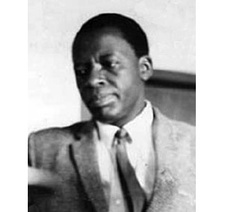
Michael Mosoeu (‘Mike’) Moerane was a composer, pianist, teacher and conductor. He was born on 20 September 1904 in Mount Fletcher (South Africa) to an evangelical priest, Jacane Moerane and his wife Sofi. His younger siblings included Epainette, who became the wife of ANC leader Govan Mbeki and mother of future South African President Thabo Mbeki. The family lived on their own farm, which was taken away from them in the white South African government’s land reforms of the mid-20th century. The family was Sesotho-speaking, and Sesotho was the language of most of Moerane's song texts and the one that he later insisted his own children speak at home.
2
Student & Teacher
After primary schooling at a Catholic mission Moerane enrolled at Lovedale Missionary Institution where he passed the Junior Certificate. In 1925 he enrolled at the South African Native College (later called Fort Hare University) and obtained his University Matriculation Certificate in 1926, the same year in which he began teaching at the Lovedale Training School. By 1930 he was on the staff of Lovedale High School. The subjects Moerane later taught in Basutoland High School in Maseru, Lesotho (late 1930s), the Bantu H.S. in Queenstown, South Africa (1940s-50s), Mfundisweni Institute in Pondoland, South Africa (late 1950s) and Peka H.S. in Leribe, Lesotho (1960s) included English, Sesotho, Latin and Mathematics. The choirs Moerane conducted were extra-mural, and in Queenstown and Peka he had a small orchestra, teaching his pupils all the instruments (donated from overseas). His players included the young Thabo Mbeki in Queesntown and Zakes Mda in Peka.
3 Bachelor of Music
Moerane registered for a Bachelor of Music degree part-time in 1930 through the University College of South Africa, passing eleven subjects over five years. Meanwhile, he married, his first children were born, he taught full-time, and he began composing. In 1941 he completed the B.Mus. degree - the first African composer in southern Africa to do so and one of the first B.Mus. graduates at Rhodes University (a College of Unisa) - with a ‘Composition Exercise’ called Fatše la Heso (Sesotho=My Country). He received help with its composition and orchestration from Rhodes’ head of music, Austrian-born composer Friedrich Hartmann.
4 Compositions
Not all of Moerane’s output of 60-70 works has survived and much of what does is unpublished. He focused on choral music in tonic solfa notation and his first publications in the 1930s, by Lovedale Press, were Liphala (Sesotho=Horns) and an arrangement of Nobody Knows the Trouble I’ve Seen. (He made several other arrangements of spirituals.) In 1936 he wrote a set of 10 solo piano pieces in staff notation called Album for the Young (lost), and throughout the 1940s, 50s, and 60s he continued writing much music for choir and a few instrumental or piano pieces (lost). His best-known choral works, frequently prescribed at choral competitions in South African and Lesotho are Ruri (Sesotho=Truly), Sylvia, Della, and Matlala.
5 Fatše la Heso
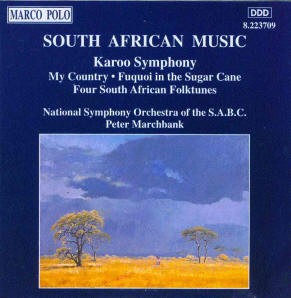
This 10-minute tone poem is scored for full orchestra including triple woodwinds, 4 horns, 3 trombones, 3 trumpets, tuba, cymbals, triangle, piano & harp. The composer told Percival Kirby that it “is built mainly around three traditional African themes - a war song, a work song and a lullaby” and that it was accompanied by what he called “a more or less adequate analysis”. The folksongs pull it in a tonal direction while the harmonic language is modernist and the orchestration romantic. As a student work by a largely self-taught composer who did not grow up in a compositional or orchestral environment, Fatše la Heso is extraordinary. The external examiner of Moerane’s portfolio, composer William Henry Bell from the South African College of Music in Cape Town, told Hartmann ”he never had expected such a work to be written in South Africa, and less so by a Native” [sic]. The work was premiered by the BBC Symphony Orchestra in England in 1944, conducted by pianist Clifford Curzon. The first recording of the work by the BBC in 1944, conducted by Clarence Raybould was destroyed. Dean Dixon premiered the work in New York and Paris, and a commercial recording by the South African National Symphony Orchestra (SANSO) conducted by Edgar Cree in 1973. The last recording (shown here) was made in 1994 by Peter Marchant and the SANSO.
6 Pianist & Conductor
Moerane lived his life between Lesotho and South Africa, his movements often dictated by political involvement and harassment by the authorities. Moerane joined the Non-European Unity Movement in 1943, which was more radical and uncompromising than the ANC (this seems to reflect his personality) and believed in a policy of non-collaboration with any government structure. Probably as a result of his views, he had little time for parastatals such as the South African Broadcasting Corporation, who are often responsible for what little information about his life is officially available.
He thought of himself as Basotho, a staunch Protestant and a classical musician. (He hated jazz: in Queenstown his next-door neighbor was Todd Matshikiza, composer of the musical King Kong, whom he scorned.) Moerane’s six children were all brought up musically and several of them learnt the piano, at which Moerane was very proficient, and his youngest son, Thabo (1947-2006) even more so. Moerane was a strict teacher and conductor and occasionally adjudicated competitions where his songs were prescribed. He spent his last years at home in Tsifadimali, Lesotho, and died in hospital in Bloemfontein, South Africa on 27 January 1980. He is buried in Tsifadimali.
7 Catalog
The Southern African Music Rights Organisation, of which Moerane was a member, has an incomplete catalogue of Moerane’s music. A more complete list includes the following:
Fatše la Heso, tone poem for orchestra, 1941
Chorale, for school orchestra
Sunrise, for school orchestra
Why worry? for school orchestra
Album for the Young for solo piano
Sunny South suite for solo piano
Unaccompanied choral works (some for SATB, some for TTBB or SSC):
Alina
Atamelang
Barali ba Jerusalema
Banoyolo
Ba Tsabang Molimo
Bokang Jesu
Bonukunyana
Boputsoa
By and By (arr.)
Della
Ea Folisang Maloetse a Hao
Ea Hlolang
Go Tell It on the Mountain (arr.)
Ha ke Bala He
Hobane re Tsoaletsoe Ngoana
Hoja Ke Nonyana
I Gotta Home Inna Dar Rock (arr.)
I Stood on the Ribber of Jordan (arr.)
It's Me O Lord (arr.)
Jehova oa busa
Kati
Lebili
Leseli la Hao
Letsatsi
Lia Qhomaqhoma
Likhohlo
Liphala
Mahakoe
MaHomemakers
Mankholikholi
Mmankokotsane
Mmitsa-Mahosi
Mohokare
Monyaka oa Pelo
Morena Tlake
Mosele
Naleli ka 'Ngoe
Ngeloi la Me
Ngokuba Sizalelwe Umtwana
Nobody Knows the Trouble I’ Seen (arr.)
Ntate ea Mohau
Ntsoaki
Paka-Mahlomola
Paki ha li eo
Pelo le Moea
Ruri
Sa 'Mokotsane
Satana a Tseha
Sekolo se Koetsoe
Seotsenyana
Shenandoah (arr.)
Sylvia
Tsatsi la Pallo
Vumani kuYehova
Witness SATB
Guest Author: Christine Lucia
Christine Lucia is a "Fiction and non-fiction writer, and music professor" as detailed at her website, http://christinelucia.co.za/. Prof. Lucia is the Guest Author of the Michael Mosoeu Moerane Biography at Africlassical.com. She is fully responsible for the extensive research required for the Biography. We gratefully acknowledge her generous contribution.
This page was last updated
on
March 5, 2022
|